

|
|

BAGATELLEDARTSKOLOKOLOCHESS
Juho Jussila - Toy Manufacturer in a School Town
|
A toy exhibition which entertains the whole family, displaying well-known wooden toys and games from various decades. Jussila's trains, rocking horses, Jukka cars, the Askare "posting box" and the Hakka hammer toy have brought joy to children for three generations, already. The clear and simple, elaborate form of Jukka toys, together with their solid structure and durability, have made them classics of Finnish toy design. In the museum's play-room you can try out the Hakka hammer and the Klipperi "Clipper" wagon, ride a wooden train or a rocking horse, as well as play the Fortuna game. Even though the exhibition is closed, the play-room is still open. |
 |
 |
Juho Jussila (1874-1947) - Pedagogue and Industrialist
Juho Jussila graduated from the Jyväskylä Teacher Training College,
and in later years worked as a supervising teacher at the training school
of the college. Jussila emphasized the importance of a child-centred approach
to education, learning by doing, the educational value of manual training, and
the instructive potency of play. He picked up new pedagogical ideas on a study
trip to Germany, where he became acquainted with the local handicraft teaching
and toy industry. His observations on German toy production, especially as a cottage
industry, prompted him to design the first "Selection of Jussila's Educational Toys"
in 1909. |
|
Toy Councellor Jussila's Fortuna Factory Jussila started by setting up a small carpentry workshop in the basement of his home in 1923. The secret of success of Jussila's enterprise was the Fortuna game, developed on the basis of a pastime known as bagatelle. During the depression of the 1930s, the international success of the Fortuna game was something quite unique in Finland. The primary market for the game was England, where it became popular under the trade name "Corinthian Bagatelle". Jussila also made the game of darts popular in Finland as a summer pastime. His Tikka game is a modified version of the English darts, adapted to the Finnish taste. |
 |
 |
| Click the pictures for magnified old advertisements | ||
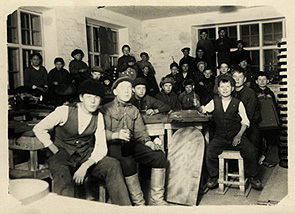 |
A large part of the workers of the factory were school-age "nail-boys". They drove nails into the Fortuna games at piecework pay during holidays and in autumn. As the trade became increasingly international, the production was moved to larger premises: at first to the buildings of the Jyväskylä Beer Factory in 1929, and then to a new factory of Jussila's own at Lutakko in 1934. At present, the factory of Oy Juho Jussila operates in Palokangas, Jyväskylä. |
| Playing is Child's Work " We should view the entire toy issue through the eyes of a child. After all, playing is for children what working is for adults. -- When engaged in a play, a child expresses the manifold original stems of his own thinking, hidden in his soul. Already at that point it is possible to lay foundation for future creative work, which may, as the child reaches adulthood, find expression in some work of utmost importance, for the benefit of all mankind." |
| Ever since the late 1930s, the logotype of Jukka toys has received a great deal of attention abroad. The Jukola House set, representative of Finnish peasant culture, and the traditional Finnish animal toys illustrate the idea of "national toy", which Jussila promoted. In accordance with the trend towards a more urban toy fashion, Jukka cars and the "everyman's trains" entered the selection in 1938. The "psychological" design competition for wooden toys in 1946 introduced new ideas, derived from developmental psychology, into toy production: a toy should be a functional, modern object with reduced forms, leaving room for the child's own imagination and creativity, and developing the child's own thinking. |  |
 | "We parents commit
an unforgivable crime, when we presumptuously criticize a child's play, and the child's soul
may turn irretrievably bitter because an adult interrupted or broke a nearly completed structure
which was based on the child's own thoughts. His grief can cause him to burst into uncontrollable
tears." "A toy should be durable. If it breaks down at the first touch, for instance if the wheels of a train will not hold or they break loose at the first pull, or a horse's head is cut at the first collision, the toy will easily educate the child into a bungler, who will not appreciate the full value of any object even later. But if the toy is of solid make, so that it still is in good shape as the boy grows into a man, the owner will relish the sight of this toy from his childhood even at his old age, and warmly cherish the innumerable memories which it evokes, and which are by no means insignificant in our everyday life, which can often be so drab." |
| A sample collection created in cooperation with the Central Union of Child Welfare has formed an integral part of the immediate environment of Finnish children, at home as well as through child-mother clinics and kindergartens since the late 1940s. The world-wide triumph of Jukka toys began in the 1950s. Since the 1960s, the factory has been one of the leading manufacturers of wooden toys in the world. |  |
|
|