The most significant changes to the field:
- 1931 a backline established 86 metres (94 yd) from the home base
- 1933 a bend to home path
- 1937 field bases enlarged
- 1954 field extended to 91 metres (99.5 yd)
- 1959 the plate was set deeper into home base
- 1959 intersection of sidelines 4 metres (4.4 yd) in front of the back bases
- 1975 circle for bouncer hits established at home base
- 1975 field extended to 94 metres (approx. 103 yd)

Pesäpallo fields 1931 and 1937
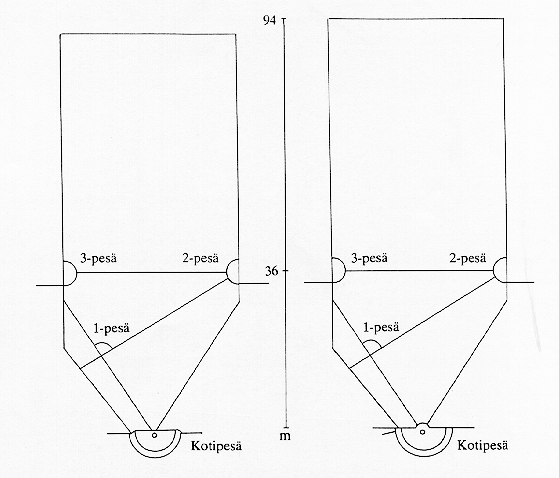
Pesäpallo fields 1959 and 1975
Kotipesä Home base
1-pesä 1st base
2-pesä 2nd base
3-pesä 3rd base
Vara-alue safe zone
The Killer River
One of the loveliest pesäpallo fields in Finland, Vimpelin Saarikenttä, is famous for the river surrounding it. For decades, teams have tried to bat the ball all the way to the river. A run, if not several, was practically a sure thing then.

Vimpeli’s saarikenttä has hosted pesäpallo games since the 1930s.
It is every batter’s dream to see the ball plop into the water.
The fielders may try to fish the ball out by using nets set on the banks by the field. The story has it that once the net caught a one-pound pike with the ball! The brave ones jump into the river to fetch the ball. On a hot summer day it may be a refreshing experience, but generally the water is ice cold!
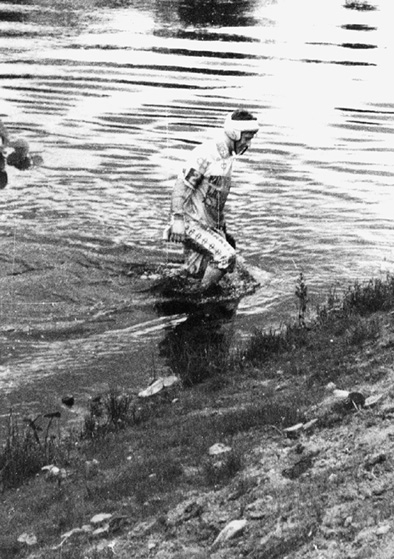
Fetching the ball from the river is a fielder’s nightmare. Mostly the river gets to keep it.
Paavo Mäkelä of Vimpeli’s Veto says: “We were playing a home game at Saarikenttä, and the visitors already had a point runner on 2nd base. I was defending 1st base and Jaakko Nygård was on 3rd base. The visitors were getting a runner to the first base when our team threw a high ball which neither me nor Jaakko, my back-up, could catch. The ball bounced off the bank and landed almost in the middle of the river. We both ran after it, Jaakko first. While he hesitated on the river bank, I dashed in and pushed him into the river. Jaakko jumped and dived in head first, caught the ball, came up, and chucked the ball at me. I threw it to Markus Lakaniemi in the home base, and he quickly passed it on to 3rd base. The result was two men out, and no runs. Niilo Tarvajärvi, who was commentating on the game, promised Nygård 10,000 marks after the game if he would repeat his glorious dive. Jaakko, however, considered the water too cold for a retry.”
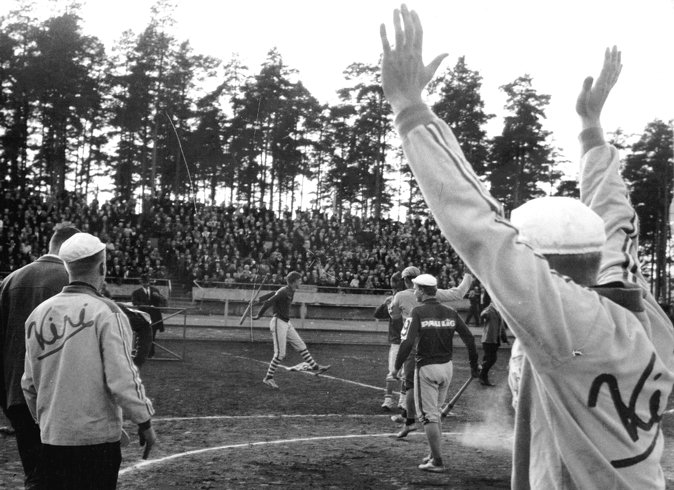
Jyväskylä’s Harju was the most famous pesäpallo arena in Finland in the 1950s and 1960s.
Jyväskylä had three home teams Kiri, Veikot, and Hongikko, and the biggest crowd of spectators.

The Pihkalan kenttä had a full house during Hyvinkään Tahko’s championship years 1979-1981.
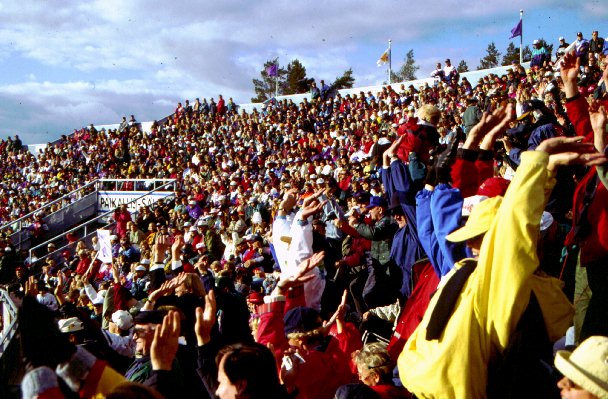
The grand bleachers of Sotkamo pesäpallo field attract 3000-4000 spectators per game, and even more for the championship games.
