Game of the People
Training Gets Professional (1970s-1980s)
Success in pesäpallo concentrated on large pesäpallo clubs during the 1970s and 1980s. Playing for fun declined, and the game lost ground in school activities. An attempt was made to compensate for this decline by training juniors, even including children under the age of 10. Girls became interested in the sport, as well. Pesäpallo training camps and schools trained thousands of enthusiasts
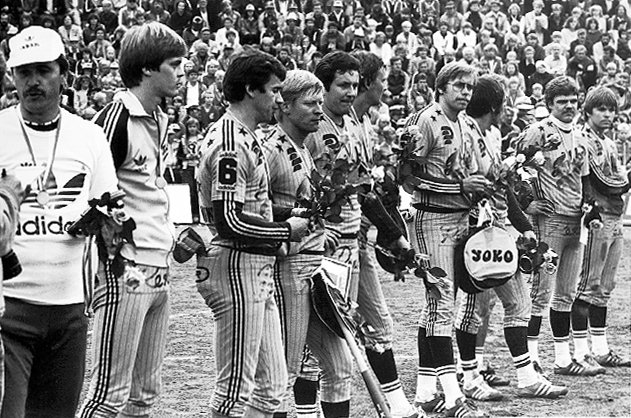
Hyvinkään Tahko wins the championship in 1980. Players from the left: Oiva Latikka, Ilkka Musto, Risto Korhonen,
Markku Kuikka, Timo Hakala, Stig Tainio, Antti Laurila, Jari Laurila, and Kari Kuusiniemi.
The old pesäpallo centres in medium-sized cities did alright, but teams from the countryside suffered. Oulu, Imatra, Seinäjoki, Hyvinkää, and Jyväskylä thrived in the 1980s.
Effective training entered into pesäpallo. The quality of play improved, the new championship series (from 1979 on) fascinated people, and spectators increased. The new trend included the marketing of the game and statistical analyses of individual players.
In 1986, the jokers stepped in. They were the power batters in colourful uniforms. A team could use their joker once in every offensive inning. The joker rule made Unto Väisänen of Sotkamo a star, the most feared joker batter in the country.
From Super Series to Sponsorship (1990s)
In 1990, the national series in pesäpallo was renamed superpesis. The name comes from the super inning, which was played if the game was a tie after nine innings. In 1994, the period system came into practice. There are two four-inning periods in a game. If the period scores are a tie, a super inning is played. If the result is still a tie, there will be a scoring contest (since 1996)
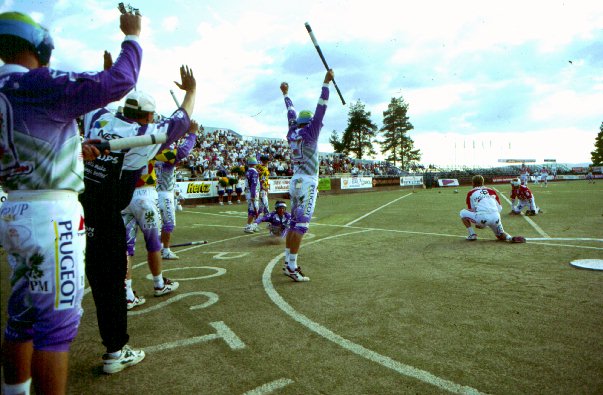
Sotkamo’s Jymy has been the absolute ruler of the 1990s: six Finnish championships in eight years. Players cheering at Hiukka pesäpallo stadium, as the home team triumphs.
The super series has added to the popularity of pesäpallo, and sponsors have noticed this. Pesäpallo has become more professional, and “local village teams” have been replaced by money-driven “all star teams”. Concern about pesäpallo’s low status in the metropolitan area led to the creation of a Helsinki-based team, Kaisaniemi’s Tiikerit, which entered the national series in 1997.
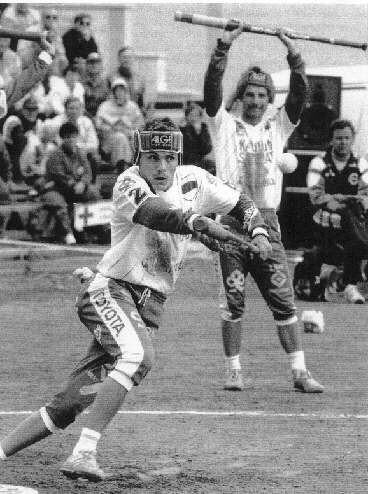
Janne Vuorinen is the most feared runner of the 1990s, and one of the chief architects
of a new defensive inning tactics, the closing-in. Vuorinen has won five gold medals for Sotkamo’s Jymy.
There is always an exception to the rule. Sotkamo’s Jymy, with their local players, has ruled in the 1990s. Sotkamo’s success is based on an excellent point runner, and new defensive tactics, especially the “closing-in”. The result: six Finnish championships in eight years.
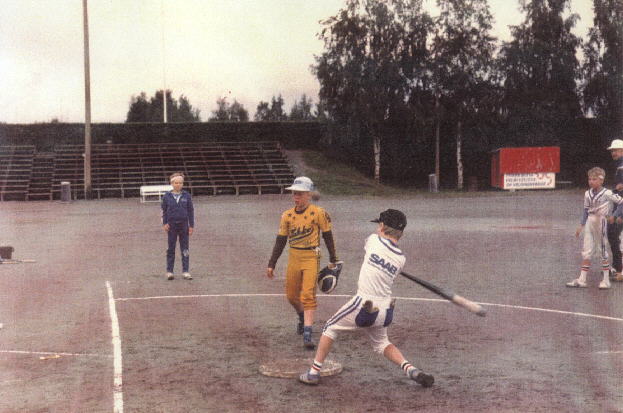
A playing man’s measure – even a junior’s – is a pair of sliding gloves in the back pocket.
Junior players imitate the adult players.
Women Strike for Equality
Women have played for the national championship since 1931. The games were first played in a cup system. Since 1955, the championship has been settled in a championship series, nowadays known as the women’s superpesis. Until the 1970s, the Helsinki-based teams Katajanoka’s Haukat, Pallo-Toverit, Työväen Mailapojat, and Punamustat had ruled the sport.
In the late 1980s, women’s pesäpallo began to develop into a top sport. Batting skill and strength, running speed and defensive play improved radically. The forerunner was Ikaalisten Tarmo followed by the centers of women’s pesäpallo Lapua’s Virkiä, Jyväskylä’s Kiri, Viinijärvi’s Urheilijat, Vihti’s Pallo, Siilinjärvi’s Pesis, and Oulu’s Lippo.
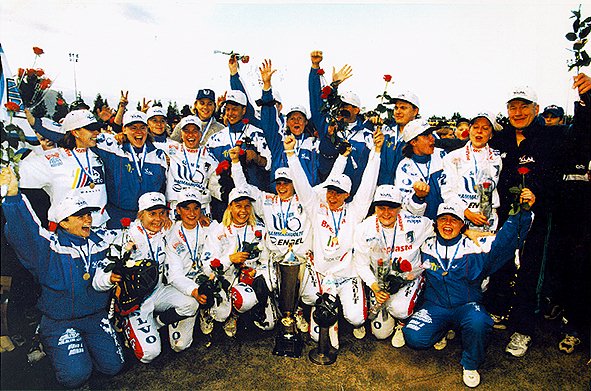
Pesäpallo is by far the most popular women’s team sport in Finland.
Jyväskylä’s Kiri rejoicing at Hippos after taking the 1996 Finnish championship.
Almost 3000 spectators saw the deciding match.
Women have been quick to adopt the innovations of men’s pesäpallo. The 1996 and 1997 seasons showed such flamboyant closings-in that even men were in awe. The vivacious playing style and cheery spirit has won many hearts for women’s pesäpallo. The championship matches gather 2000-3000 spectators. Pesäpallo is by far the number one in women’s team sports.