Local Co-operation Grows Strong
Firepower to the Crossline (1950s)
The popularity of pesäpallo increased in the post-war enthusiasm, and it continued in the 1950s. Series were settled, the number of teams grew, and pesäpallo in schools flourished. The public loved the game, and they filled the bleachers.
Lahti’s Maila-Veikot and Jyväskylä’s Kiri dominated this period. Both snatched four Finnish championships. The Ostrobothnian teams Vimpeli, Nurmo, and Ilmajoki inched their way towards medals. The Ostrobothnians had five teams in the championship series at best, Helsinki had four, and Jyväskylä three. Pesäpallo began to strengthen in certain areas.
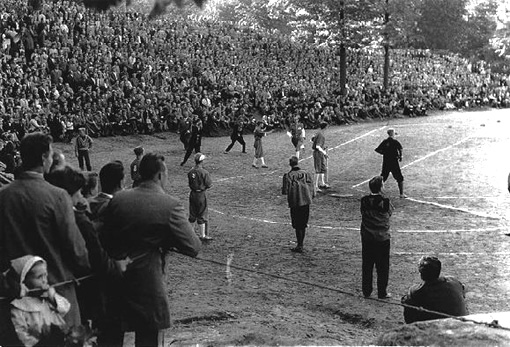
All East vs. West matches were long played in Helsinki.
The Hesperian kenttä was the popular temple of the championship game. This picture is from the late 1950s.
The greatest change tactically was the four-player crossline created by Erkki “Pulla” Heikkilä. Previously, one of the back-up basemen had joined the crossline (= 2nd baseman – stop – 3rd baseman) from between the crossline and the fielder, and the other had been a back-up fielder. The new terms were 2nd and 3rd stops and right and left fielders.
The Country Rules (1960s)
In the 1960s, the centre of pesäpallo moved northward. Helsinki and Uusimaa kept losing ground in the 1960s. Teams from Eastern Finland rose to the championship series: Imatra, Sotkamo, Puurtila, and Nurmes, among others. Sotkamo won their first championship.
The real power centre of the game was Ostrobothnia. Ilmajoki’s Kisailijat and Vimpeli’s Veto each took two Finnish championships. Vimpeli succeeded steadily: during 1958-1968 they took 11 successive championship medals. The other great team of the decade was Kouvola’s Pallonlyöjät, with four consecutive championships in 1966-1969.
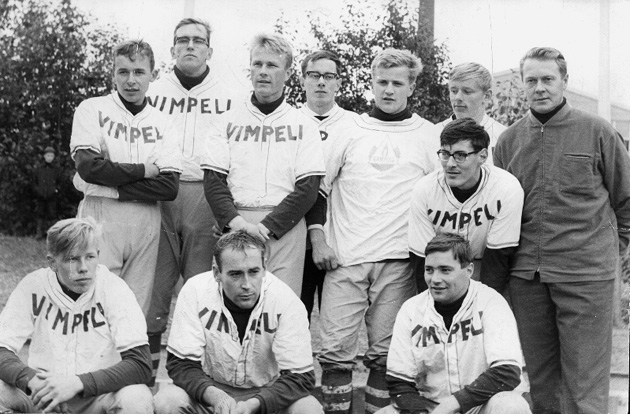
The Finnish champions Vimpeli’s Veto in 1965. Front: Mikko Peltola, Paavo Mäkelä and Jaakko Nygård,
middle: Kari Lakaniemi. Back: Lauri Pippola, Tuomo Vihriälä, Kalervo Havinen,
Markus Lakaniemi, Olli Latvala, Kalevi Junnila and Rauno Latvala.
Teams from the countryside succeeded better than ever in the 1960s. The game remained popular in the country, but it struggled in the cities.
On the field, the 1960s was the decade of bouncing the ball. People tried to eradicate excessive bounces by moving the plate, but to no avail.