We focus on applications of analytical and inorganic chemistry for a more sustainable future. Urban mining of critical metals from electronic waste increases our self sufficiency of these essential metals and can have important effects in lowering the environmental impacts when we utilize these metals in our every day life.
Perustiedot
Tutkimuksen painoala
Basic natural phenomena and mathematical thinking
Tutkimusalueet
Sustainable use of the natural resources
Center of Expertise for Circular Economy
Circular Economy
Department of Chemistry - Research areas
Tiedekunta
Faculty of Mathematics and Science
Osasto
Department of Chemistry
Tutkimusryhmän kuvaus
The research group focuses on developing applied, process-scale recovery methods for critical metals from complex industrial matrices. Integration of analytical chemistry, process development at the pilot scale, and implementation of circular economy and green chemistry principles creates application-oriented approach to our projects. We are working with increasing the self sufficiency of rare earth elements in our REEVIVE-project, and with information and communication technology equipment circularity in the upcoming DemoEPR project.
Development of novel adsorbent materials and environmentally more benign leaching alternatives (including organic acids) especially for metal recovery are at core of our work. The main focus is currently on the rare earth elements and the platinum group metals, which are commonly found in secondary sources such as electronic waste.
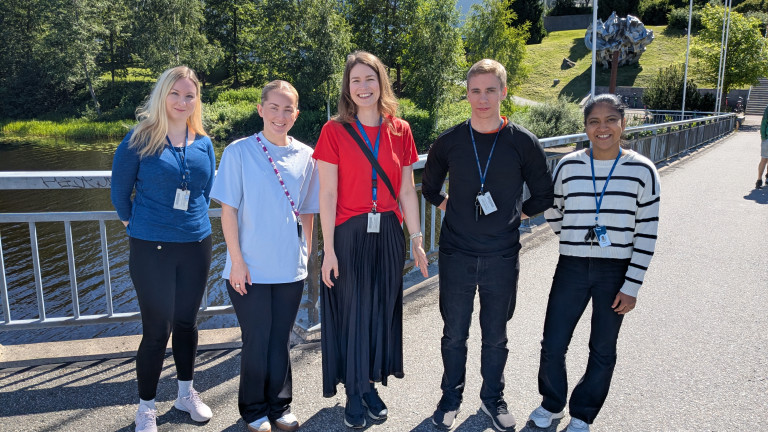
Group members in summer 2026 (from left): Emilia, Roosa-Maria, Siiri, Jimi, and Jessy.
We utilize our versatile bench scale facilities for piloting of our lab-based hydrometallurgical processes in a more realistic scale, with up to 10 L reactor volumes. The bench scale facilities contain three reactors with efficient ventilation for piloting of e.g. leaching reactions, and units for solvent extraction, electrolysis, solids separation (filter press, lamella separator), and ion exchange.
The facilities can be modified to each process individually, allowing a wide variety of testing capabilities in larger volumes. The processes are usually operated in batch mode, and some processes can be run in a semi-continuous manner if needed. For a tour of our facilities, see our presentation video.
Our bench scale laboratories are utilized in bringing our laboratory scale processes into a more realistic scale.
Instrumentation
Elemental and structural analysis
Reliable analysis of elemental concentrations from difficult sample matrices is essential in our work, and we utilize our elemental analysis laboratories for this purpose. ICP-OES (inductively coupled plasma - optical emission spectrometer) instruments are used by our personnel every day to determine the elements present in our process samples. Our modern ICP-laboratories feature two ICP-OES instruments, and one ICP-MS (inductively coupled plasma - mass spectrometer) instrument.
The ICP-MS is our most sensitive tool for trace element analysis, with capabilities of analyzing ng/L concentrations of elements, isotope analysis, nanoparticles, and even speciation analysis. Our group collaborates with the Department of Biological and Environmental sciences to analyze very low elemental concentrations in environmental samples, e.g. resting eggs of Daphnia ephippia in the Hippicap project led by Minna Hiltunen.
ICP-OES laboratories ensure reliable analysis of elemental concentrations from varying sample matrices.