
Christmas traditions
University of Jyväskylä Christmas events in 2026
This list will be updated as new events are announced!
Please note: some of the links lead to the university's intranet if participation in the event is restricted or the news item relates to staff benefits.
- 27.11. at 6 p.m. Sinfis final rehearsal concer
- 2.12. at 5 p.m. The most beautiful Christmas carols from Seminaarinmäki | University of Jyväskylä
- 7.12. at 5 p.m. Student and staff choirs' Christmas concert and singalong
- 8.12. at 8 p.m. Mieskuoro Alvar Male Choir: Christmas concert
- 11.12. at 10.00 Lucia Day procession
- 11.12. (times and venues to be confirmed) The Musica Choir’s traditional mini-tour on campus
- 12.12. at 2 p.m. Mieskuoro Alvar Male Choir: Christmas concert
- 12.12. at 6 p.m. Ruamjai: Loimu Christmas concert
- 17.12. at 1 p.m. Traditional Christmas celebration and Christmas porridge for work community

Author Erja Kosonen | Photo Jyväskylä University Museum archives
The primary school system brought along school Christmas parties at the end of the autumn semester, for which gifted Seminary students wrote new Christmas poems and carols (Pajamo, 1976). The Christmas parties were attended by the Teacher Training School pupils and Seminary students together. The first venue for these parties was the Seminary's assembly hall (S212), located in in the Seminarium building.
After graduation, the teachers took the Christmas celebrations tradition with them to different parts of Finland. The Christmas celebrations became a joint semester-ending event for the whole school and village and also a model for the celebration culture of other, later established Teacher Seminaries.
The teachers of the Jyväskylä Teacher Seminary brought influences from their study trips to Central Europe into the Christmas celebrations. Christmas traditions, decorations, as well as decorated Christmas trees gradually made their way from the Christmas celebrations in primary schools to the Christmas festivities in Finnish homes.
The next Finnish-language Seminary started in Sortavala in 1880. Jyväskylä Teacher Seminary created various key practices for primary school education and teacher training, which were transferred to other Seminaries. A noteworthy point for the celebration traditions of primary schools is that after Jyväskylä and Sortavala, the next Teacher Seminary for male and female students was not established until the mid-20th century. Jyväskylä Teacher Seminary students included many distinguished female and male poets and composers whose relationship to Finnish-language Christmas developed particularly during their studies.

Santa Claus and the Christmas bag
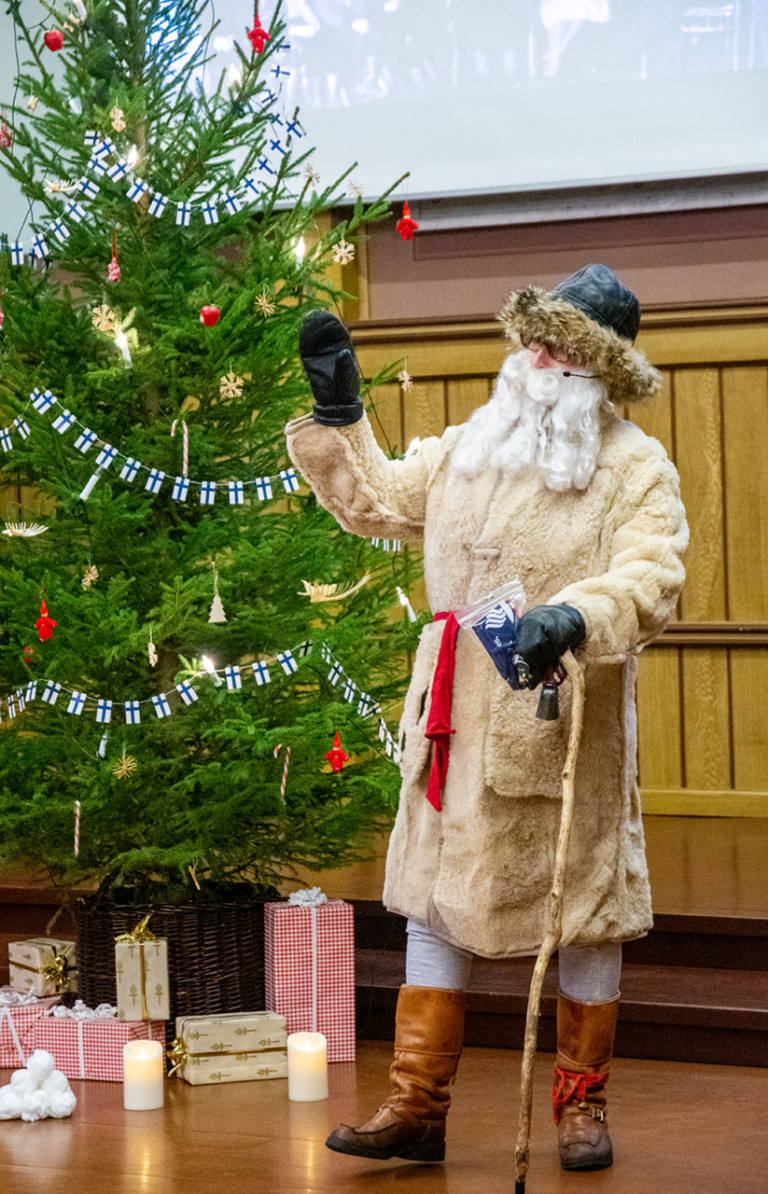
Santa Claus visited the Christmas celebrations for the first time in the 1910s at the Christmas party of Jyväskylä Seminary and Teacher Training School. Lecturer of music P. J. Hannikainen had made his own song for Santa Claus called “Joulupukki - laululeikki kuusen juurella”.
This started the annual Christmas visits of the friendly Santa Claus wearing a sheepskin coat to bring joy to children and other people. His visit included a Christmas bag for the children. The bag contained a Christmas cookie, an apple, and a piece of candy wrapped in colourful wrapping paper. The Christmas bag practice became an established part of the Santa Claus visits at school Christmas parties, and it is still in use in many schools and also at the University of Jyväskylä.


Christmas carols
An essential part of the Finnish-language Christmas traditions was the cooperation between Jyväskylä Teacher Seminary and the local parish. The Seminary and its music activities inspired people to write songs in Finnish for schools and choirs.
Birth of Christmas carol classics
G. O. Schöneman, who was born in Laukaa, worked as a parish priest in Jyväskylä from 1864 to 1894 and also as a religion teacher at a girls’ school. He was a keen advocate of Finnish identity.
The Christmas carol ”Silent Night” is considered the most popular and beautiful one in the world. Its premiere in Finnish was in the City Church of Jyväskylä in the beginning of the 1880s. Schöneman translated the lyrics, and the song by Franz Gruber was published in 1883 in a collection “Suomalainen lauluseppele II” edited by E. A. Hagfors, Lecturer of Music at Jyväskylä Teacher Seminary. Already earlier, in 1871, the Hosanna hymn had been sung in Finnish in the same church as a start for the advent. The hymn was published in the first song collection by Hagfors. In 1876, Schöneman published his new lyrics for the carol ”Joulupuu on rakennettu”, which he made to a popular school song melody.
In the first decades of primary school, the song was a kind of a flagship; it played a central role in schools’ daily life and celebrations. Music was instrumental for civilisation. A starting point of Cygnaeus was that a prospective primary school teacher had to be able to both sing and play. Therefore, singing skills were an important criterion in the admission of Seminary students. In the decree concerning primary schools from 1866, this was expressed as a requirement for “a good musical ear”. As Finnish was at the same time being developed as the nation’s language for education, and the selected Seminary students included persons with literary talent, the necessary prerequisites for creating songs in Finnish were ready. Along with mother tongue, singing and playing were Seminary students’ favourite subjects. By the Seminary’s example, singing became an essential subject also at primary schools.
Christmas carol composers and writers
Jyväskylä Teacher Seminary staff and students included numerous Christmas carol writers and composers. For instance, the following persons wrote and/or composed Christmas carols during their Seminary years:
E. A. Hagfors, G. O. Schöneman, Pekka Juhani Hannikainen, Otto Kotilainen, Helmi Auvinen, Immi Hellen, J. H. Erkko, Olli Vuorinen, Juhani Pohjanmies, Einari Vuorela, Maiju Ollilainen, Ilmari Hannikainen, and I. E. Koskimies.
Martti Korpilahti was a significant translator of Christmas carol lyrics into Finnish.

References:
- Halila, A. (1963). Jyväskylän seminaarin historia [History of Jyväskylä Teacher Seminary]. Porvoo: WSOY.
- Kosonen, E. (2012). Kansakoulunopettajat kulttuurikasvattajina. Seminaarien musiikinopetus kansakoulun laulun opetuksen esikuvana. Opettaja yhteiskunnallisena ja kulttuurivaikuttajana. [Folk school teachers as cultural educators. Seminary music teaching as an example for folk school singing education. Teacher as a social and cultural influencer.] Suomen kouluhistoriallisen seuran vuosikirja 2012. 69–91.
- Kosonen, E. & Pajamo, R. (eds.). (2009). Seminaarinmäen koululauluja. Jyväskylän yliopisto 75 vuotta. [School songs from Seminaarinmäki. University of Jyväskylä 75 years.] Jyväskylä: University of Jyväskylä.
Retrieved from https://jyu.finna.fi/Record/jykdok.1111582 - Pajamo, R. (1976). Suomen koulujen laulunopetus vuosina 1843-1881 [Teaching of singing at Finnish schools in years 1843-1881]. Helsinki: Suomen musiikkitieteellinen seura.
- Pajamo, R. (2009). Laulusta tulee kansakoulun pakollinen oppiaine [Singing becomes a compulsory subject at folk school]. Musiikkikasvatus: Näkökulmia kasvatukseen, opetukseen ja tutkimukseen. 31–49.
- Pajamo, R. (2011). Joululaulujen kertomaa [Told by Christmas carols]. Helsinki: Repale-kustannus. Retrieved from https://jyu.finna.fi/Record/jykdok.1279884