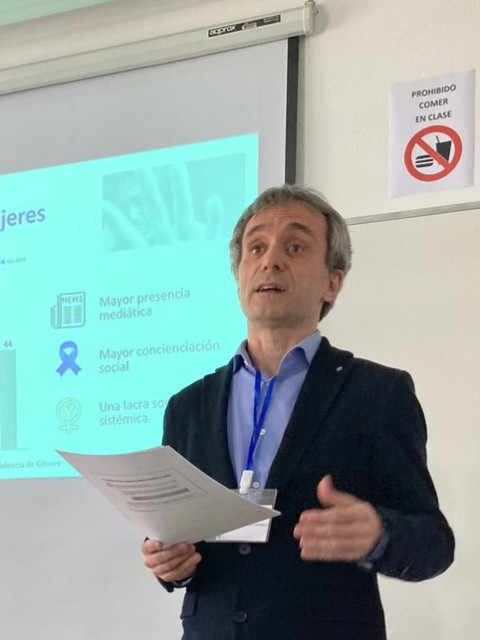
The training school is now complete. This page is left as a record for trainees to verify their learning.
Feedback from the training school delivered an overall feedback score of 8.95/10 (100% response rate).
Trainees in this FORTHEM Alliance training school were funded through Erasmus+, as a Blended Intensive Programme (BIP ID: 2024-1-FI01-KA131-HED-000236388-4). Nominations were coordinated by each institutions' international mobility team.
Participation in the training school required: completion of a series of assigned pre-readings; full attendance for the whole week of the training school; preparation and delivery of a short 'pecha kucha' presentation on the trainee's own research; participation in an online discussion forum reflecting on the training school; and participation in a follow-up remote meeting on 3 June 2026.
Completion of the training school will lead to an award of 3 ECTS. 1 ECTS = approx 27 hours of work. This breaks down broadly as follows:
- Assigned pre-readings, 27 hours
- Preparation of pecha kuchas, 15 hours
- In-person participation (lectures, workshops, pecha kucha sessions), 27 hours
- Online discussion, commenting on three other participants’ pecha kuchas, and adding substantive reflective comments based on the teaching and readings, 10 hours
- Live participation in a follow-up online meeting. virtual element, 2 hours
The training school focuses on intersectionality (the interplay of multiple social factors at once) and capability theory (a borrowing from economics focused on people's ability to improve their life own life circumstances) as they apply to language education policies. All this helps us to better articulate goals of equity, inclusion, and social justice.
Trainees will be actively conducting research into language education policy. We define this very broadly – not just formal government policies about school curricula, but any policies in any organisation, community, or family, aiming to influence how people learn and/or use particular languages. A 'policy' can be written or unwritten, and can be interpreted differently by different people (in many cases these diverse interpretations are where the most interesting research questions lie).
Trainees do not need prior experience of the specific headline terms and concepts named above. The objective of the training school is to educate trainees about these terms, and the relevance of these terms to trainees' research.
In addition, through the use of trainee pecha kucha presentations, trainees have the opportunity to showcase their own work, and learn about each other’s. A followup virtual exercise will facilitate further dialogue – requiring participants to link taught lecture content to the content of each other’s pecha kuchas, in a collaborative online meeting and associated discussion forum. Altogether this in turn will increase their presenting and networking skills.
Trainers
Dave Sayers, University of Jyväskylä, Finland

Andrew Shorten, University of Limerick, Ireland

Mateja Centa Strahovnik, University of Ljubljana, Slovenia

Helder De Schutter, KU Leuven, Belgium
Bogusława Gosiewska-Turek, University of Opole, Poland
Sergio Maruenda-Bataller, University of València, Spain