

Research collaboration helps to address emerging safety challenges
At the Faculty of Mathematics and Science of the University of Jyväskylä, safety is studied broadly from the perspectives of multiple disciplines. The new master’s degree programme in Technology for Safety and Risk Management responds to this multidisciplinary need by combining high-level research, technology, and practical applications, while educating future experts to address increasingly complex safety challenges.
Researchers Heikki Kettunen, Varpu Marjomäki and Ari Väisänen from the University of Jyväskylä share their perspectives on some of the current safety threats and how research can help address them.
- Heikki Kettunen is a staff scientist and leads radiation hardness testing of electronics in the RADEF research group at the Accelerator Laboratory of the Department of Physics of the University of Jyväskylä.
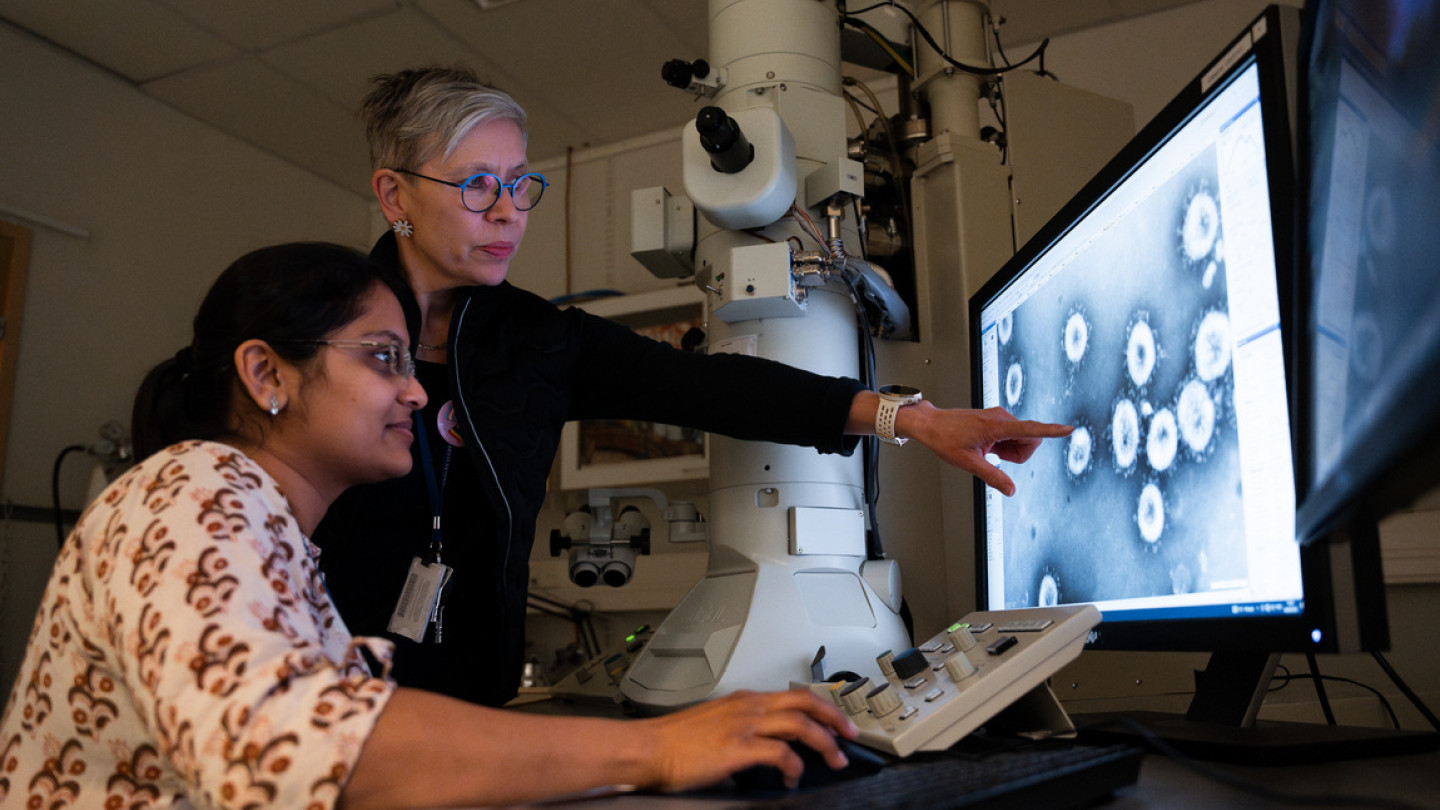
- Varpu Marjomäki is a professor in cell and molecular biology who studies virus infection mechanisms and action of antiviral compounds. Her research group has identified antiviral compounds from synthetic and natural materials that are effective against enteroviruses and coronaviruses.
- Ari Väisänen is a professor of circular economy who develops analytical methods for detecting harmful metals in environmental samples, as well as methods for recovering raw materials classified as critical by the EU, such as rare earth elements and phosphorus, from waste materials while conserving natural resources. Väisänen leads The Center of Expertise for Circular Economy.
Radiation safety
Heikki Kettunen, Staff Scientist
What risks related to harmful background radiation in living environments do you think should currently be studied across different disciplines?
The topic is important from the perspective of technological reliability and the functioning of society.
Radiation can cause interference or damage to electronics, which is why pre-emptive testing and system-level solutions are necessary.
The impacts are not limited to outer space, as they also concern aviation and terrestrial systems, particularly critical infrastructure.
What does your research group study and why?
Our RADEF (RADiation Effects Facility) research group focuses on commercial applications of nuclear and accelerator physics, particularly radiation hardness testing of electronics.
We study the reliability of electronics used in space, as all space components must be tested for radiation tolerance before use.
We use the K-130 cyclotron at the Accelerator Laboratory of the University of Jyväskylä, and especially heavy-ion particle beams ranging from boron to gold, to simulate the demanding radiation conditions of space.
How extensively has this topic been researched in Finland and internationally?
The topic is widely studied internationally, and radiation hardness testing of electronics is an established part of space industry development in both large and small companies.
In this context, Jyväskylä serves as an exceptional centre on a European scale.
RADEF laboratory has been an official test laboratory of the European Space Agency (ESA) since 2005. Our client base is highly international, with about 90 percent coming from Europe, particularly France, but global demand exceeds the currently available beam time.
Which fields need to work closely together in researching this topic?
To understand the effects of radiation and anticipate risks at an early stage, researchers must engage in broad and close multidisciplinary collaboration.
Key fields include circuit design, micro and nanoelectronics, software engineering, radiation effects research, accelerator and nuclear physics, as well as numerical simulation.
Emerging developments, such as the use of artificial intelligence in space, and even the potential deployment of data centres in space, further increase the relevance and importance of this research and call for even broader international collaboration.
What are the most complex aspects of this research topic right now?
The greatest challenges in this research area are the rapidly increasing complexity and development pace of electronics.
A growing number of functions are being integrated into the same components, which makes understanding their behaviour and distinguishing between them more difficult.
At the same time, the accelerating development of new components makes research on radiation effects increasingly demanding and requires broad expertise across multiple disciplines, as well as extensive accelerator resources.
Is it easy or difficult to anticipate safety risks related to the research subject?
Anticipation is possible to some extent but remains challenging in the long term.
The average effects of space weather are well understood and can be modelled, but the exact timing and intensity of major solar eruptions cannot be predicted.
Solar monitoring and warning systems usually provide one to three days’ advance warning, which helps protect satellites and other critical systems and mitigate the most severe consequences.

Virus safety
Varpu Marjomäki, Professor of Cell and Molecular Biology
What risks related to virus safety do you think should currently be studied more widely across different disciplines?
The COVID-19 pandemic demonstrated that viruses can affect all of society, from healthcare to the economy and politics. Prevention and its consequences must therefore be examined not only from a biological perspective, but also from the perspectives of the social and behavioural sciences.
Current threats include avian influenza viruses, which are being closely monitored for their potential for human-to-human transmission.
Viruses also behave differently, with some spreading poorly but being life-threatening, whereas others can remain latent in the body for long periods. As a result, understanding the mechanisms how they infect and spread is essential.
What does your research group study and why? And how extensively has the topic been researched in Finland and internationally?
Our research group studies viruses in conditions that mimic everyday environments, on various surfaces and under typical temperature and humidity conditions.
Exposure to viral infections is continuousin a range of environments and on surfaces, including those in shops, nursing homes, and daycare centres.
We collaborate with companies to develop safe surface materials that reduce the spread of viruses and bacteria.
Our research focuses on both enveloped and non-enveloped viruses and on environmentally friendly, naturally occurring surface-binding molecules that inhibit viral infection. The work combines basic research with practical applications.
Which fields need to work closely together in researching this topic?
The topic is widely studied internationally, but in Finland, we are one of the few research groups taking such a broad approach to natural antiviral solutions for surfaces.
We collaborate, for example, with the Natural Resources Institute Finland, the University of Helsinki, and the University of Eastern Finland.
The research requires close collaboration between biology, virology, chemistry, materials science, medicine, and the business sector. It is precisely this multidisciplinary approach that is its greatest strength.
What are the most complex aspects of this research topic right now?
The most significant challenges are related to determining mechanisms of action and isolating natural compounds. Although promising antiviral and antibacterial effects are observed at an early stage, it is often difficult to determine which individual molecule is responsible for the effectiveness and how it acts at the cellular level.
Natural materials often contain multiple similar compounds, whose separation and purification are demanding and requires close collaboration in the field of chemistry.
Pure molecules enable mechanistic studies, but in practice, the most effective antivirals are likely extracts containing several similar molecules. Predicting viral threats is also challenging, as viral mutation and spread often occur rapidly and in a partly unpredictable manner.
Is it easy or difficult to anticipate safety risks related to the research subject?
Anticipating safety risks from viral pathogens is partly possible, but overall challenging. Certain risks are well known, such as the threat posed by avian influenza viruses when they are repeatedly exposed to humans.
It is difficult, however, to predict the precise evolutionary direction of viruses and when they may become capable of spreading efficiently from one human to another.
Although genomes and mutations are actively monitored, the rapid and non-linear evolution of viruses makes accurate prediction uncertain. Continuous monitoring, genomic research, and interdisciplinary collaboration are therefore needed.
Recycled materials
Ari Väisänen, Professor of Circular Economy
What risks related to recycled materials do you think should currently be studied across different disciplines?
Circular economy solutions must be safe and sustainable. It is essential that we have precise understanding of the composition of materials, because recycled materials may contain, for example, heavy metals, toxic compounds, and even radioactive substances, requiring careful assessment of their long-term effects on the environment and living organisms.
Residues from bio and side streams or mining waste, for example, can pose environmental and radiation risks.
Circular economy solutions can only be genuinely safe and sustainable if they are based on thorough risk assessment and collaboration between different disciplines.
What does your research group study and why?
Our research group investigates material flows that are essential for the circular economy, such as electronic waste, permanent magnets, and power plant ash, which contain both valuable and harmful substances. Electronic waste, in particular, is an important source of critical raw materials, such as rare earth metals, which are widely used in modern technology.
How extensively has the topic been researched in Finland and internationally?
The topic is widely studied in Finland and internationally, but our research stands out due to its distinctive approach. The metals are first dissolved into a solution and then selectively recovered using the 3D Scavenger technology we’ve developed.
The recovery of rare earth metals, and especially their separation from one another, is challenging because they are chemically very similar.
Individual rare earth elements can, however, be separated from one another by adjusting the chemistry and operating conditions used in the separation process. A simple and environmentally friendly solution has also been developed for removing harmful substances such as arsenic and cadmium from fly ash.
Which fields need to work closely together in researching this topic?
Research requires close collaboration between several fields.
Chemistry, materials science, environmental science, and process engineering each contribute critical expertise to the overall effort, while the involvement of industrial actors ensures the practical applicability of solutions.
This multidisciplinary collaboration enables both the development of new solutions and their smooth implementation.
What are the most complex aspects of this research topic right now?
The sufficiency of resources and the development of comprehensive solutions. The central problem is the efficient separation of components containing valuable raw materials from complex device assemblies as early as possible.
At present, many devices are processed by crushing them, after which the crushed material is leached.
In this process, the concentration of valuable substances is diluted, as non-valuable parts of the devices also end up in the leaching process. A key challenge in the research is therefore to focus processes more effectively on the most valuable components. Robotics and automation offer potential solutions, but they are not yet widely economically viable.
Is it easy or difficult to anticipate safety risks related to the research subject?
Risks related to consumer products are generally well understood due to strict regulations, but side streams and waste streams can reveal unexpected harmful substances.
Anticipation is further complicated by global crises and rapidly changing material flows.
Assessing safety therefore requires continuous research, situational awareness, as well as flexibility in changing conditions.


