
What did you study?
I studied fractional Sobolev spaces, a mathematical toolbox for describing functions that are not smooth, such as signals with sudden jumps or surfaces with rough texture. These spaces are used to model nonlocal phenomena, where what happens at one point depends on what happens farther away. I worked both in ordinary Euclidean space and in general metric measure spaces, where only distances and volumes are defined.
What were the results?
I developed a new tool, a fractional upper gradient, which measures how quickly a function changes. With it, I showed that a sufficiently regular function behaves smoothly along most reasonably nice curves, even though the function itself may be rough. I also determined exactly when such functions tend toward a limit when going infinitely far away. Surprisingly, this does not depend on one of the parameters in the data. Finally, I found a precise condition on how fast the volume of the space should grow in order the “capacity” of a space to be finite. Capacity measures how large a set is from the viewpoint of the functions.
How can the results be applied?
This is basic research in pure mathematics. The results are optimal, meaning they cannot be improved in general, and the tools are largely self-contained. They give researchers a clearer foundation for working with these spaces, which are used in areas such as image analysis and the modelling of nonlocal diffusion.
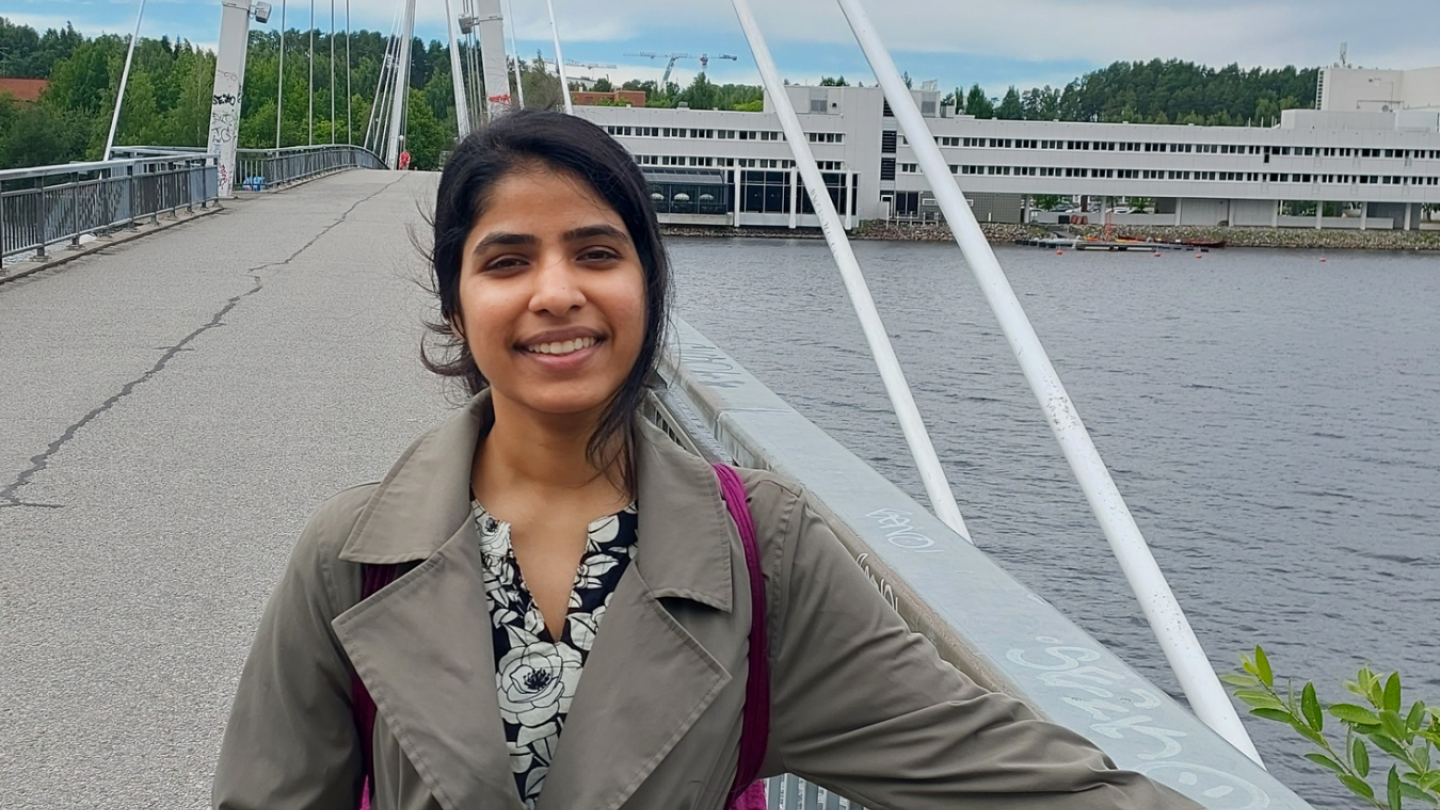
M.Sc. Angha Agarwal defends their doctoral dissertation “Intrinsic properties of Fractional Sobolev Spaces” on December 3, 2026, in hall S212 (Seminarium).
Opponent is Professor Jana Björn (Linköping University) and custos is Professor Pekka Koskela (University of Jyväskylä). The language of the dissertation is English.
You can read the dissertation online.


