
Extensive research project on para cross country sit-skiing launched in Vuokatti – measurements and race analyses progressing
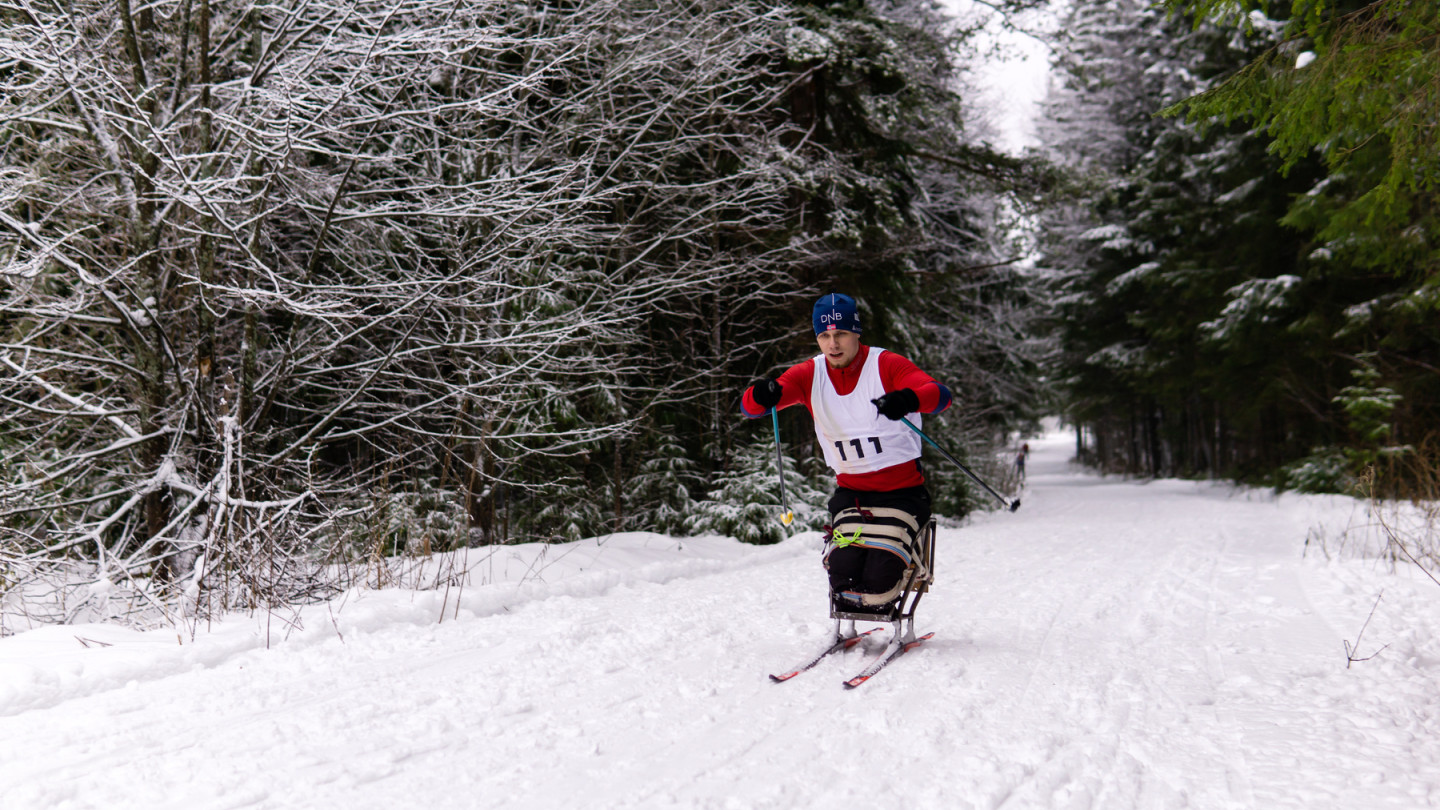
Ville Sampolahti is currently working on his doctoral dissertation on the biomechanics and performance of para cross-country sit-skiing, and in autumn 2025 he conducted the first measurement sessions for the study in Vuokatti.
The first phase of the study consisted of three parts carried out in a single measurement session: assessment of maximum upper-body strength and power output, measurement of isometric double-poling force production in the athlete’s competition posture during the first two phases of the poling action, and two short anaerobic performance tests performed on a ski treadmill. Measurements related to isometric double poling were performed in two stages: the pre-stage, where the poling action begins, and the poling stage, where the poling action is already underway.
Short anaerobic maximum performance tests on a ski treadmill measure athletes’ performance on uphill and flat terrain.
“Unfortunately, the number of participants has been small this autumn, as no international para cross-country skiing competition has been held in Vuokatti this year,” explains Sampolahti. “Fortunately, we have still managed to measure a reasonable number of athletes.”
“One of the strengths of the study is that we were able to include the world’s current top para cross-country sit-skier in the testing, and athletes from four different competition classes have been represented. Athletes from all competition classes except the lowest one were included in the measurements. In this class (LW10), the number of athletes is currently small in international competitions. Now we need to consider whether we want to supplement this data next autumn. The variables to be measured are interesting and illustrative enough that there would be good reason to increase the sample size during the next year.”

There is a total of five competition classes in sit-skiing: LW12, LW11.5, LW11, LW10.5, and LW10. Division into classes is based on a standardised international classification process, which assesses an individual’s body control and functional capacity. Each class receives a separate adjustment percentage, which is applied to the athlete’s performance time (0%, 4%, 7%, 13% or 14%). The athlete’s competition result is based on this adjustment.
The next step for the project is to have Archinisis GPS analyses from proper sit-skiing competitions events in World Cup level. This involves a race analysis method in which the athletes carry a small GPS sensor during the competition that records their performance. Based on the collected data, it’s possible to monitor the techniques used by the athletes, as well as their cycle frequencies, poling lengths, and poling durations across different terrain sections during the competition.
Race analysis helps researchers examine athletes’ performance differences
Archinisis GPS analysis has been widely used in cross-country skiing World Cup races, as well as in other sports, both for race analysis and for monitoring high-intensity training. In Sampolahti’s study, the main variable examined in the race analyses is the athletes’ performance speeds across different terrain. The aim is to evaluate the effectiveness of different race postures and, consequently, the performance of various disability classes in steep uphill and fast terrain sections. At the same time, variables related to the poling cycles are also examined during races across different terrain sections.
“With the help of race analyses from World Cup events, we are able to examine the differences in athletes’ performance in uphill sections, technical downhill sections, and during straight and flat skiing using a larger sample size,” explains Sampolahti. “The aim is to examine the differences observed between performances in relation to the class-specific adjustment percentages.”
In addition to laboratory measurements and race analyses, Sampolahti’s study extensively examines the athletes’ training backgrounds. Such analysis of para cross-country sit-skiers’ training regimens has not been previously conducted. Based on the observations derived from the data, the study also aims to assess the effects of training background on the performance differences observed in laboratory and competition analyses.
In 2024, Urheiluopistosäätiö(Sports Institute Foundation) awarded Sampolahti a three-year grant of 30,000 euros for his doctoral dissertation.


