
From Asia and Eastern Europe to Finland: How Global Scientific Exchange Is Shaping Study Pathways to the University of Jyväskylä’s Faculty of Information Technology

During the latter months of 2025, Dr. Kristóf Fenyvesi, Senior Researcher in the Innovative Learning Environments (ILE) research group at the University of Jyväskylä, participated in a series of conference keynotes, professional development programmes, and policy-oriented meetings across South Korea, Japan, Malaysia, Indonesia, China, and and further regions engaged in internationalisation, including Kazakhstan and Romania.
The science festival events in Tokyo and Seoul, teacher academies in Beijing, university leadership meetings in various locations in Southeast Asia, brought together education authorities, school leaders, deans, embassies, and teacher educators. Collectively, these actors play a decisive role in shaping students’ future study pathways.

Across these diverse contexts, a shared concern emerged: how education systems can prepare learners for AI-driven futures while maintaining strong foundations in mathematical thinking, systems understanding, creativity, and ethical responsibility.
The University of Jyväskylä’s Faculty of Information Technology and its international degree programmes were frequently referenced as environments where artificial intelligence and software engineering are taught not only as technical disciplines, but also as creative, ethical, and socially responsible practices.

At the centre of these discussions was the Bachelor’s Degree Programme in Immersive Software Engineering and Artificial Intelligence, a flagship English-taught programme that represents a distinctive Nordic model of higher education.
The programme combines:
- strong foundations in mathematics, programming, and artificial intelligence,
- project-based learning instead of traditional lecture-centred instruction,
- paid industry internships linking studies with real-world practice, and
- close personal mentoring in a supportive, high-trust Nordic learning environment.
Teachers and education leaders across Asia recognised the programme as a natural next step for students already engaged in STEAM learning, AI literacy, and problem-based education. Rather than short-term promotion, discussions focused on long-term academic guidance—helping students discover Finnish higher education early through trusted teachers, school networks, and sustained international cooperation.
As a result, what began as academic and scientific exchange gradually evolved into emerging recruitment pathways, supported by institutional partnerships, mobility frameworks, and shared educational values—connecting global classrooms directly to future studies at the University of Jyväskylä’s Faculty of Information Technology.
If you are a student interested in AI, software engineering, and creative technology—and want to study in one of the world’s most innovative education systems—Jyväskylä is ready to welcome you.
Learn more about the Bachelor’s Degree Programme in Immersive Software Engineering and Artificial Intelligence:
https://www.jyu.fi/en/study-with-us/bachelors-degree-programmes/bachelors-degree-programme-in-immersive-software-engineering-and-artificial-intelligence
From Education Policy to International Recruitment
South Korea
In Seoul and Incheon, exchanges with teacher education institutions and education authorities demonstrated strong alignment between Korea’s national convergence education agenda and the interdisciplinary, project-based model of the University of Jyväskylä’s Faculty of Information Technology.

A key moment was a policy dialogue hosted by the Incheon Metropolitan Office of Education led by Superintendent Do Seong-hoon, together with Prof. Mi Yung Hong from the Korea National University of Education (KNUE). Discussions focused on future classrooms, STEAM education, and teacher capacity building, highlighting close parallels with Finnish phenomenon-based and inquiry-oriented learning models.
These exchanges positioned Incheon Metropolitan Office of Education and KNUE as both a strategic research partner and a key recruitment interface, capable of supporting long-term student guidance from Korean schools and teacher networks toward international STEM degrees at the University of Jyväskylä’s Faculty of Information Technology.
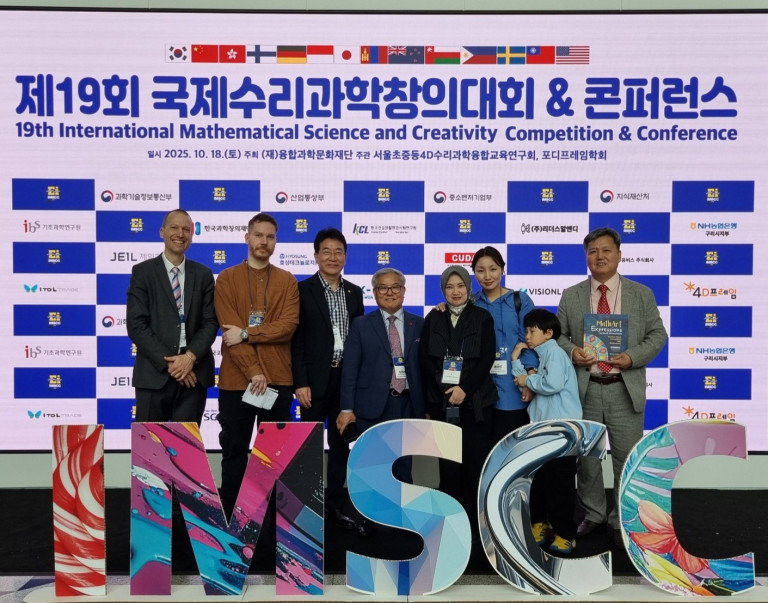
As a keynote of the 19th International Mathematical Science and Creativity Competition & Conference in Seoul, Dr. Fenyvesi introduced University of Jyväskylä’s Faculty of Information Technology's BA program for 600 students from 16 countries and received an award for his work in STEAM Education research and development.
Japan
In Japan, outreach centred on Science Agora in Tokyo, where Dr. Kristóf Fenyvesi engaged with hundreds of high-achieving upper secondary students, many of whom are actively considering international study pathways. A significant share of these interactions took place in collaboration with Girls Unlimited, a national initiative dedicated to expanding girls’ participation and leadership in STEM fields.
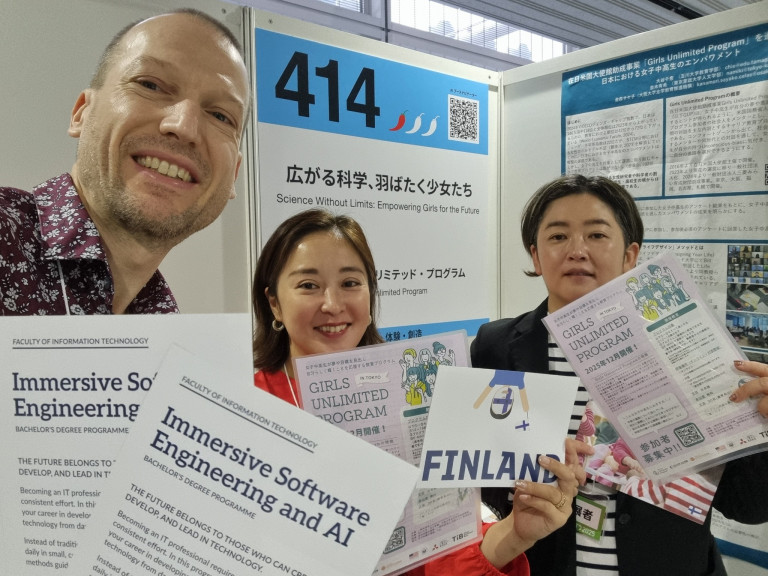
Girls Unlimited provided the organisational framework for discussions on equity, access, and future STEM careers, particularly for female students seeking international opportunities in technology and engineering. Within this context, cooperation opportunities were explored not only at student level, but also institutionally, including dialogue hosted at the Embassy of Finland in Tokyo, where the role of Finnish higher education in supporting inclusive, globally connected STEM education was discussed.

These engagements highlighted the importance of trusted intermediary organisations—such as Girls Unlimited and embassy-linked networks—in guiding talented students toward international degree options, while reinforcing Finland’s visibility as a destination for ethically grounded, innovation-driven technology education.

Indonesia
In Indonesia, engagement focused on cooperation with the FORKOM (Communication Forum of State Teacher Training and Education Leaders throughout Indonesia), which brings together deans of Faculties of Teacher Training and Education from universities across the country. These faculties play a central role in shaping national teacher education, professional development, and curriculum innovation, and thus strongly influence how students encounter STEM, STEAM, and AI-related learning from an early age.

Participation enabled strategic discussions on how teacher education reform, digital transformation, and internationalisation intersect. Within this context, the University of Jyväskylä’s Faculty of Information Technology and its international degree programmes were discussed.

Rather than focusing on short-term recruitment, these exchanges emphasised structural cooperation: linking teacher professional development, joint research, doctoral supervision, and Erasmus+ mobility with long-term student guidance. The FORKOM network thus emerged as a key interface for sustainable talent pathways, supporting informed transitions from Indonesian school systems and teacher education ecosystems toward international STEM and technology degrees at the University of Jyväskylä.
Malaysia
In Malaysia, engagement centred on higher education leadership, internationalisation, and graduate employability within rapidly evolving digital and innovation-driven ecosystems. As a Research Fellow at INTI International University, Dr. Kristóf Fenyvesi participated in academic and strategic dialogues that link research collaboration with talent development across ASEAN higher education networks.
A key milestone was the ASEAN Social Business Conference, where the Bachelor’s Degree Programme in Immersive Software Engineering and Artificial Intelligence was introduced as part of a keynote contribution addressing the role of AI, software engineering, and interdisciplinary competence in shaping future-oriented careers. In recognition of sustained academic collaboration and regional impact, Dr. Fenyvesi received an award for Scientific Collaboration Excellence, further strengthening institutional trust and visibility.

Parallel to university-level engagement, these efforts were acknowledged by the Embassy of Malaysia in Finland, which expressed interest in exploring cooperation with the University of Jyväskylä’s Faculty of Information Technology. Discussions highlighted the potential to promote international study opportunities through Malaysian Ministry of Education school and teacher networks, positioning the programme as a structured pathway for students seeking high-quality STEM education in Europe.

Together, these interactions connected research collaboration, policy interest, and recruitment strategy—laying the groundwork for long-term cooperation that links Malaysian education ecosystems with international degree pathways at the University of Jyväskylä.
China
In China, engagement focused on teacher networks and system-level capacity building, recognising teachers as key mediators between educational policy, classroom practice, and students’ future study decisions.

Dr. Kristóf Fenyvesi led an intensive AI-in-education professional development programme for approximately 100 Beijing-based teachers from leading primary and secondary schools, delivered through a teacher academy framework. The programme addressed the pedagogical use of artificial intelligence across disciplines, with emphasis on inquiry-based learning, STEAM integration, ethical reflection, and problem-oriented teaching.
Within this context, participating teachers were introduced to the Bachelor’s Degree Programme in Immersive Software Engineering and Artificial Intelligence as an international study pathway aligned with the competencies they are increasingly expected to cultivate in their students. Given the advisory role of teachers within the Chinese education system, this dissemination operates at significant scale, enabling informed guidance for large cohorts of students considering international higher education.
Kazakhstan
Engagements in Kazakhstan complemented the broader Asian outreach through participation in an international digital education conference, co-organised by INTI International University (Malaysia) and hosted at Narxoz University. This setting brought together higher education leaders, researchers, and innovation-focused institutions from across Central Asia and Southeast Asia. Within this regional platform, the Bachelor’s Degree Programme in Immersive Software Engineering and Artificial Intelligence was introduced as part of wider discussions on digital transformation, future skills, and international study pathways. While Kazakhstan was not a primary recruitment focus, the conference provided valuable visibility for the University of Jyväskylä’s Faculty of Information Technology within emerging regional networks engaged in internationalisation and digitally oriented higher education.
Romania
Engagements in Romania highlighted the importance of early talent development and curiosity-driven learning as foundations for future international study pathways. At the XIII. Laborkukac Student Science Competition, hosted by Sapientia Hungarian University of Transylvania (Sapientia EMTE), Dr. Kristóf Fenyvesi participated as chief patron and delivered a keynote on artificial intelligence and sustainability in research.

A central moment of the event was the joint programme with Rena Arai, a Japanese upper-secondary student living in Thailand, whose work in environmental research and youth-led scientific inquiry exemplified how individual curiosity can evolve into impactful, globally relevant STEM engagement. Her presence demonstrated how non-traditional, student-driven research trajectories increasingly align with international higher education models.

Within this context, the Bachelor’s Degree Programme in Immersive Software Engineering and Artificial Intelligence was introduced as a future-oriented pathway for students who already demonstrate independence, interdisciplinary thinking, and social responsibility in their learning. Rather than direct recruitment, the Romanian engagement emphasised aspirational visibility: showing how Nordic higher education can support young talents whose interests emerge early through competitions, community science, and self-initiated research.
These exchanges reinforced the role of regional STEM platforms as long-term feeders of motivation and preparedness, connecting Central and Eastern European student talent with international study opportunities at the University of Jyväskylä’s Faculty of Information Technology.


