Making sense of bi- and multilingual disciplinary literacies
CA21114 CLIL Network for Languages in Education: Towards Bi- and Multilingual Disciplinary Literacies (CLILNetLE) is an international research network funded by the European Cooperation in Science and Technology (COST). It addresses a key challenge in contemporary education: the need for greater conceptual clarity around disciplinary literacies, i.e. subject-specific ways of building and communicating knowledge, in the context of bi- and multilingual education (BMDLs).
To this end, CLILNetLE has brought together academics, teachers, and teacher educators working in multilingual educational contexts such as Content and Language Integrated Learning (CLIL) and English-medium instruction (EMI). With a community of more than 280 participants organised into five working groups, the network has worked towards a negotiated and comprehensive understanding of BMDLs.
Researchers from Jyväskylä leading one of the working groups
Working Group 1 (WG1) has laid the theoretical and conceptual foundations for BMDLs. Building on this, the other WGs have provided complementary perspectives: WG2 has explored how BMDLs are enacted across subject areas such as science, mathematics, and history, asz well as their role in curricula; WG3 has examined how these literacies develop across educational stages and in key transition phases; WG4 has investigated the influence of digital technologies and out-of-school learning environments; and WG5 has focused on identifying effective practices, developing training resources, disseminating findings, and engaging with stakeholders.
Researchers from the Centre for Applied Language Studies of the University of Jyväskylä have played key leadership roles in WG1, with Tarja Nikula as WG1 leader and Talip Gülle as vice-leader. In CLILNetLE, WG1 has focused on conceptualising BMDLs as well as exploring features of CLIL provision across Europe.
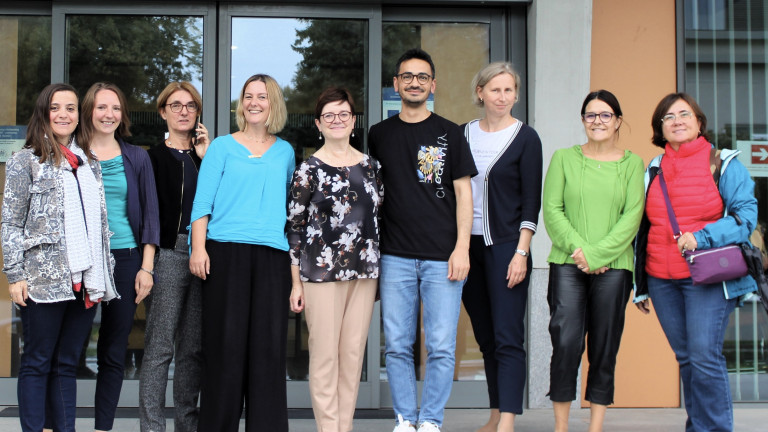
Photo: Talip Gülle and Tarja Nikula (in the middle) with other WG1 members in CLILNetLE meeting in Constantine the Philosopher University in Nitra
Collaboration has led to several outputs
The work in WG1 has led to several publications. Firstly, an initial position paper on BMDLs was produced through collaboration of 31 researchers from across COST member countries (Nikula et al., 2024). This paper conceptualises BMDLs as a multi-dimensional construct, encompassing multisemiotic, multilingual, functional, critical, and technological dimensions. It also highlights the role of schooling in recontextualising knowledge and preparing students as active, informed participants, while calling for stronger collaboration between language and content teachers and further research to support implementation.
Secondly, the work in WG1 has culminated in a forthcoming Special Issue, “Bi- and multilingual disciplinary literacies: Novel conceptualisations and empirical insights,” to appear in the Journal of Multilingual and Multicultural Development. The issue brings together an introduction paper and six articles that offer conceptual and empirical insights from across diverse educational contexts. The conceptual paper (Nikula et al., 2026) extends earlier work (Nikula et al., 2024) by offering a more comprehensive and refined grounding for the multidimensional BMDLs framework. The other contributions explore what BMDLs mean in practice through studies with/on teacher educators, teachers, classroom practices, and curricula across Europe and beyond. The Special Issue demonstrates BMDLs as a fruitful thinking tool for both research and pedagogy, offering practical guidelines and novel perspectives to support integrated content and language education.
Alongside this work, WG1 has worked towards a more comprehensive understanding of CLIL provision across contexts. A key outcome of this is the report, “Overview of CLIL Provision in Europe and Country-Specific Insights: A Report By CLILNetLE Working Group 1”, co-authored by Gülle and Nikula (2024) based on a questionnaire study collaboratively developed by WG1 members. It provides insights into CLIL provision across 23 countries in Europe drawing on the responses by CLIL specialists and applied linguists. Building on this report, Şimşek, Gülle, and Nikula (2025) produced ‘CLIL Landscape Across Europe’, a set of infographics that present concise country-specific snapshots of CLIL practices and policies. Designed for a broad audience, including teachers, students, and researchers, the infographics offer an overview of the report’s main findings.
Deeper collaboration and a joint project
Beyond these research outputs, collaboration within CLILNetLE has also paved way for new research avenues. Talip Gülle has joined the Centre for Applied Language Studies as a Marie Skłodowska-Curie Actions (MSCA) postdoctoral fellow for a two-year project under Tarja Nikula’s supervision. Their MultiAp-EMI project explores how EMI instructors across different disciplines make use of multilingual and multimodal resources in their teaching, and how these practices relate to students’ learning experiences. It also seeks to further develop and empirically validate the concept of BMDLs by exploring its relevance in tertiary education, drawing on perspectives from both content specialists teaching in English and their students.
References:
Gülle, T., & Nikula, T. (2024). Overview of CLIL provision in Europe and country-specific insights: A report by CLILNetLe Working Group 1 (Version 2). University of Vienna, PHAIDRA repository. https://doi.org/10.25365/phaidra.524
Nikula, T. et al. (2024).Towards an initial operationalisation of disciplinary literacies: A paper by CLILNetLE Working Group 1 (Version 1). University of Vienna, PHAIDRA repository. http://hdl.handle.net/11353/10.2050621
Nikula, T. et al. (2026). A multidimensional framework of bi- and multilingual disciplinary literacies. Journal of Multilingual and Multicultural Development. Advance online publication. https://doi.org/10.1080/01434632.2026.2617424
Şimşek, E., Gülle, T., & Nikula, T. (2025). CLIL landscape across Europe Infographics based on “Overview of CLIL provision in Europe and country-specific insights: A report by CLILNetLe Working Group 1”. PHAIDRA repository (University of Vienna). https://phaidra.univie.ac.at/detail/o:2116535