
University of Jyväskylä participated in the first measurement of the chemical bond of a superheavy element
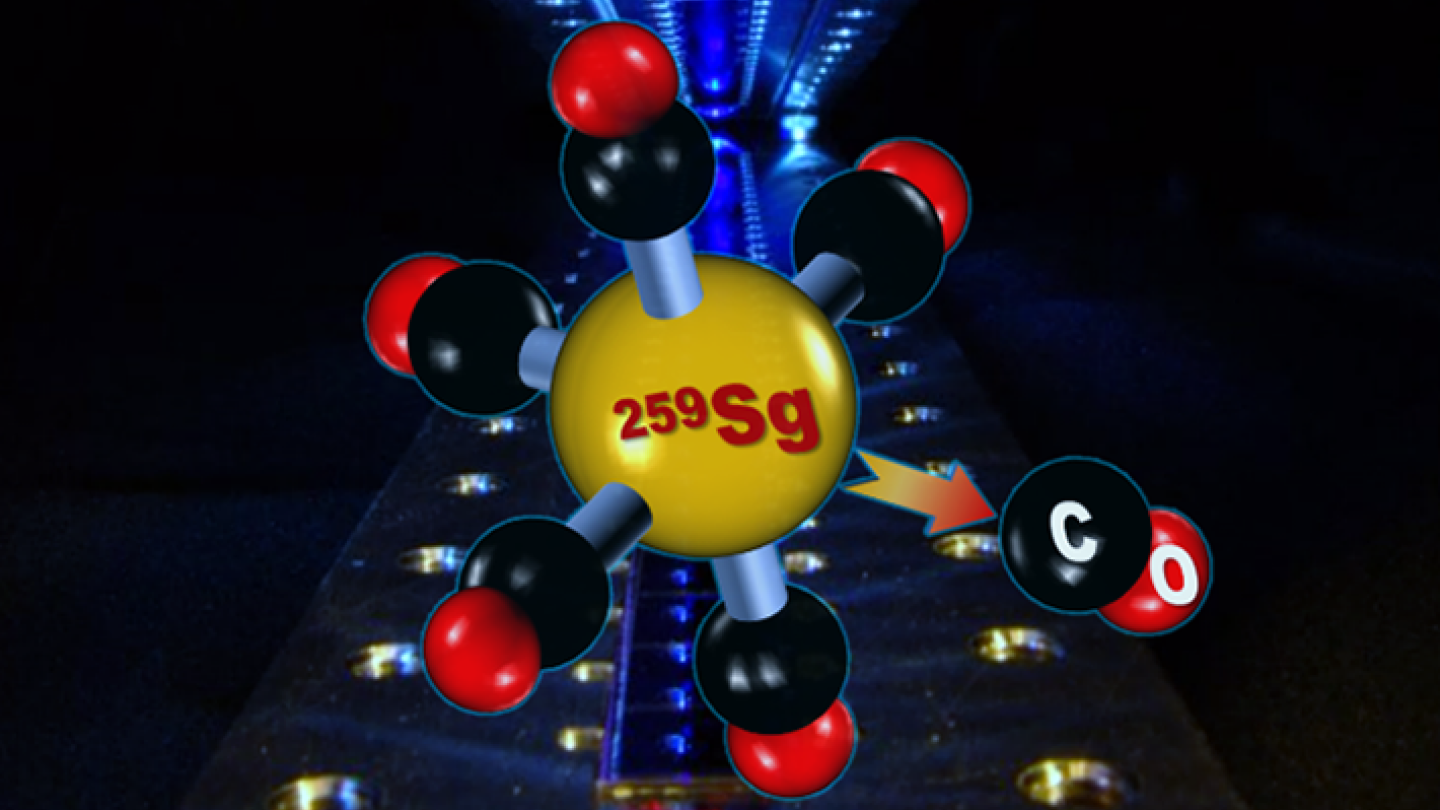
Researchers at the GSI/FAIR accelerator laboratory in Darmstadt, Germany, studied the hexacarbonyl complex Sg(CO)₆ of seaborgium (Sg, element 106). Senior Researcher Juha Uusitalo from the University of Jyväskylä participated in this international research project.
Superheavy elements challenge the predictions of the periodic table
Superheavy elements (SHE) with atomic numbers from 104 to 118 are artificially produced in nuclear fusion reactions at particle accelerators - at rates of at most a few atoms per day. Due to their short lifetimes, in the range of seconds at most, chemical studies are very challenging.
In these elements, electrons move so quickly near the nucleus that relativistic effects affect the electronic structure of the atoms and the formed chemical bonds.
- Based on the periodic system, we would expect the bond to strengthen from chromium through molybdenum and tungsten to seaborgium. However, the study observed the opposite phenomenon. In seaborgium, the bond weakens as a result of relativistic effects, explains Uusitalo.
In total, 75 seaborgium atoms were registered, thereof three in the hexacarbonyl-detector. In contrast, 17 percent of all tungsten atoms formed the analog compound. From the much lower yield of Sg(CO)6 compared to W(CO)6, a bond strength that is lower by 4 kJ/mol in Sg(CO)6 was deduced. Thus, the trend of increasing stability of hexacarbonyls within the chromium group from chromium over molybdenum to tungsten is inversed in seaborgium.
The University of Jyväskylä has a long history of collaboration on TASCA experiments
The study was carried out at the multidisciplinary and international GSI/FAIR accelerator laboratory in Darmstadt, Germany. The experiment was carried out using the TASCA (TransActinide Separator and Chemistry Apparatus) facility, which was built about 20 years ago specifically for research on superheavy elements.
- Using the TASCA separator, seaborgium atoms were separated from other reaction products and forwarded for chemical analysis, explains Uusitalo.
The University of Jyväskylä has been involved in research collaboration related to the TASCA separator since its construction. At the time, a similar RITU gas-filled recoil separator was in use in Jyväskylä, and Uusitalo was invited to consult on the TASCA project based on the expertise he had gathered in Jyväskylä.
Since the completion of the TASCA separator, Uusitalo has participated in experiments conducted with it nearly every year. The recently published study is one of the latest results of this long-term collaboration.

International collaboration is driving forward research on superheavy elements
The research is based on long-term international collaboration. The Sg(CO)6 was synthesized for the first time about ten years ago at the RIKEN Nishina Center, Japan, as the first compound of the carbonyl class for a superheavy element. Its bonding properties made it immediately attractive for attempts to measure the strength of a chemical bond between the central seaborgium atom and a carbon monoxide ligand, but first attempts remained unsuccessful. Now, the researchers have taken it a step further and succeeded in determining the strength of the compound’s chemical bonds.
- This research demonstrates what can be achieved through long-term international collaboration. At the same time, it allows us to study the properties of matter at the extreme limits of the periodic table, says Uusitalo.
After this first successful detailed study of the chemical bonding in molecules of superheavy elements, the researchers already prepare experiments with yet heavier elements beyond seaborgium.
Article information:
-
Scientific publication in the journal Nature: https://www.nature.com/articles/s41586-026-11105-2
-
DOI number: 10.1038/s41586-026-11105-2


