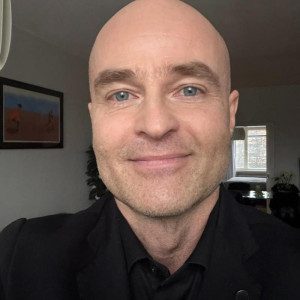
Kari Silvola, PhD, is a grant-funded researcher in Creative Writing and Literature at the University of Jyväskylä whose research focuses on queer histories, affect, and sexuality, combining archival research, sensobiographical interviews, digital and spatial humanities, and autobiographical writing as a research method.
Silvola’s research in the history of sexuality, gender studies, masculinity studies, and creative writing engages with themes such as closet epistemology, intersectionality, queer theory and history, masculinities, sexualities, race, and class. His theoretical orientation draws critically on Judith Butler’s performative theory, social constructionist traditions in lesbian and gay studies, and Michel Foucault’s radical anti-essentialism. His work has introduced conceptual contributions such as thetriad of the closetand thehomopticon, which analyse the social dynamics of visibility, surveillance, and identity in queer life.
Silvola defended his dissertation A Darkroom of My Own: Confessions of a Male Model: An Autoethnographic Study of Internalized Self-Discrimination and Passing for Straight in 2025, receiving the grade pass with distinction. His external examiners were Professor Tony E. Adams (Bradley University) and Dean Graeme Harper (Oakland University), with Professor Adams serving as the opponent.
His main research project is the four-year (2026–2030) Kone Foundation-funded project The Posthumous Stamps of Tom of Finland: Tracing Queer Histories from Homoerotic Mail-Order to Cruising during the Cold War, conducted in collaboration with Professor Matt Cook at the University of Oxford (https://koneensaatio.fi/apurahat-ja-residenssipaikat/the-posthumous-sta…). The project is situated within the history of sexuality and examines how underground homosexual networks developed during the Cold War under conditions of censorship, criminalisation, and geopolitical division. Focusing on the global circulation of Tom of Finland’s homoerotic art through mail-order infrastructures and its relation to urban cruising cultures, the project reconstructs queer networks that connected men across national borders from the 1960s onward. The research combines archival research, geospatial analysis, oral history, and sensobiographical urban studies in order to map the infrastructures and lived spatialities of Cold War queer life.
Another strand of Silvola’s research examines queer grief. Within this work he develops the concept of belated realization, which describes the retrospective recognition of losses that could not previously be articulated or socially acknowledged.
A third ongoing project explores the intersectional dynamics of desire, identity, and power in same-sex relationships. This work is also developed through literary practice in the autofictional novel Call Me Anyone, which examines the intersections of age, race, sexuality, class, religion, nationality, migration, and language in relationships between men.
His work has been published in SQS – Journal of Queer Studies in Finland, Critical Studies in Men’s Fashion, Scriptum, with forthcoming work in the Journal of Autoethnography (University of California Press).
Silvola has guest lectured at Adam Mickiewicz University in Poznań and at the University of Greifswald. In 2023 he was a visiting scholar at the School of Theater, Film and Television at the University of California, Los Angeles (UCLA). He is a member of the editorial board of Kulttuurintutkimus (Journal of Cultural Studies).
He has completed university pedagogical studies (25 ECTS). From 2021 to 2025 he worked regularly as a fixed-term lecturer in creative writing within the discipline of literature.
Silvola is a member of the board of the Finnish Society for Queer Studies (SQS) and an active member of Friends of Queer History, ICAE, IAANI, EACWP, and the KANTTI and VIHI research networks.