
Plastlife - Biology

Project description
Biodegradable plastics (compostable, soil-degradable) have started to replace conventional plastics, but their safe use requires an understanding of the potential ecotoxicological effects and biodegradation in the aquatic environment.
Aquatic organisms are particularly sensitive to various contaminants, so it is important to define the potential health risks of new biodegradable plastics in the aquatic environment. Current research has shown that conventional plastics have ecotoxicological effects only at high unnatural concentrations. These results are mainly due to an acute toxicity study with mortality as an endpoint. However, lower concentrations may have effects at the molecular or cellular level that elicit a higher level of response only after prolonged exposure.
A compostable or biodegradable material is defined as biodegradable in the aquatic environment if the degradation rate is two years or less. In this project, we study the biodegradation rate of biodegradable plastics in different waters, such as marine, brackish, freshwater, or wastewater. Biodegradability is also compared with the biodegradability of conventional plastics and natural materials to determine whether their life cycle in the aquatic environment is shorter or longer than that of conventional plastics and natural materials.
The subproject also aims to create a database where ordinary consumers can find information on the environmental fate of plastics, such as ecotoxicology and biodegradability.
Health safety of plastics
Biodegradable plastics (soil or compostable plastics) have been considered replacements for conventional plastics, but their safe use requires understanding their potential ecotoxicological impacts on organisms. Aquatic consumers are also susceptible to different pollutants, and thus, it is important to determine the potential health risks of new biodegradable materials in aquatic environments. Current research has shown that conventional plastics have an ecotoxicological impact only with high unnatural concentrations. These results mainly come from acute toxicity tests with the endpoint of mortality. Lower concentrations may have effects at lower biological levels of organization (e.g., molecular and cellular levels) that will cause higher-level responses only after a longer exposure. Therefore, studying plastic materials at different concentrations and exploring impacts at molecular and cellular levels is important.

In PlastLIFE - BIO, we examine the expression of genes related to D. magna development, reproduction, and oxidative stress in addition to Daphnia's survival, growth, and reproduction. Additionally, ecotoxicoproteomics can reveal the early response of organisms to stress or toxins, and therefore, proteomics is a powerful tool to reveal the possible ecotoxicological impact of different materials. The ecotoxicity of new biodegradable materials will be investigated by comparing the results to those of conventional plastics (e.g., PE and PVC) and natural materials (lignin, cellulose) to determine the level of the health risk the biodegradable plastics pose. In addition to the pure materials, an ecotoxicity test will be done from collected and recycled materials to understand the potential toxicity of secondary contaminants on the plastics. This will help us determine the health risk level of new bio-plastic materials during their whole life cycle. This task is well-integrated into PlastLIFE by determining the health risks of new bioplastics. Since Daphnia is a globally common herbivorous zooplankton and model organism in ecotoxicology, results are applicable for wide geographical regions.

Biodegradability of biodegradable and compostable plastics in lakes and Baltic Sea
Biodegradable plastics have been thought to be the solution for plastic pollution since they are derived from renewable resources, and microbes may decompose them quickly. Plastic material is defined as a material that can be decomposed by microbes in certain environments. For example, polylactic acid (PLA) is a thermoplastic aliphatic polyester prepared from corn or tapioca starch and planned to decompose at ~60 °C. The temperature of rivers and lakes in sub-arctic, boreal, or temperate zones never reaches above 30°C, and the average temperature is even lower in the Baltic Sea. Moreover, microbial community structures in rivers, lakes, and oceans may also vary greatly, resulting in differences in the decomposing of biodegradable plastics and their life cycle in aquatic environments.
We aim to unravel if biodegradable plastics (shown to decompose in high temperatures) are also biodegradable in aquatic environments. To understand the biodegradability of plastics in wider geographical regions, biodegradation studies will be done using waters from sub-artic lakes, boreal lakes, and the Baltic Sea. We are using standards including CO2 measurements and mass differences but also using 13C-labelled materials and compound-specific isotopes to test the biodegradability of biodegradable or compostable plastics in aquatic environments. Experiments are done in the laboratory but also the field. The biodegradability of biodegradable plastics will be compared to that of conventional plastics and natural materials to determine whether their life cycle in aquatic environments is shorter or longer than that of traditional plastic and natural materials.

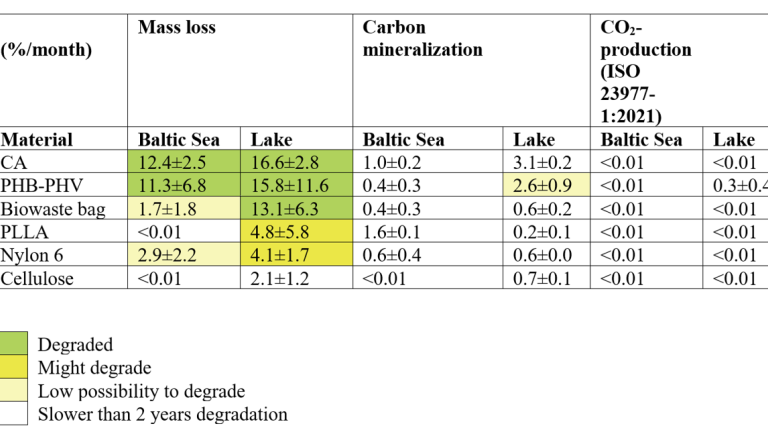
Table 1. Estimated disintegration andbiodegradation after two years using three different methods in Boreal Lake and Baltic Sea water. Mineralized carbon combines dissolved inorganic carbon (DIC) and CO2, while the standard method (ISO 23977-1:2021) uses only CO2 production relative to theoretical maximum CO2 production. Mass loss represents physical change of the studied films. Values shown are monthly degradation averages (%) and standard deviation (n=5). Colors indicate the estimated degradation, assuming constant monthly rate, in two years: green=ultimate (≥90 %) degradation in all replicates, yellow = one (light yellow) or more replicates from five achieved ultimate degradation and white=none of the replicates achieved ultimate degradation in two years.
Publications and Results
Master thesis
[1] Master Thesis of Aliisa Yli-Tuomola. Biodegradable plastics toxicity on Water flea (Daphnia manga). 2024.
[2] Master Thesis of Milja Aalto. Application to detect toxicity of recycled plastics using boar spermatozoa motility. 2024
[3] Master Thesis of Emil Huovila. Biohajoavien muovien hajoaminen järvi- ja murtovedessä. 2025.
Articles
[1] Zhou, G. J., Vehniäinen, E. R., Hiltunen, M., Rigaud, C., & Taipale, S. Effects of microplastics and natural particles on the aquatic invertebrate Daphnia magna under different dietary quality scenarios. 2025. Oecologia, 207(6), 81.
[2] Risku, N., Dahl, O., Vanhanen, H., Pulkkinen, K., Litmanen, J. J., Rigaud, C., & Taipale, S. J. Breakdown of plastic waste into microplastics during an industrial Composting: A case study from a biowaste facility. 2025. Waste Management, 203, 114889.
Blogs
Hajoaako vai ei? Pohjoiset olosuhteet haastavat biohajoavat muovit - Kiertotalousratkaisuja


