
From Digital Carbon Literacy to Planetary Responsibility: CarbonClass Pilots in Hong Kong and Finland
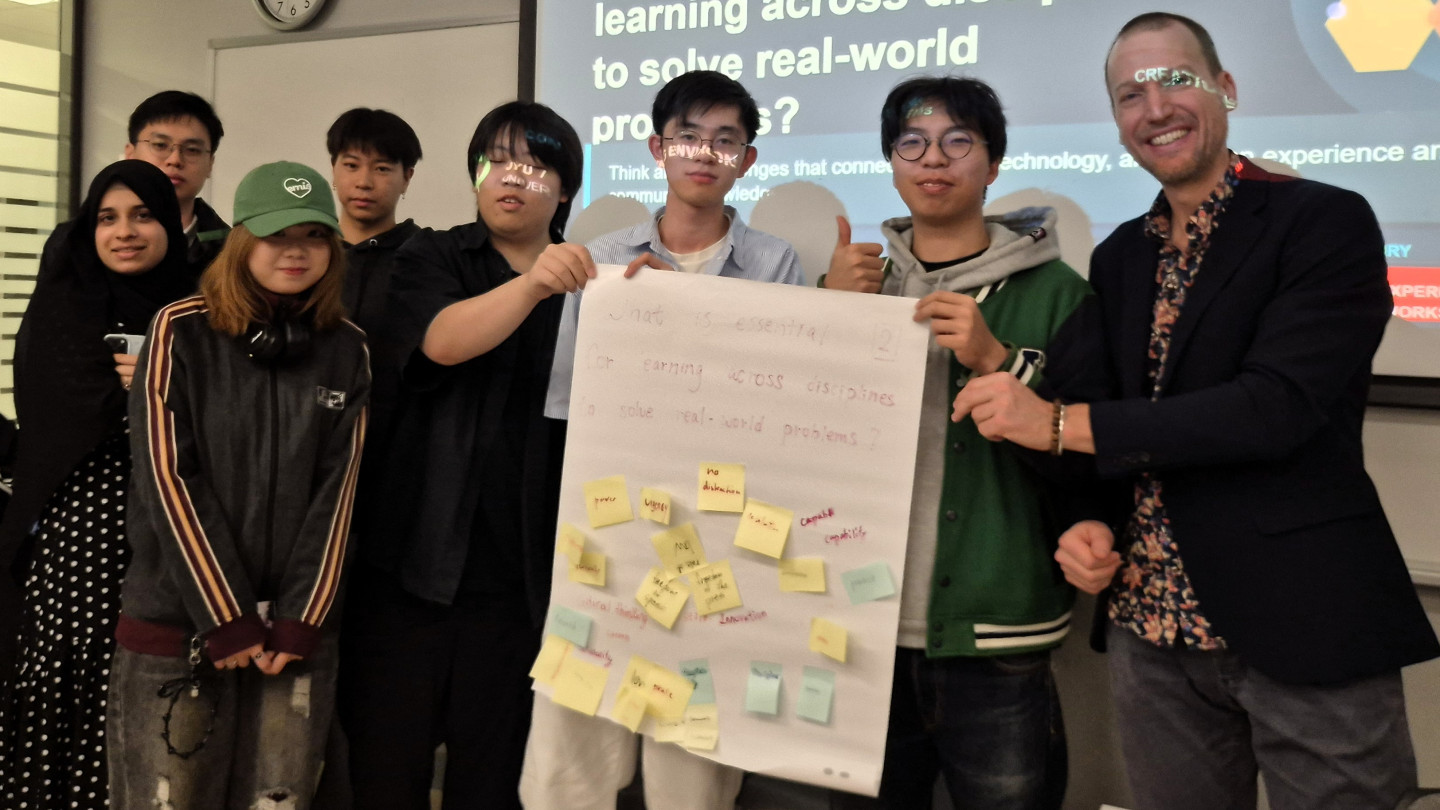
How much energy does artificial intelligence use, and how can students make more sustainable technological choices? During autumn 2026, connected educational activities engaged more than 50 learners across two countries: first, 35 university students in Hong Kong, followed by nearly 20 school students in Äänekoski, Finland.
The cross-border educational and research cooperation was initiated by Dr Kristóf Fenyvesi, Adjunct Professor of Thinking and Learning in Digital Culture, and International Coordinator of the University of Jyväskylä’s Innovative Learning Environments research group.
As a Visiting Professor at The Hang Seng University of Hong Kong, Fenyvesi helped to shape the School of Transdisciplinary Studies profile and connected several of its international speakers, experts and partner networks with the course. Together with György Huszics and Carbon.Crane, he delivered the Hong Kong CarbonClass session and connected it with a Finnish school pilot and ILE’s broader work on planetary responsibility.
The resulting Hong Kong–Finland trajectory shows how AI literacy, STEAM education, sustainability competences and digital carbon awareness can be combined across countries and educational levels.
The story began in Hong Kong
The story began in Hong Kong with a classroom of 35 students and a deceptively simple question: what happens beyond the screen when we ask an AI system to generate an answer?
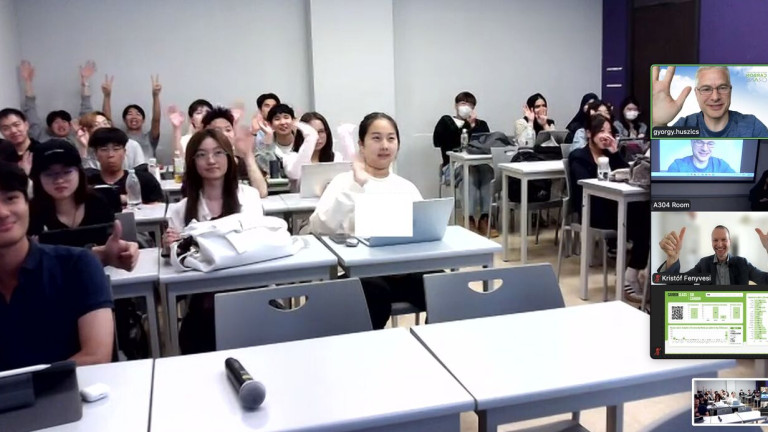
On 15 September 2026, students at The Hang Seng University of Hong Kong participated in a 90-minute hybrid session entitled Introduction to Digital Carbon Footprint – Understanding and Reducing the Environmental Impact of Our Digital Lives.
The session formed part of HSUHK’s International Classroom for Sustainable Development, a September–November programme connecting students and faculty members with scholars and practitioners from universities and academic networks worldwide.
The institutional cooperation at HSUHK was facilitated by Dr Muk-Yan Wong, Associate Professor in the Department of Social Science, Programme Director of the BSocSc-PPE Programme and Director of Common Core Curriculum.
The course was led and coordinated by Ms Crystal Chow, its module coordinator and an award-winning bilingual journalist and journalism educator. Drawing on her experience in climate change, global health, environmental advocacy and social justice, she connected the guest sessions with the course’s broader learning objectives, prepared the students through Moodle and facilitated the on-campus learning process and discussions.
Fenyvesi and Huszics jointly delivered and co-facilitated the entire online component of the 90-minute hybrid class, while the 35 students participated on campus at HSUHK.
Fenyvesi connected digital carbon literacy with AI education, learning, STEAM and planetary responsibility. Huszics, Co-founder and Managing Director of Carbon.Crane, contributed Carbon.Crane’s applied expertise, measurement perspectives and interactive tools. Throughout the class, they jointly guided the activities, student interaction, discussion and questions.
Students examined the material infrastructure behind apparently weightless digital services. The session addressed data centres, electricity and water consumption, carbon emissions, websites, online communication, differences between AI models and tasks, and the ways everyday digital behaviour can have a measurable environmental footprint.
The objective was not to discourage the use of AI. Instead, students were encouraged to consider when AI is genuinely useful, which tools and models are appropriate for a particular task, and how unnecessary environmental impacts can be reduced without compromising the purpose or quality of their work.
From Hong Kong to a Finnish school
The cooperation subsequently travelled from a Hong Kong university classroom to a Finnish school.
On 29 October 2026, nearly 20 students in Äänekoski participated in an introductory CarbonClass workshop organised through cooperation between Carbon.Crane and the University of Jyväskylä’s Innovative Learning Environments research group.
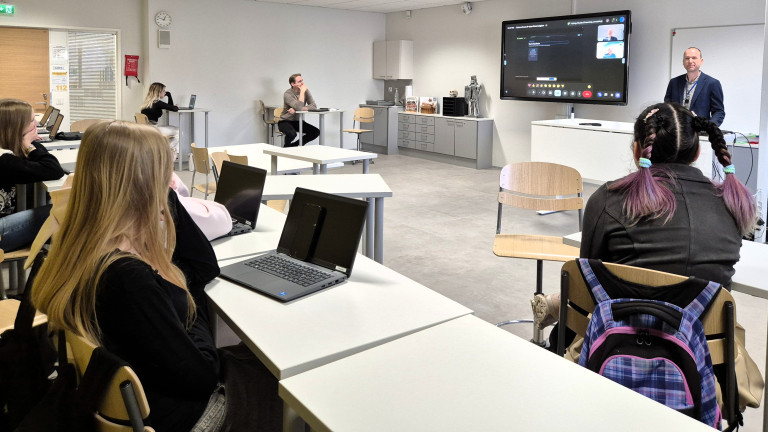
Students in Äänekoski explored the environmental footprint of artificial intelligence through an introductory CarbonClass workshop.
Fenyvesi facilitated the session, while Huszics joined online to introduce the CarbonClass learning environment and discuss the environmental footprint of AI with the students.
The session introduced the interactive CarbonClass learning environment rather than completing the entire course together. Students received access to continue independently, complete the knowledge assessment and earn a digital CarbonClass badge.
Back in Hong Kong: from awareness to action
The educational process did not end with recognising the environmental footprint of digital technologies.
In a follow-up International Classroom session on 10 November, Fenyvesi worked with the students on how GreenComp and the emerging BlueComp perspective could be translated into concrete educational and sustainability opportunities in Hong Kong’s urban, island and coastal context.
Through speed ideation, students responded to a series of short, thought-provoking questions and rapidly generated, shared and developed ideas related to planetary responsibility, global citizenship, real-world learning and action.
Students also used AI as an ideation resource, while the learning process remained primarily hands-on and co-creative. Peer dialogue, collaborative problem-solving, physical interaction and collective knowledge creation were placed at the centre of the learning experience.
This created a progression from recognising the hidden environmental impacts of AI to exploring alternatives and strengthening learners’ agency and capacity to take responsible action.
Planetary responsibility across learning environments
From the perspective of JYU’s Innovative Learning Environments research group, Hong Kong and Äänekoski are not simply two locations where similar content was presented. They are connected learning environments in which planetary responsibility was interpreted through different local conditions, educational levels and forms of participation.
In Hong Kong, the university context made it possible to connect digital carbon literacy with GreenComp, BlueComp, global citizenship and the challenges of an urban, island and coastal environment. Students moved from critically examining technological systems to generating ideas for collective and locally meaningful action.
In Äänekoski, the school workshop connected AI energy awareness with students’ everyday digital practices, Finland’s changing energy infrastructure and the industrial characteristics of their local environment.
ILE’s role was not to transfer one fixed lesson unchanged between the two countries. Instead, the learning design was adapted to each environment while retaining a common educational pathway:
making hidden impacts visible → developing critical understanding → exploring alternatives → strengthening agency → supporting responsible action
This reflects an understanding of planetary responsibility as more than environmental awareness. It combines scientific and technological understanding with ethical reflection, creativity, collaboration, local participation and the capacity to act.
Flexible formats for digital carbon literacy
CarbonClass can support several learning formats: a short introduction, a facilitated 45–90-minute workshop with collaborative mini-activities, or self-paced study followed by an assessment and digital badge.
Across these formats, the shared objective is to develop digital carbon literacy as a practical component of planetary responsibility. This involves understanding the physical and environmental foundations of digital technologies, critically examining technological choices and translating knowledge into responsible individual and collective action.
Why the environmental footprint of AI belongs in education
As AI and educational technologies become part of everyday learning, their environmental consequences remain insufficiently visible in AI literacy and responsible-technology education.
This is particularly relevant in Finland, where the expansion of data centres is increasing electricity demand and raising questions about infrastructure, resource use and environmental sustainability. Finland’s transmission system operator, Fingrid, identifies data centres as an important driver of future electricity-consumption growth.
The Hong Kong and Finnish pilots demonstrate how these complex global questions can be translated into accessible, participatory and locally relevant learning experiences in both higher education and schools.
From educational pilots to research and institutional cooperation
The pilots also create opportunities for educational research and broader institutional development.
ILE and Carbon.Crane are exploring further cooperation in schools, universities and teacher professional development. Potential next steps include examining changes in learners’ understanding and technological choices, developing new CarbonClass activities, and assessing the digital carbon footprints of educational organisations.
The initiative complements ILE’s existing work, including the AIWARE and PERMA-Digital projects, while creating new connections between Finnish and Hong Kong educational environments.
Schools, universities and educational organisations interested in developing AI and EdTech sustainability education are welcome to explore cooperation.
Contact
Dr Kristóf Fenyvesi
Senior Researcher, Finnish Institute for Educational Research
International Coordinator, Innovative Learning Environments research group
University of Jyväskylä
kristof.fenyvesi@jyu.fi
Related links
HSUHK International Classroom for Sustainable Development:
https://sts.hsu.edu.hk/en/international-classroom-for-sustainable-development/
Innovative Learning Environments research group:
https://www.jyu.fi/en/research-groups/innovative-learning-environments-ile
Carbon.Crane:
https://carboncrane.io/
CarbonClass:
https://carbonclass.io/


