
Finnish Vocabulary Learning Research Notification & Privacy Notification
RESEARCH NOTIFICATION
- Name of the study and invitation to participate in research
Are you interested in learning Finnish as a foreign language? Would you like to contribute to advancing our scientific understanding of vocabulary learning while studying some Finnish words?
If you have answered yes, we are pleased to invite you to participate in one or several of the four studies corresponding to the project "The Arousal of Cognitive Processes in Vocabulary Learning". These studies investigate the effectiveness of different vocabulary learning strategies and the role that electrodermal activity (EDA) can play in studying and supporting Finnish vocabulary learning. The studies are an integral part of a doctoral dissertation that proposes and investigates wordlist learning strategies for Finnish as a foreign language by examining different word relationships. The ultimate goal is to study ways to foster and optimise the learning of foreign language vocabulary, thereby supporting a cornerstone of the foreign language learning process.
This research notification describes the study and related participation. The accompanying Privacy Notice provides information on the processing of your personal data.
Participation in each study requires being an adult (18 years or older) whose mother tongue is not Finnish and who is not fluent in Finnish (yet). Each study will involve about 100 participants, in batches of a maximum of 10 participants simultaneously. Each study takes about 30–60 minutes. You are encouraged to participate in as many of the four studies as it suits your availability, interest, and willingness to contribute to the science of vocabulary learning. In each experiment, new Finnish words are waiting for you to learn.
- Voluntariness
Participation in this study is voluntary. You can refuse to participate in the study, stop participating, or cancel your previously given consent, without stating any reason for this, and at any time during the study. No questions asked. This will have no negative consequences for you (except missing the opportunity to learn new Finnish words).
If you stop participating in the study or if you cancel your consent, the personal data, samples and other information collected on you up to that point will be used as part of the research material as far as it is necessary to ensure relevant research outcomes.
3. Progress of the study
Each of the four studies will take place in a room where participants will be seated at a table equipped with a laptop or desktop computer, as the studies will be conducted using the Gorilla Experiment Platform, an online environment. A maximum of 10 participants will participate in the experiment simultaneously.
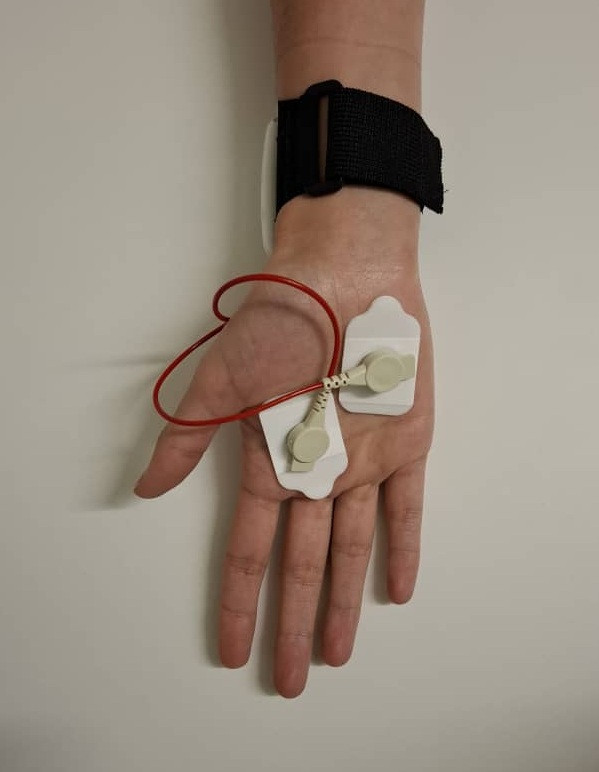
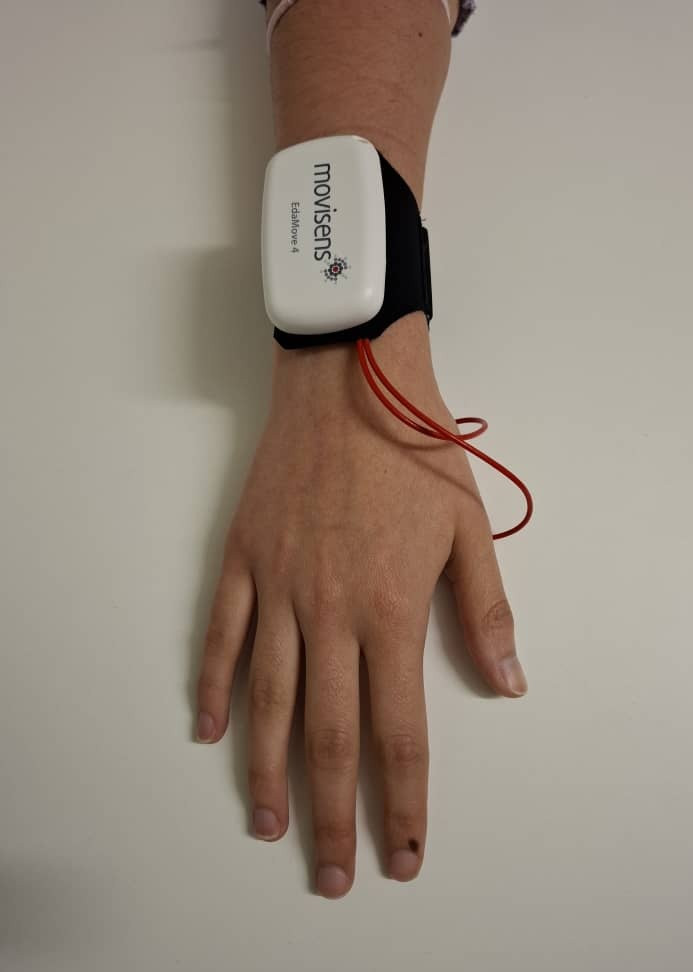
At the start, we will ask participants to wear an electrodermal activity sensor (EDA) in their non-dominant hand. In practice, this implies wearing a wristband with two cables connected to electrodes attached to the palm of your hand, as shown in Figure 1. EDA enables us to measure changes in participants’ skin conductance due to sweating from the cognitive-affective processes during vocabulary learning.
Figure 1. Wearing an electrodermal activity (EDA) sensor.
Participants will be provided a link to the Gorilla online environment. There, participants will be asked some demographic information such as age, gender, native language(s), field(s) of study or educational background, and duration of learning and proficiency in the Finnish language. Furthermore, participants will share their perception of mental effort (cognitive load) for each word learned and remembered, and their self-confidence in their capacity to learn the Finnish vocabulary, known in psychology as self-efficacy, before and after each group of about 10 words.
- Possible benefits from the study
This is a meaningful task for learning Finnish vocabulary. By the end of the task, participants are expected to have learned around 30 new Finnish words. We also hope that the task has a motivating effect on participants to continue learning Finnish.
The results of this study will translate into recommendations for practical Finnish vocabulary learning strategies. This could be beneficial for providers of language courses, for example, from the Movi language centre of the University of Jyväskylä, and for designers of mobile and computer-assisted language learning.
The research will also advance the theory of the cognitive-affective processes involved in language learning and the effect of different factors on vocabulary learning outcomes.
From a methodological perspective, this research will enhance the use of physiological data (specifically electrodermal activity) in understanding learning processes, providing an extra data modality to understand learning processes, and informing the possible integration of real-time data in the field of learning analytics.
- Possible risks, harm, and inconvenience caused by the study, as well as preparing for these
This research involves four experiments where participants will be learning Finnish vocabulary using an online learning platform on a computer. As a result, participants may experience both positive and negative emotions that are related to the learning process, for example, enjoyment of learning when recalling new words, but also confusion and frustration when they are unable to recall new words. Just as it happens when learning anything else.
By wearing a wristband with a sensor and electrodes on their palms or fingers, participants may feel a little uncomfortable, for example, when typing on the keyboard.
The use of the EDA sensors could make participants feel itchy or experience mild skin reactions or irritations, in which case, participants will be instructed to discontinue the use of the wristband immediately as recommended by the manufacturer. This is, however, a very low risk since wristbands are supplied by a reputable company and have undergone dermatological and usability tests.
No preparation is required for the experiments. Participants are only expected to come eager to learn some new Finnish words.
- Study-related costs and compensation to the subject, as well as research funding
It is desirable that, where possible, participants take part in more than one of the four studies. Accordingly, as a token of appreciation for taking part in this research, participants may choose among the options shown in Table 1. Naturally, participants may also opt out of any compensation for participation.
Table 1. Participation gift policy.
| Number of experiments | Participation gift | Personal data required by tax administration |
| 1 | 1 Candy bag (or equivalent) | No |
| 2 | 2 Candy bags | No |
| 3 | 3 Candy bags or S-Card loaded with 13€ | Yes, if the participant opts for the S-Card |
| 4 | 4 Candy bags or S-Card loaded with 20€ | Yes, if the participant opts for the S-Card |
If you opt for the S-Card option, according to the applicable regulation for taxation purposes, your name, nationality, social security number, and address are needed. We must report this reward to the Incomes Register. When the University of Jyväskylä pays a reward or cost reimbursement, the University will store your personal data for 10 years.
Additional information about taxation https://www.vero.fi/henkiloasiakkaat/verokortti-ja-veroilmoitus/tulot/ansiotulot/gallupit-kyselyt-ja-tutkimukset/
- Informing about research results and research outcomes
The material collected in the study will be discussed in scientific publications through the doctoral researcher’s dissertation and possibly master’s theses and other publications. The information produced by the research will also be presented at national and international scientific conferences and events organised either targeting the research community or the general public.
The study will therefore yield scientific publications, conference/seminar presentations, and overall, an academic doctoral thesis. Research results will be published whenever possible and feasible as open access articles.
Participants will receive a summary of their vocabulary learning outcomes at the end of the experiment.
Following principles of open science, it is the will of the research team to make the anonymised research data openly available once the results are published. Anonymised data means that before publishing the data, any record or file connecting their pseudonymised data to their identity will be permanently deleted.
- Insurance coverage for research subjects
The University of Jyväskylä has insurance for its activities and research subjects.
The set of insurance includes malpractice insurance, operational liability insurance, and optional insurance against accidents. During the research activities, the subjects are covered by the insurance for accidents, damages and injuries inflicted by an external cause. The accident insurance is valid during measurements and on trips integrally connected to them.
9. Contact persons for further information
(a) Name: Pijeira Díaz, Héctor
Phone Number: +358 50 575 2429
Email Address: hector.j.pijeira-diaz@jyu.fi
Role: Principal Investigator and Doctoral Supervisor
(b) Name: Ngwenya, Jobert
Phone Number: +358 50 454 2432
Email Address: jobert.m.ngwenya@jyu.fi
Role: Doctoral Researcher
University of Jyväskylä
PRIVACY NOTICE
You are participating in scientific research. This privacy notice informs you about the processing of your personal data as part of the research. You have a legal right to receive this information under the European Union and Finnish legislation.
- Data Controller(s) in the study "The Arousal of Cognitive Processes in Vocabulary Learning"
The Data Controller is responsible for the lawful processing of personal data in this research. The Data Controller of this research is: the University of Jyväskylä (JYU), Seminaarinkatu 15, P.O. Box 35, 40014 University of Jyväskylä. Business ID 0245894-7. Data Protection Officer: tietosuoja@jyu.fi, + 358 40 805 3297.
Responsible leader or team for the research
Name: Pijeira Díaz, Héctor
Title: Assistant Professor; Principal Investigator (PI) of this project
Phone Number: +358 50 575 2429
Email Address: hector.j.pijeira-diaz@jyu.fi
Work address: University of Jyväskylä (JYU), Seminaarinkatu 15, P.O. Box 35, 40014 Jyväskylä
Visiting address: Ruusupuisto Building; Alvar Aallon katu 9, 40600 Jyväskylä, Finland. Office: RUU D421.
Name: Ngwenya, Jobert
Title: Doctoral Researcher
Phone Number: +358 504542432
Email Address: jobert.m.ngwenya@jyu.fi
Work address: University of Jyväskylä (JYU), Seminaarinkatu 15, P.O. Box 35, 40014 Jyväskylä
Visiting address: Ruusupuisto Building; Alvar Aallon katu 9, 40600 Jyväskylä, Finland. Office: RUU D328.
Team members who process personal data in this research: The abovementioned team plus research assistants collaborating on the project. Such research assistants will sign a commitment before they can process personal data.
- Processor(s) of personal data
Processor of personal data refers to somebody processing personal data on behalf of the Data Controller and according to the Data Controller’s instructions. A Data Processing Agreement must be signed with the processor of personal data. In this research, personal data are processed by:
- JYU MS Forms
- Webropol
- NextCloud
- Gorilla Experiment Builder
During research, the Data Controller can also use other processors of personal data that cannot be named beforehand. Necessary agreements are always signed with the processors, and their eligibility for the processing of personal data in terms of information security is assessed before signing the agreement. The data subject will be informed separately about the use of another processor if the change is significant from the data subject’s point of view.
To ensure the accuracy of research data, the Data Controller may submit data for processing (primarily without direct identification data) to a so-called research reviewer or verifier for a defined period when necessary. These reviewers or verifiers work under the supervision of research staff, and data processing agreements are signed with them.
3. Other disclosure of personal data during research
Your personal data will be handled by as few members as possible of the research team and data processors. The data will be pseudonymised as soon as possible in the research process.
If a reward or cost reimbursement is paid to the research subject, the payer discloses statutory information to the Incomes Register Unit for the Incomes Register without being hindered by confidentiality provisions and other restrictions on access to information (Act on the income information system 53/2018).
- Personal data to be processed in "The Arousal of Cognitive Processes in Vocabulary Learning" study.
Your personal data will be processed for the research purpose described in the information letter.
In this research, we will collect the following personal data: name, gender, age, period of learning Finnish as a foreign language, native language(s), educational background, email address, phone number and your skin conductance, which is technically known as electrodermal activity (EDA). This data is necessary to contextualise and analyse the role of different factors on Finnish vocabulary learning outcomes. The contact data (phone and email) are necessary to schedule your participation in the experiment and contact you for possible updates (e.g., changes of timing or location).
You will be paid a reward and/or reimbursement of expenses for your participation in the study. For taxation purposes, your name, nationality, social security number, and address are needed. In case of a monetary reward, a tax card is also needed. The payer reports the monetary reward and/or cost reimbursement to the Incomes Register. When the University of Jyväskylä pays a reward or cost reimbursement, the University will store your personal data for 10 years.
This research does not involve the processing of personal data of special categories such as ethnicity, beliefs, politics, health status (condition or risks), sexual orientation or sex life.
This privacy notice has been made available to data subjects at the recruitment phase in electronic and/or printed form. Data subjects are also able to access it at the beginning of the experiment on the Gorilla Experiment Platform.
- The lawful basis for processing personal data in scientific research
☒Scientific research serving a public interest (GDPR, Article 6.1e, special personal data categories 9.2j)
- Transfer of personal data outside the EU/EEA area
In this research, your personal data will not be transferred outside the EU/EEA area.
- Protection for personal data
Processing of personal data in this research is based on an appropriate research plan and the study has a designated person in charge. The personal data collected and saved for this research will include only such data that is necessary for the research purpose.
Preventing identification
☒ The data is not analysed with direct identification data, but such data is kept until the last one of the series of experiments corresponding to this project, to be able to connect the different datasets across experiments.
The personal data processed in this research will be protected using:
☒ user ID ☒password ☒registered use ☒access control (physical spaces)
All the research team is JYU personnel, so the JYU shared network folders (i.e., NextCloud) will be used for data storage. Thereby, the content is automatically backed up by the university's digital services. The data key, which connects the name and pseudonym, is kept separately from the rest of the data in the folder only those protected by the username and password of the principal researchers of the university on shared network disks.
The researchers have completed data protection and information security training.
☒Yes
Agreements with research assistants and/or processors of personal data /Joint Data Controllers
☒ Yes
- Processing of personal data after the research has ended
☒ The research register will be anonymised after the series of studies comprising this research has ended, approximately by January 2027. This means that all identification data is fully removed so that there will be no return to the identifiable personal data, nor any new data can be connected to this data set. Anonymised data will be published, in line with open science practices.
- Rights of the data subject
Right to access your personal data (GDPR, Article 15)
You have the right to get to know whether and which personal data of yours are processed. If you wish, you can also request a copy of your personal data to be processed.
Right to rectification (GDPR, Article 16)
If there are any inaccuracies or errors in your personal data to be processed, you are entitled to request that these be rectified or supplemented.
Right to erasure (GDPR, Article 17)
You have the right to demand, in some cases, that your personal data be erased. However, the right of erasure is not applicable if the erasure would prevent or greatly hinder reaching the goal of processing in scientific research.
Right to restriction of processing (GDPR, Article 18)
You have the right to restrict the processing of your personal data in some cases, like when you challenge the correctness of your personal data.
Deviating from the rights
In some individual cases, it is possible to deviate from the described rights on the grounds stipulated in the GDPR and the Data Protection Act insofar as the rights would prevent or greatly hinder reaching the goals of scientific or historical research or statistical purposes. The need for deviating from the rights is always assessed case-specifically. It is also possible to deviate from the rights if the data subject cannot, or cannot any longer, be identified.
Profiling and automated decision-making
In this research, your personal data will not be used for any automatic decision-making. In this research, the purpose of the processing of personal data is not to assess your personal qualities, i.e. profiling, but personal data and qualities are considered from the perspective of broader scientific research.
Implementing the data subject rights
If you have any questions about your data subject rights, you can contact the University’s Data Protection Officer. All requests concerning the implementation of data subject rights are submitted to the JYU Registry Office. Registry Office and Archives, P.O. Box 35 (C), 40014 University of Jyväskylä, tel. 040 805 3472, email: kirjaamo@jyu.fi. Visiting address: Seminaarinkatu 15, Building C (University Main Building, 1st floor), Room C 140.
Reporting an actual or suspected information security breach to JYU
You have to lodge a complaint with a supervisory authority, especially with a locally relevant one in terms of your permanent place of residence or work, if you regard that the processing of personal data violates the EU General Data Protection Regulation (EU) 2016/679. In Finland, the supervisory authority is the Data Protection Ombudsman.
Updated contact information of the Office of Data Protection Ombudsman: https://tietosuoja.fi/etusivu
CONSENT TO PARTICIPATE IN SCIENTIFIC RESEARCH
"The Arousal of Cognitive Processes in Vocabulary Learning"
I understand that participation in the study is voluntary and that I can pause or stop taking part in the study at any time without giving a reason, and without negative consequences for me. The research materials collected about me up to the point of pausing or stopping may still be used in the study.
By giving my consent, I accept that data and materials will be collected from me as described in the information sheet.
Yes ☐ No ☐
I confirm that I will not participate in face-to-face data collection if I have flu symptoms, fever, or am recovering from illness or am feeling otherwise unwell.
Yes ☐
I confirm that I have received the information sheet about the content of the study, how it will be conducted, and what it means on my part, as well as the privacy notice. I have also had the opportunity to ask the researchers further questions. I have therefore been adequately informed about the content of the study, how it will be conducted, and what it means for me, as well as about the processing of my personal data, which is processed on the basis of public interest as set out in the law.
I have had sufficient time to consider my participation in the study. I have not been pressured or tempted to take part in the research.
Yes ☐
____________________________________________________________________________
Signature of the participant Name (in block letters) Date
Contact details:
For more information, contact: Doctoral Researcher: Jobert Ngwenya, jobert.m.ngwenya@jyu.fi or Principal Investigator: Héctor Pijeira Díaz, hector.j.pijeira-diaz@jyu.fi

