
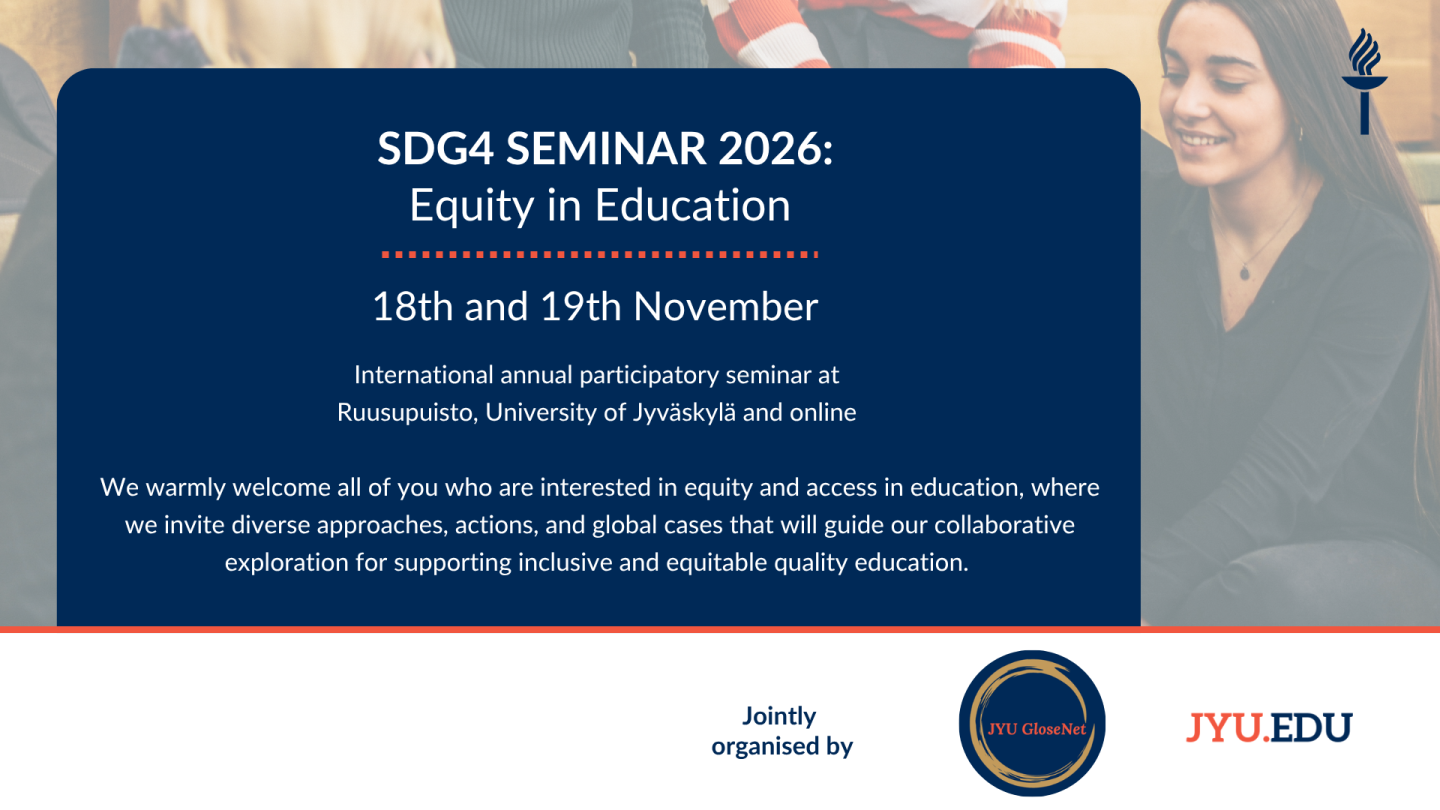
Annually, the Faculty of Education and Psychology organises the SDG4 seminar following the UN’s Sustainable Development Goal 4: “Ensuring inclusive and equitable quality education and promoting lifelong learning opportunities for all”. This year, our theme is ‘Equity in Education’.
Based on the Global Education Monitoring Report, equity is defined through measurable progress in reducing educational disparities between different student groups across gender, socioeconomic status, geography, disability, and ethnicity. Since equity is a contextual phenomenon, inclusive consideration of variations and different voices is crucial to ensure that no one is left behind.
We warmly welcome all of you who are interested in equity and access in education, where we invite diverse approaches, actions, and global cases that will guide our collaborative exploration for supporting inclusive and equitable quality education.
This seminar is an international participatory two-day hybrid event with keynotes, workshops, roundtables, and entertainment. Whether you are a student, researcher, teacher, educator, or merely curious, come and lend your voice. “All Means All” is only realized when we act together. 2026 SDG4 seminar is also a home for the Nordplus funded Nordic Antiracism in Teacher Education (ARTE) network meeting. The seminar is sponsored by Jyu.Edu
The schedule below provides an overview of the planned events, and specific details for each session will be updated soon.
| Time | Day 1 - Wednesday, 18th November |
| 10.30-11.00 | Seminar info desk opens in the Ruusupuisto lobby |
| 11.00- 11.30 |
Welcome and Introduction (E101 Aula – hybrid)
|
| 11.30- 13.00 |
Keynote (E101 Aula – hybrid) Presentation 1: Countdown to 2030: 2026 GEM Report on Access and Equity in Education
Presentation 2: Involving ALL children in decision-making in education: why that matters more than ever
This presentation will focus on the role of human rights law in ensuring that all children are involved in decision-making in education. It will discuss Article 12 of the UN Convention on the Rights of the Child and Article 7 of the UN Convention on the Rights of Persons with Disabilities before reflecting on why it is particularly important for children and education systems that all children are included and involved in educational decision-making. The presentation will draw on examples of good practice, with a focus on children whose behaviour is considered to be challenging or disruptive. |
| 13.00-14.00 | Lunch (own cost) |
| 14.00-15.30 |
Parallel Workshops Workshop 1: Designing With, Not For: A Learner-Centered Approach to Advance Access and Equity
Workshop 2: Building a Shared Reality: Social Cohesion in Diverse Classrooms
We study the effects of a light-touch classroom intervention designed to reduce exclusion and discrimination in Finnish primary schools. The program consists of two forty-five minute workshops that use discussion, perspective-taking exercises, and facilitators' personal experiences to make exclusion more visible and clarify norms around how peers should respond. In a randomized field experiment covering 17,022 fifth-grade students, the program increases native students' reports of bullying and strengthens anti-bullying norms, without increasing measured victimization or broadly changing anti-immigrant attitudes. Immigrant students become less socially isolated and lonely, and immigrant-native segregation in friendship networks falls. The results suggest that schools can foster integration by building a shared understanding of exclusion and changing the norms that govern peer interactions. Workshop 3: Drawing as a Shared Language: Differentiated Teaching in the Art Classroom.
Art education has always carried its own challenges. One of the most persistent is building a learning environment that responds to students from very different backgrounds — one that protects each person's visual language while adapting the teaching to what that student actually needs. Participants in an art classroom arrive with widely varying experience, and teaching drawing calls for lesson plans shaped individually while the group stays in conversation with one another. This workshop treats drawing as a foundational visual language and moves through three stages. Participants begin together, drawing from a shared live model with pencil and paper. After this first round, the drawings are reviewed and each participant's needs are identified. In the second round, each person works from an individual lesson plan built on what that review showed. The workshop closes with all the drawings placed side by side and an open discussion of the different approaches that emerged. Equity here is not a theme laid over the activity but the structure of it: everyone starts from the same task, diverges according to need, and returns to a shared conversation. Drawing can be learned at any level, and no prior experience is needed. Workshop 4: Knowledge, Power and Equity in International Education
International education brings educational ideas, knowledge and expertise into relation across different contexts through education export, internationalised curricula, cross-border partnerships and commercial activities. While these encounters can create possibilities for exchange and learning, they also raise questions about how and whose knowledge is valued, who can shape educational priorities and change, and how institutional and commercial arrangements influence these relations. What are the implications for equity when different forms of knowledge, expertise and interests meet across contexts? This 90-minute interactive workshop explores these issues through four interconnected areas of research: Finnish education export, internationalisation of curricula in Finnish higher education, North-South higher education partnerships, and Finnish education export policy. Our research examines how Finnish educational expertise is constituted for international audiences; how distinctions between “international” and “local” knowledge are produced within curricula; how knowledge, objectives, ways of working and conceptions of time are negotiated within international partnerships; and what happens to equity when education grounded in a publicly funded system and commitments to equal educational opportunity is also developed for commercial purposes. Across these settings, we are interested in why some forms of knowledge become widely applicable or authoritative while others are treated as context-specific or expected to adapt. We ask what happens to knowledge already present, what assumptions shape interactions between different forms of knowledge, and under what conditions mutual learning and knowledge co-creation become possible. Commercialisation introduces another dimension: how does treating public education as a commercial offering affect its purposes and commitments, and how are opportunities, resources, influence and benefits generated through these activities distributed? The workshop takes a participatory approach in which participants’ knowledge and experiences become part of the inquiry. Brief empirical examples from our research projects will provide discussion prompts for small-group conversations. Participants will examine what is happening in these examples, identify the knowledge, assumptions and interests at play, and relate them to situations from their own research, professional practice or educational contexts. Groups will consider what they see differently, where tensions or inequalities emerge, and what could be done differently. The whole-group discussion will bring these different interpretations, experiences and questions into conversation. We aim to create space for multiple perspectives, including disagreement, and to think with participants about what more equitable relations of knowledge and education might require in different contexts. Workshop 5: Digital divide in education: What is it and whom does it affect?
The aim of this interactive workshop is to spark a conversation about digital skills through a hands-on task that will put you in the shoes of 8th grade students. The workshop is split into two parts. The first part briefly explores what we have learned about the digital divide over the last two decades. The digital divide broadly refers to access to, use of, and attitudes toward digital technology, as well as what kinds of digital skills are developed. There are a number of influencing factors that shape this divide, mostly revolving around already established inequalities. In the main part of the workshop, participants will be invited to test their own digital skills in small groups of 3-4 people (or if they prefer, individually). This will be followed by a discussion of how students performed on the exact same task and what patterns emerged from the data. Please note that while the interactive task is doable on a smartphone, it is more comfortable on a computer or tablet. It is okay to have a single computer per group and do the task together. Workshop 6: Teach for Bulgaria’s research report, "High Achievers We Don't Talk About"
Teach for Bulgaria’s research report, "High Achievers We Don't Talk About" (March 2026), investigates schools with high concentrations of vulnerable students that defy standard socioeconomic barriers to achieve above-average National External Assessment (NVO) outcomes. It summarizes the findings of several months of classroom observations and field work. The findings highlight visionary school leadership, targeted language interventions, holistic student engagement, and non-traditional community outreach as underlying factors. The findings also point to actionable strategies to bridge educational achievement gaps in disadvantaged communities. Workshop 7: Title and Facilitator (TBA) |
| 15.30-15.45 | Break |
| 15.45- 17.00 |
Panel Discussion (E101 Aula – hybrid) Multi-Layer Perspectives on Marginalized Learners: Understanding Barriers and Advancing Educational Equity
Educational equity requires more than equal access. It requires understanding how learners' experiences are shaped by social, economic, geographic, cultural, and systemic factors that influence their opportunities to participate, succeed, and thrive in education. While inequities can be identified through disparities among different student groups, meaningful responses demand insights from multiple levels of the education ecosystem. This panel brings together representatives from policy, educational practice, and community engagement to explore how marginalized learners experience education in different contexts around the world. By examining the challenges faced by learners who are often excluded or underserved, we aim to understand not only the barriers they encounter but also the strategies being developed to create more inclusive learning environments. Together, the panelists will offer complementary perspectives on how different actors can contribute to reducing educational disparities and supporting more equitable futures for all learners. The discussion will focus on the realities of marginalized student populations and the complex barriers that affect them, including social exclusion, emotional wellbeing challenges, geographic isolation, economic constraints, discrimination, and systemic inequalities. At the same time, the panelists will share promising practices and lessons learned from their work within government, schools, and local communities. The seminar will gather students, researchers, teachers, policymakers, practitioners, and community actors from diverse contexts to explore actionable approaches for advancing equitable and inclusive education worldwide. By bringing together these diverse perspectives, the session seeks to highlight how educational equity can be advanced through collaboration across sectors and levels of action. From policy frameworks to grassroots initiatives, every actor has a role to play in ensuring that "All Means All" becomes a reality rather than an aspiration. |
| 17.00-18.30 | Networking Event (refreshments provided) (E101 Aula – in-person) |
| Day 2 - Thursday, 19th November | |
| 09.00-10.00 |
Keynote (E101 Aula – hybrid) Cracks in the image of the educational model country: (anti-)racism in Finnish basic education Speakers:
Finnish education has long been lauded as an example of what quality education looks like, and how equality can be integrated into the schooling system. What kind of factors have contributed to the idea of Finland as educational model country? What kind of practices and policies are employed to support educational equity? Nevertheless, there are also cracks in the image that have begun to form. Schooling in Finland has been the center of attention in the past decade: there has been worry over Finland’s declining PISA ranking, about unrest in schools, segregation between and among schools, and the growing learning gap between genders. But what are the often avoided cracks challenging the image of the educational model country for inclusive and equitable quality education? In this keynote, we focus on the different ways how racism manifests in Finnish education. This urgent need has been addressed by research in Finland, as well as countless efforts conducted by BIPOC activists and actors and allies. We exemplify how racism functions as a structuring force throughout the Finnish educational system. This is not only limited to children’s schooling but also addresses adult basic education, emphasizing the need to also focus on equity for all learners. In addition, within this scope, we present possibilities to antiracism. We give examples of antiracism by focusing particularly on the institutional, communal and epistemic level. At different levels (respectively), we discuss teachers’ responsibilities, pupils and students coming together to resist racism, and challenging epistemic authorities. With these examples, we urge teachers, teacher educators and policy makers to consider possibilities, policies and practices that better recognize racism and epistemologies of the marginalized. |
| 10.00-11.30 |
Parallel Workshops Workshop 1: Student Thesis Presentation [1] Workshop 2: Student Thesis Presentation [2] |
| 11.30- 12.30 | Lunch (own cost) |
| 12.30- 14.00 |
Panel Discussion (E101 Aula – hybrid) Internationalization and Recruitment – How can Higher Education Institutions ensure equity in Finland?
Finland increasingly positions itself as an attractive destination for international students. While the internationalization agenda has expanded opportunities for students from around the world to study in Finland, it is evident that access to higher education alone does not guarantee equitable outcomes. International students (may) face vulnerabilities related to social isolation, limited support networks, discrimination, financial pressures and challenges in navigating unfamiliar educational, administrative, and labour-market contexts. Students receiving scholarships that only partially cover their tuition fees may experience considerable pressure to progress successfully in their studies while simultaneously securing sufficient income to support themselves. In some cases, these vulnerabilities can increase the risk of exclusion, precarious living conditions, and exploitation. These challenges very often affect students from the Global South, who already have invested significant financial, social, and personal resources in pursuing a degree and building a future in Finland. In addition, these students may feel a strong sense of responsibility towards family members who have contributed financially to their education, creating further pressure to succeed. This roundtable examines the relationship between internationalization, equity, integration and student protection in Finnish higher education. The session explores how institutions, and universities more specifically, can move beyond student recruitment and academic support to foster genuine inclusion, labour-market readiness, social belonging, safety, and well-being. The roundtable discussion asks: What responsibilities do higher education institutions have to ensure that international students can study, work, and live safely in Finland without facing exploitation, vulnerability and exclusion? And how can these responsibilities be translated into concrete practices and support structure? Taking a critical perspective on this highly relevant societal issue, the roundtable places international students' experiences, safety and protection at the center of the conversation. Through student voices, expert insights and audience participation, the session invites participants to reflect how Finland can move from providing access to education towards ensuring equitable opportunities, meaningful inclusion and long-term well-being for all students. The goal is to identify concrete actions that higher education institutions and their partners can take to strengthen support systems, promote ethical internationalization, and advance educational equity. |
| 14.00-15.30 |
Coffee Break (provided) Learning Café (E101 Aula – hybrid) Feedback Session (E101 Aula – hybrid) |
| 15.30-16.00 |
Closing Words (E101 Aula – hybrid)
|


