
Discover the origins of the Universe at a new physics exhibition opening in Ruusupuisto
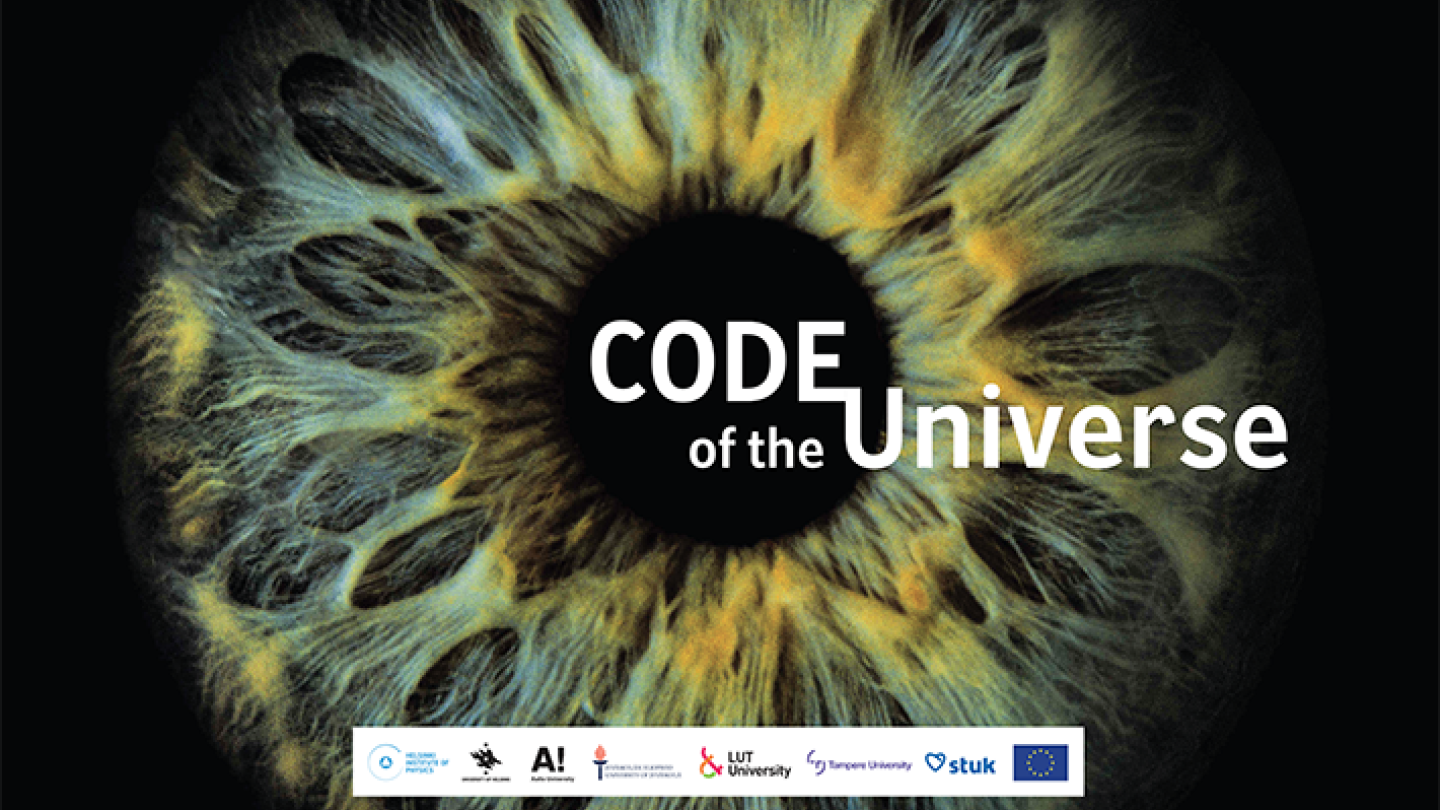
Code of the Universe is a travelling photo exhibition that explores humanity’s quest to understand the complexity of the surrounding reality. The exhibition consists of 40 illuminated panels presenting key open questions in modern physics.
Through the impressive photos and thought-provoking stories, the exhibition gives a view on how international cooperation on fundamental scientific issues has deepened our understanding of physics. This work has also enabled breakthroughs, and various accelerator technologies developed based on these, which have become increasingly and more concretely visible in our everyday life.
The exhibition invites visitors to ponder: What does the Universe consist of? What rules do make life possible – and why, in general, is there something instead of nothing?
In addition to big questions, the exhibition also demonstrates the practical effects of ground-breaking research and shows how accelerator technologies promote innovations with applications in the fields of medicine, energy and many other areas.
The exhibition is produced by CERN, the European Organization for Nuclear Research, and in addition to Jyväskylä, will also tour in Tampere, Lahti and Helsinki in Finland.
The JYU Department of Physics is a globally significant research unit for particle, nuclear and quantum physics. The Accelerator Laboratory is the largest research device constellation of this field in Finland. The Department’s researchers are involved in the ALICE and ISOLDE experiments at CERN.
“Particle physics research calls for massive investments and resources, which has led to collaborations involving hundreds of universities and research institutes at CERN,” explains Associate Professor Sami Räsänen from the Department of Physics at the University of Jyväskylä. “Experimental LHC collaborations, consisting of thousands of researchers across the world, work together to address the ultimate questions of nature as to what matter basically is. Experimental research serves as a driver for technological development and also contributes to the advancement of measuring techniques applied in hospitals, for example, as well as to the processing and analysis of large datasets.”
The exhibition is partly funded by the EU’s Horizon 2020 Framework Programme. Entry to the exhibition is free.
Programme for the exhibition opening Mon 18 May, 6:00–6:30 p.m., at Ruusupuisto Square (Alvar Aallon katu 9). The event is open to all. Welcome!
- Music, Ruamjai Choir
- Welcoming words, Professor Juha Muhonen
- Quark matter research at JYU Department of Physics, Associate Professor Sami Räsänen, Finland’s team leader in the LHC ALICE experiment at CERN
- Music, Ruamjai Choir
- An opportunity to discuss the exhibition with physicists


