Entrepreneurship research today and in the future was discussed at the BOOST 2 networking workshop in April
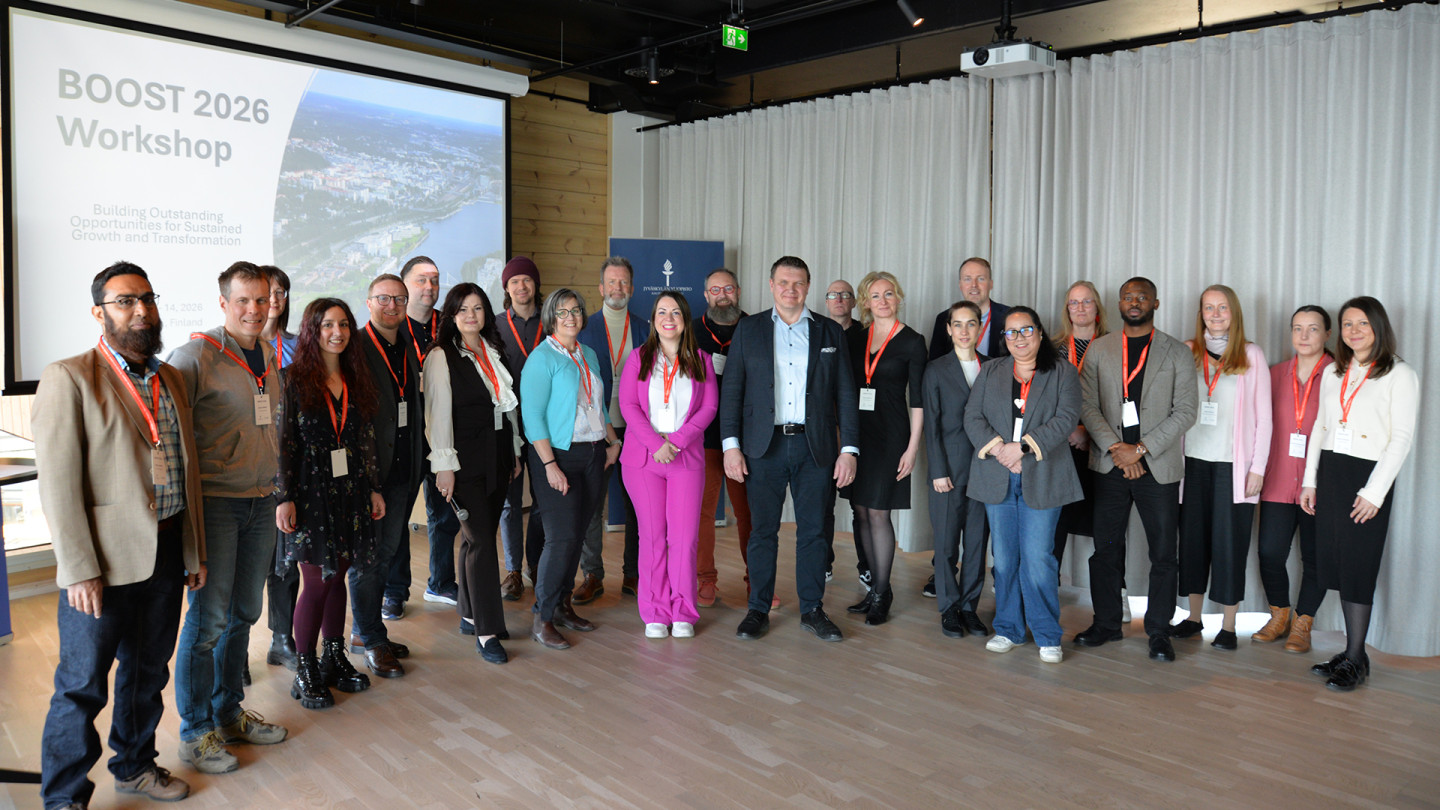
BOOST 2, a two-day research development workshop, gathered researchers, journal editors, and industry experts in the fields of entrepreneurship, strategy, and management. The main goal for the event was offering the opportunity for participants to receive in-depth, constructive feedback on their ongoing research projects from senior scholars in entrepreneurship and management.
"Societal impact is an important part of our university activities. We encourage the sharing of ideas and networking," said Pasi Raiskinmäki, Vice Rector at the University of Jyväskylä, when he opened the event.

Keynote by Professor Christina Theodoraki: "Entrepreneurial ecosystems in time of change: Coordination, adaptation, and growth"
Professor Christina Theodoraki said that entrepreneurial ecosystem research has been reaching the maturity point of the first era and now we're heading in our next era. The focus is now on more micro-foundational approach, multi-level approach, not only studying the macro perspectives.
“We see that we're trying to find out the dynamics of success,” said Theodoraki.
She continued that another part of interest is technological inspiration.
“How, for example, some specialized industry or technology advancement will have an influence of the habits of the ecosystem. For example, we see the focus on high-tech, high-growth firms, artificial intelligence, that completely change also the way of the ecosystem perform, but also there's some industry focus. We see also that focus on sustainability and inclusiveness, these are targeted also for ecosystem.”

One important thing in developing an entrepreneurship ecosystem strategy is cultural aspect, we need to be very aware of entrepreneurial culture.
“That means that we are tolerate entrepreneurial failure,” told Theodoraki. “This is something that in Europe it's not, it's evolved, but it's not yet at the levels of Silicon Valley. We see that in Silicon Valley, the entrepreneur is a hero. And even though she or he fails, she or he is not stigmatized by society. While in Europe, the entrepreneurial failure is not well perceived. If you fail a company once, it's like you don't have any other possibility to recover. So, we need to change this mindset about entrepreneurship.”
Theodoraki said that when we're thinking about entrepreneurship, it has been studying entrepreneurship by studying one person, the entrepreneur and its behavior, and sometimes the company and its operations.
“However, by putting the accent to the ecosystem, this ecosystem lens, we put the entrepreneur in the context. Using this ecosystem lens allows us to really perceive the potential of entrepreneurs, and what they can implement.”
Keynote by Professor Kim Klyver: "Entrepreneurship in a poly-crisis world: Why context matters more than ever"
Professor Kim Klyver said we are moving from talking about single crisis that happens rarely and disrupts and then getting back to normal, to poly-crisis world.
“Now we are facing a poly-crisis, where we have several crises overlapping, internally entangled and creating unpredictable synergies. And those poly-crisis together create a crisis that influenced the operations of the businesses,” said Klyver.

According to Klyver, we need to think about entrepreneurship in a different way, because we're not in normal times.
“We don't have crisis as an event, but we have crisis as context,” said Klyver. “We're in constant adversity caused by a crisis. And that essentially means assumptions about returning to normal become irrelevant. It also becomes very hard for the firms or new ventures or the entrepreneurs to control their environments. So rather than trying to control the environment, they must control how they react to the crisis environment. For instance, hope and courage become important.”
Klyver pointed out that resilience becomes irrelevant because resilience is about bouncing back, getting back to normal.
“That might be replaced by antifragility which is essentially about using the uncertainty and the instability as a source of growth and source of development.”
Klyver also said that in poly-crisis world entrepreneurs and businesses need to learn and change their way of thinking about their business to survive.
“You need to have different procedures, different rules, you need more flexibility and you need antifragility. And if you don't learn that, you're probably less likely to survive in this new business environment.”
Industry keynote by Dr. Vilja Laaksonen: "The growth paradox: Why strategy struggles to become everyday practice?"
Vilja Laaksonen, CEO of Aava & Bang, said that strategy does not translate into growth, and that is the Finland’s greatest growth challenge. According to research findings, the strategy-to-practice gap is not an isolated phenomenon. It is a structural challenge that repeats year after year (employee net promoter score (eNPS) variation by respondent role from 2023–2026).
“AI appears in strategy documents but not in everyday organizational structures. Its use is left to individuals, which fragments practice and increases ethical risk,” told Laaksonen.

Laaksonen said that the best organizations do not do more things. They do fewer things but together, and with purpose.
“Organisations don’t fail because they don’t grow, but because people can’t keep up with the growth.”
"For me, leadership is the gap between what's decided and what actually happens. Four years of research data show that the problem isn’t the quality of the strategy. It is the journey from the management team's room to everyday practice," Laaksonen summarized.
Industry keynote by Dr. Kari Aho: "Secapp – from research innovation to a high growth company"
Kari Aho, CEO of Secapp, said that their company had several products right from the start and that the last few years have been a period of strong growth. The market looks good.
“75 % organizations are still relying on tools not meant for crisis response. Majority of the practitioners are dissatisfied, and response times are long, and crisis response plans fails due to lack of response,” said Aho.
Aho's data brings the real-world consequences of poor crisis management into sharp relief, reinforcing why rigorous research into crisis response processes, tools, and organizational preparedness remains both timely and essential.

***
BOOST 2 was a co-branded event with European Council for Small Business and Entrepreneurship. Other sponsors were Yksityisyrittäjäin säätiö, the Foundation for Economic Education (Liikesivistysrahasto), and the University of Jyväskylä. The BOOST workshop was organised by Dr Daria Hakola and Dr Mari Suoranta, Jyväskylä University School of Business and Economics, Strategy and Entrepreneurship research group.