
JSBE Professor Mikko Rönkkö wins Best Paper Award from Organizational Research Methods
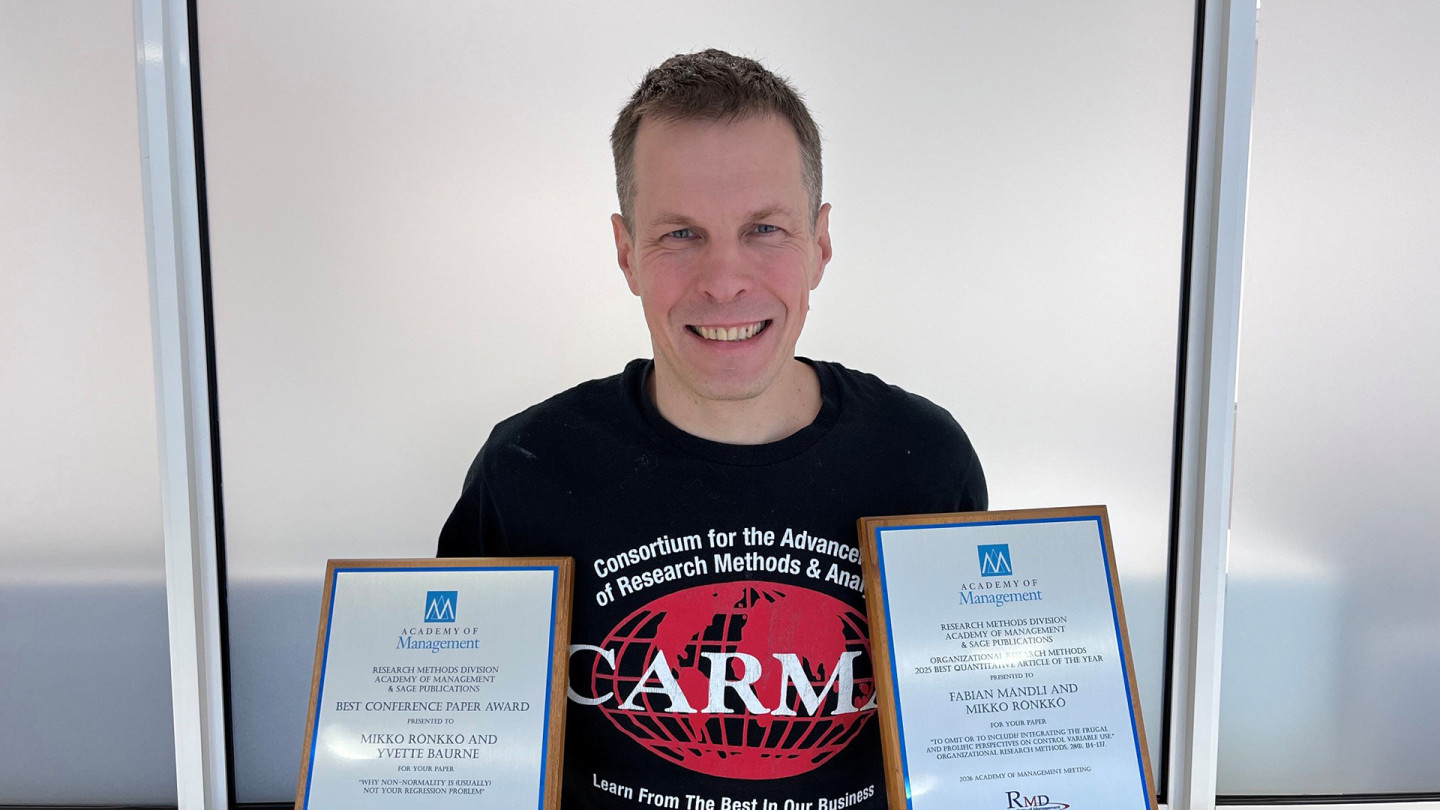
The award was presented by the Research Methods Division (RMD) of the Academy of Management (AOM) at the 86th Annual Meeting of the Academy of Management in Philadelphia (July 31 – August 4, 2026). The winning paper, titled “To Omit or to Include? Integrating the Frugal and Prolific Perspectives on Control Variable Use”, was selected by the editorial team of Organizational Research Methods (the premier methods journal in management and one of the most influential journals in both management and applied psychology) as the outstanding quantitative methodology article published in the journal in 2025.
For Professor Mikko Rönkkö, who has served as an Associate Editor (AE) with Organizational Research Methods since 2024, this marks his second time winning the ORM Best Quantitative Article of the Year Award, following his 2022 win. For lead author Dr. Fabian Mändli, Postdoctoral Researcher at the University of Bern, receiving the award for his very first published journal article represents a defining milestone on the international stage.
In addition, Rönkkö (together with JSBE postdoctoral researcher Yvette Baurne) won the Research Methods Division Best Conference Paper Award at the same meeting, alongside a shortlist nomination for the Best Professional Development Workshop (PDW) Award. Receiving both the best conference paper and the best journal paper awards in the same year is an unprecedented achievement in the division’s history.
Resolving a pervasive methodological dilemma
Control variables are ubiquitous across quantitative empirical research in management, economics, psychology, and the social sciences. Whenever researchers attempt to demonstrate that a business strategy, management practice, or intervention causes a change in performance, they must rule out alternative explanations. However, how researchers should choose control variables, especially when theoretical guidance is ambiguous, has long divided the field into two competing camps, which Mändli and Rönkkö categorize as the frugal perspective and the prolific perspective:
- The “Frugal Perspective”: Prevalent in management guidelines (e.g., Becker, 2005; Carlson & Wu, 2012), this view urges researchers to keep models sparse: “When in doubt, leave them out.” Proponents argue that unnecessary controls consume statistical power, cause multicollinearity, and complicate interpretation.
- The “Prolific Perspective”: Rooted in econometrics and championed by methodologists such as Antonakis and colleagues (2010), this view advises researchers to “err on the side of caution by including more than fewer control variables.” Because omitted variable bias poses a severe threat to causal inference, whereas adding irrelevant exogenous regressors does little harm, this view favors generous inclusion.
Mändli and Rönkkö conducted two systematic literature reviews of top management journals, uncovering a striking paradox: while methodology guidelines routinely state that controls must be justified by theory, applied researchers in practice overwhelmingly rely on mechanical, statistical rules of thumb promoted by the frugal perspective to decide what to include or drop.
To address this dilemma, Mändli and Rönkkö evaluated the claims of both perspectives by comparing their recommendations against econometric theory, reviewing current research practice, and running three extensive Monte Carlo simulations.
Their results challenge the frugal perspective’s popular rules of thumb, showing that omitting weakly correlated “impotent” controls or avoiding imperfect proxies can cause severe omitted variable bias. At the same time, the authors demonstrate that uncritical prolific inclusion is equally hazardous, as adding endogenous “bad controls” introduces severe bias.
To resolve the debate, the study proposes an integrated framework that moves beyond the simplistic question of whether to include few or many variables, recommending instead that researchers select controls strictly based on causal theory using directed acyclic graphs (DAGs) while carefully screening out endogenous variables.
From a doctoral classroom assignment to an award-winning paper
Behind the publication lies a compelling story of academic mentorship and curiosity. The project originated in a doctoral classroom at HEC Lausanne, where Professor Rönkkö was a visiting instructor teaching a doctoral course on causal claims.
For the final course assignment, students were challenged to take a common methodological rule of thumb from the literature and put it to the test using Monte Carlo simulations.
“I had long been skeptical of the advice in our literature telling researchers to omit so-called ‘impotent controls’, referring to variables that do not have a statistically significant bivariate correlation with the dependent variable,” recalls Rönkkö. “I suspected this advice was fundamentally flawed, but I had no empirical proof to demonstrate it. So, I included it on the list of course assignments.”
Fabian Mändli, then a PhD student in the course, chose the topic. His simulations produced striking results, demonstrating that the conventional advice was indeed misleading. Recognizing the broader significance of the findings, Rönkkö encouraged Mändli to develop the work into a full journal manuscript, offering to co-author and mentor the project.
“What started as a classroom assignment quickly grew into a project addressing questions with immediate, daily consequences for applied researchers,” says Dr. Fabian Mändli. “Having a course project evolve through student-mentor collaboration into my very first journal publication, and now receiving this award, has been an incredible experience.”
Reproducibility, open science, and AI replication
A cornerstone of the award-winning research is its commitment to open science, computational reproducibility, and transparency. Mändli and Rönkkö made their complete simulation code open source in both R and Stata, running in mere minutes so that scholars, educators, and doctoral students worldwide can replicate the findings, explore alternative parameter settings, and adapt the scripts for their own projects.
In addition to serving as a core teaching resource in doctoral seminars, Rönkkö has used the article as an empirical benchmark to test how effectively generative AI coding agents can independently reproduce published quantitative research from the article PDF.
An initial test in March 2025 with Claude 3.7 Sonnet required an hour of prompting, as the model struggled to interpret equations in figures and required human intervention to fix code bugs. By November 2025, models showed dramatic improvement: Claude Sonnet 4.5 accurately reproduced the simulation in just 10 minutes with minimal guidance. Later that month, Gemini 3 Pro set a new benchmark by becoming the first model to achieve complete, accurate reproduction with zero human intervention in just five minutes.
In December 2025, a final replication attempt with Claude Opus 4.5 ended with an unexpected outcome: the model refused to run the replication because its meticulous reading of the text detected a typographic error in a reported statistic, concluding that the paper was internally inconsistent and could not be replicated.
See also & further resources:
- Award-Winning Article: Mändli, F., & Rönkkö, M. (2025). To Omit or to Include? Integrating the Frugal and Prolific Perspectives on Control Variable Use. Organizational Research Methods, 28(1), 114–137. https://doi.org/10.1177/10944281231221703
- Behind the Paper: Video Interview with the Authors: Watch Dr. Fabian Mändli and Prof. Mikko Rönkkö discuss the origins of the paper, the review process, and future directions on Organizational Research Methods YouTube channel.
- AI Agent Replication Screencasts:
Watch autonomous AI coding agents replicate the study’s simulation and Figure 4: - AOM Research Methods Division (RMD) Publication Awards
- Academy of Management (AOM)
Further information:
Mikko Rönkkö
Professor of Entrepreneurship
Jyväskylä University School of Business and Economics (JSBE)
University of Jyväskylä, Finland
Email: mikko.ronkko@jyu.fi
Fabian Mändli
Postdoctoral Researcher
Faculty of Business, Economics and Social Sciences
University of Bern, Switzerland
Email: fabian.maendli@unibe.ch


