JYU is once again the best university in Finland for publication openness
The University of Jyväskylä (JYU) also achieved the highest openness score among universities, at 88 per cent, for the openness of all its publications.
In 2025, the top three in terms of openness at JYU were the Faculty of Information Technology (98%), the School of Business and Economics (97%) and the Faculty of Sport and Health Sciences (96%), where the openness of peer-reviewed publications is already approaching 100 per cent.
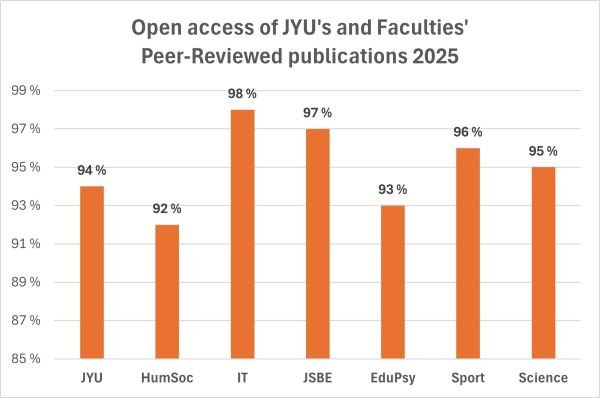
FIGURE 1. Openness of peer-reviewed publications at the University of Jyväskylä and its faculties in 2025
This result reflects a strong commitment to open science in day-to-day research work.
I am extremely proud and delighted with the open access results achieved through the collaboration between our university’s researchers and the Open Science Centre, and I would like to offer my warmest congratulations and thanks! By being open, our publications gain greater visibility and are widely accessible without paywalls. In this way, research findings are disseminated more widely and effectively and have a greater impact as they are cited more frequently, commented Kaisa Miettinen, Vice-Rector for Research and Doctoral Education at the University of Jyväskylä.
Self-archiving expands open access
In 2025, a total of 2,601 peer-reviewed publications were published at the University of Jyväskylä, of which 2,441 are openly available. 71 per cent were published either in fully open-access journals or in hybrid journals, where individual articles can be published openly for a separate publication fee.
Almost a quarter (23%) of the peer-reviewed publications, on the other hand, were made open access by depositing them as either the publisher’s version or the peer-reviewed manuscript in JYU’s open JYX publication archive.
Self-archiving is an easy and cost-free way for researchers to ensure their work is openly accessible, even when it is not published in an open-access journal. Openness increases the visibility and impact of research, as publications reach a wider audience both within and beyond the academic community, notes Jutta Aalto, Head of Services at the Open Science Centre of the University of Jyväskylä.
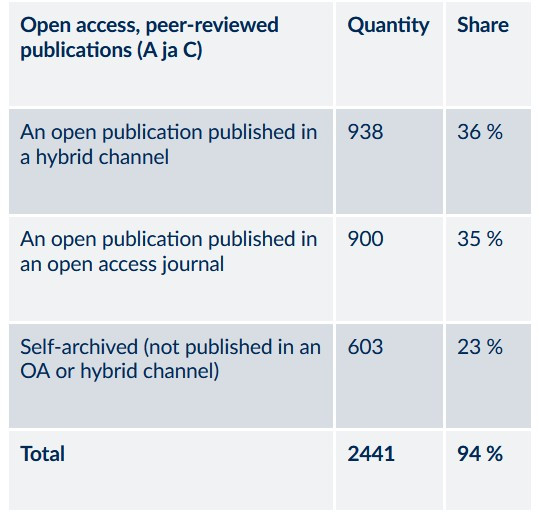
FIGURE 2. Openness of peer-reviewed publications by publication channel: hybrid OA, OA channels and self-archiving.
Working together with departments brings results
The Open Science Centre (OSC) at the University of Jyväskylä promotes open science by taking into account the entire research process, from research design to publication and the opening up of research data. The OSC supports researchers, teachers and students by offering a wide range of training and guidance on open publishing, as well as developing practices and services related to openness.
In 2025, the OSC’s publishing services enhanced self-archiving by systematically contacting authors who had not yet submitted their publications for self-archiving. At the same time, cooperation with faculty and department management was strengthened to ensure the quality of publication statistics and to make publications openly available. This collaboration with departments is now paying off in terms of publication openness.
New tools and guidelines to support open publishing
Work to promote openness continues. In early 2026, the University of Jyväskylä became the first in Finland to adopt the Open Journal Finder service, which allows researchers to easily search for open publication channels. Researchers at the University of Jyväskylä can make use of open access publishing agreements negotiated with academic journal publishers, in which the costs of publication are included in the library’s journal subscription licence fees. Using Open Journal Finder, authors can check whether a journal is covered by these agreements. This expanding service will in future also include Finnish open access journals.
Furthermore, the RRS policy (pre-licensing model), launched in March 2026, further strengthens researchers’ opportunities for openness: researchers can pre-license and open-access publish all their peer-reviewed articles without separate authorisation processes and without an embargo.