
PISA 2025: Students in Finland still perform well above OECD average in science
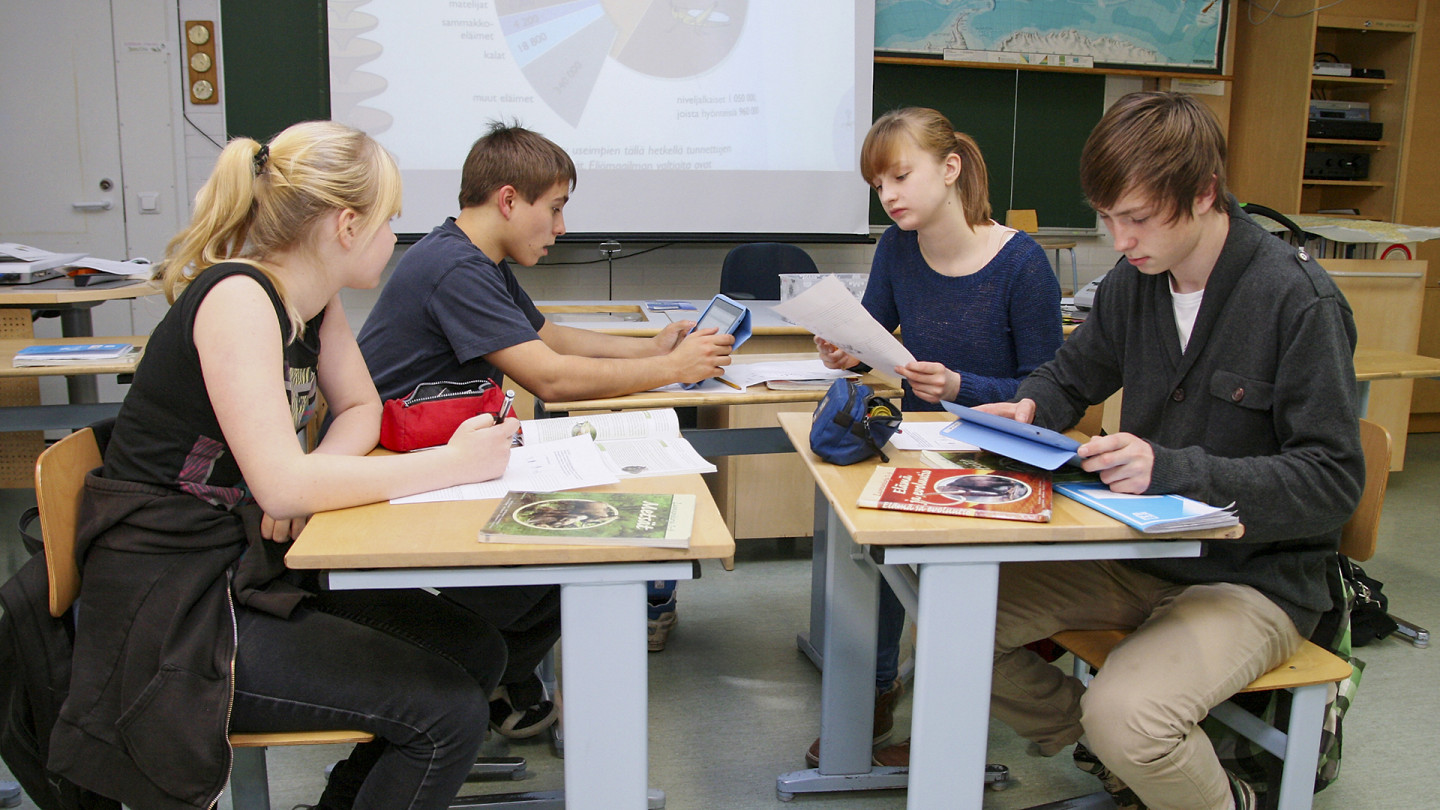
The average science score among students in Finland was 504 score points, well above the OECD average of 482 score points. Among the 91 participating countries and economies, students in Finland remained among the top performers.
The highest science score was recorded by B-S-J-Z (China) (Beijing, Shanghai, Jiangsu and Zhejiang), with an average of 597 score points, followed by five other East Asian countries and economies.
Estonia, Canada and the United Kingdom also outperformed Finland. New Zealand*, Australia, the United States*, Switzerland and Ireland performed at a similar level to Finland. Among the other Nordic countries, Sweden's result (485) did not differ from the OECD average, while Denmark (478), Norway* (470) and Iceland (441) scored below the average. Finland's science result did not differ statistically significantly from its 2022 result (511), but the longer-term downturn remains clear.
Declining performance on reading and mathematics across OECD countries
Students in Finland continued to outperform (474 points) the OECD average (461 points) in reading literacy. Fourteen countries and economies achieved a statistically significantly higher average score than Finland. Among the other Nordic countries, Sweden's reading score (466) was also above the OECD average, while Denmark (460), Norway (453) and Iceland (422) scored below it. Compared with the previous assessment, average reading literacy deteriorated in 43 countries and economies and improved in nine. Among students in Finland, the reading score fell by 16 points, matching the average decline across OECD countries.
Finnish students scored an average of 469 points in mathematical literacy, remaining above the OECD average of 463 points. Nineteen countries and economies performed statistically significantly better than Finland in mathematics. Among the Nordic countries, Denmark (470) and Sweden (464) performed at the same level as Finland. Norway (452) and Iceland (450) scored below both Finland and the OECD average. As with reading, mathematics performance has widely deteriorated. The OECD average fell by 8 points compared with the previous assessment.
In both reading and mathematics, the share of low-performing students has continued to rise, while the share of top performers has dropped. In Finland, these changes have been more pronounced than the OECD average.
"Although learning outcomes have declined and performance gaps between students have widened, Finland continues to perform well by international standards. Finnish students also believe they can influence how successful they are. These are positive findings," says Minister of Education Anders Adlercreutz.
"Nevertheless, we have every reason to take the decline in learning outcomes seriously. During this government term, we have undertaken a comprehensive programme to strengthen and develop basic education. I am confident that these measures will strengthen learning and improve students’ knowledge and skills. However, the impact of these measures on learning outcomes will take time to become visible. Learning requires persistence and determination. Every child deserves the opportunity to learn, succeed and build a good future for themselves," the Minister says.
Finland above OECD average in Learning in the Digital World
In addition to the core domains, each cycle assesses an innovative domain. For PISA 2025, this domain was Learning in the Digital World, with computational problem solving as a key component. Finnish students scored an average of 507 points in computational problem solving, statistically significantly above the OECD average of 500 points.
East Asian countries and economies also led this assessment domain. Finland performed at a similar level to 12 countries, including the Nordic countries of Denmark (506) and Sweden (503). Performance in Norway and Iceland was below the OECD average.
No change in performance gaps between girls and boys
Girls continued to outperform boys in reading and science. The gender gaps remained unchanged from the previous assessment cycle. Compared with 2022, performance declined to almost the same degree among girls and boys. There was no performance gap between girls and boys in mathematics. In computational problem solving, girls scored an average of 509 points and boys 505 points. The difference was not statistically significant.
Large performance gap remains between immigrant and non-immigrant students
Of the students who took part in the survey in Finland, 93 per cent were non-immigrant students, 3 per cent were second-generation immigrant students and 4 per cent were first-generation immigrant students. The average science score for non-immigrant students was 517 points. The corresponding score was 444 points among second-generation immigrant students and 417 points among first-generation immigrant students. Compared with PISA 2022, no statistically significant changes were observed in any group's performance. In computational problem solving, the performance gaps between non-immigrant students (515 points), second-generation immigrant students (481 points) and first-generation immigrant students (479 points) were smaller than in the other assessment domains.
Performance declines in Swedish-speaking schools, Learning in the Digital World exceeds that in Finnish-speaking schools
Science performance among students in Swedish-speaking schools (495) dropped from the 2022 assessment (526) and was lower than among students in Finnish-speaking schools. In reading and mathematics, there were no differences between students in Swedish-speaking and Finnish-speaking schools. Performance in computational problem solving was strong in Swedish-speaking schools. Students attending Swedish-speaking schools achieved an average score of 520 points, compared with 506 points among students attending Finnish-speaking schools. In addition, students in Swedish-speaking schools clearly outperformed their peers across OECD countries and in the other Nordic countries.
Impact of socio-economic status on performance close to OECD average
Students' socio-economic background had a clear impact on performance. In Finland, its effect was comparable to that in the other Nordic countries and the OECD average. The gap in science performance between students in the highest and lowest socio-economic quarters was 78 points. Over the longer term, the gap has remained unchanged. Compared with the previous PISA assessment, science scores declined statistically significantly only in the highest socio-economic quarter, where the drop was 12 points.
Differences between schools remain small, differences between students continue to grow
Differences between schools in Finland remained small compared with the OECD average and unchanged from the previous assessment cycle. However, performance differences between students within schools increased and were considerably greater than the OECD average.
No regional differences were observed in science or mathematics performance across Finland. In reading, however, students in Northern Finland achieved a higher average score than students in Eastern and Southern Finland. As in previous assessment cycles, schools in large cities achieved the highest scores in all assessment domains.
School remains meaningful, perseverance needs improvement
In addition to student performance, PISA collects extensive information on students' attitudes towards school. Students in Finland reported a stronger sense of belonging and viewed school as more meaningful than students across OECD countries on average. Even so, only three quarters of students in Finland agreed that they had learned things at school that could be useful in the world of work. When assessing their own perseverance, students in Finland stood out from their peers across OECD countries. Finland had the smallest share of students among all participating countries and economies (41%) who agreed with the statement: “I apply additional effort when work becomes challenging”.
Students find digital devices less distracting than before
The survey also examined the extent to which digital devices disrupt learning in the classroom. In Finland, 26 per cent of students reported that they became distracted using digital devices in every lesson or in most lessons (OECD average: 28%). In the previous assessment cycle, as many as 41 per cent of students in Finland reported that they became distracted using digital resources in all or most mathematics lessons. It should be noted that Finnish legislation restricting the use of mobile devices in classrooms entered into force only after data collection for this study had been completed.
Inquiries:
- Ninja Hienonen, University Lecturer (PISA results; computational problem solving), tel. +358 50 318 2273
- Tommi Karjalainen, Senior Ministerial Adviser, tel. +358 295 330 140


