Q&A with Professor Teiko Heinosaari, recipient of Nokia and OKKA Foundations’ teaching recognition award

The interview was conducted by InstituteQ and originally published on the institute’s website. Read the interview on the InstituteQ blog.
University of Jyväskylä Professor Teiko Heinosaari has received a distinguished award for his contributions to public outreach and education on the topics of quantum physics and computing.
Heinosaari is the second such recipient of this annual teaching recognition award, which was presented by Nokia and OKKA Foundations during a November 25 award ceremony.
Among Heinosaari’s important contributions to quantum science outreach and education include his publicly available, three-part ABCs of Quantum Computing (Kvanttilaskennan aakkoset) course. This self-paced course introduces users to the basics of quantum information and computing from fundamental principles all the way through advanced-level topics.
Additionally, Heinosaari started and cohosts the monthly Kello Viiden Kvanttitee (5 o’clock quantum tea) talk series, which has amassed impressive public attendance and guest lecturers.
Heinosaari is professor of physics in the Faculty of Information Technology at the University of Jyväskylä. His Quantum Information and Computation research group is part of InstituteQ. Additionally, Heinosaari is part of both the Finnish Quantum Flagship and the Quantum Doctoral Pilot Programme (QDOC) – both of which are hosted within InstituteQ.
We take a deep-dive into Heinosaari’s teaching philosophies, research interests, public outreach work and much more in the Q&A interview, published below.
This interview has been edited for clarity and brevity.
You've been recognized with a distinguished teaching recognition award by the Nokia and OKKA foundations. What does this award mean to you personally?
It means a great deal to me. It is not necessarily common for people to dedicate considerable time to outreach activities and public education, so receiving this kind of recognition feels very good. It also tells me that colleagues appreciate these activities and consider them valuable.
What makes it particularly meaningful is that the recognition came from outside my own organisation. My faculty has supported and encouraged my work, which I appreciate, but this award shows that people elsewhere have also noticed what I'm doing. It tells me that they see value in it, and that gives me a lot of motivation to continue.
It seems you have made it almost a personal mission to educate the broader public about quantum science and technology, as can be seen with the Quantum ABCs and Kello Viiden Kvanttitee. What is the underlying inspiration in these outreach efforts?
These activities have become a significant part of my work over the past three years. When I moved from the University of Turku to the University of Jyväskylä, I also moved from a physics department to the Faculty of Information Technology. That gave me a practical challenge: how do you teach the fundamentals of quantum theory and quantum information to students who may not have a background in physics?
I enjoy having a personal project that gives direction to my work, and this teaching challenge gradually developed into something broader. It led to the Quantum ABCs course series and, alongside that, other efforts to find accessible ways of explaining quantum science.
I also feel that there is a responsibility here. Society is investing increasingly substantial resources in quantum science and technology, through organisations such as the Research Council of Finland and Business Finland. I think it is important that we, as scientists, make an effort to explain what we are doing and why it matters. I'm not suggesting that everyone needs to do the same kind of outreach, but I believe it is valuable to help people understand what these investments are about.
Can you elaborate a bit for those who don't know about the Kello Viiden Kvanttitee event you cohost?
I wanted to find a setting where I could try out different ways of explaining quantum physics to a general audience. My wife is a tea enthusiast, and through her I knew about the Tea Lady (Teeleidi) and its tea house, where Anne Savela was already organising different kinds of events. I approached her with the idea of holding a quantum-themed event there, and she welcomed it.
We have now held 20 meetups. Quite early on, I realised that it would be even more valuable to invite colleagues to give talks as well. That way, I could hear how other people approach explaining their research, and we could exchange ideas. Over time, it has become a more communal effort. These days, it is actually more common for someone else to give the talk than for me to do so, and I'm very happy about that.
Can you also elaborate about the Quantum ABCs and for whom this is intended?
The Quantum ABCs began with the idea of teaching quantum information to students in the Faculty of Information Technology, including those without a physics background. But I decided to set the entry level of the first course quite low, so that it could also be taken by people who are simply curious about the subject.
The series consists of three self-paced online courses. The first course, A, is intended for a broad audience, including high school students, and does not require any mathematics. The second course introduces some of the mathematical language used in quantum information, such as matrices, without assuming that students already know it. The third course is an intermediate-level course, comparable to a standard quantum computing textbook.
The courses are built around interactive exercises that are automatically evaluated. We try to follow a learning-by-doing approach as much as possible. They are available beyond the University of Jyväskylä, and students from other universities have also taken them. The aim is to make the material accessible to people at different stages, whether they are just discovering quantum science or looking to develop a more substantial understanding.
How do you see public comprehension of quantum science and technology having changed over the last 10–20 years?
It is difficult to evaluate exactly what the general public understands about quantum science, but I think one clear change is that people are now encountering the word quantum much more frequently. Quantum computing and quantum communication appear in the news, and quantum science is no longer something people only know exists in physics textbooks. There is growing awareness that these technologies could play a role in the future, and that has generated interest.
As scientists, we can help by explaining what we do and giving people a sense of what the field is about. A public lecture or outreach event may not constitute education in the deeper sense, but it can offer an introduction and a flavour of the research. I think that is very important in a modern society that increasingly relies on science and technology.
Quantum mechanics is often portrayed as an exceedingly complex and paradoxical area of physics. Do you believe this is the case? Is there a different narrative you would wish to promote about the field?
Quantum mechanics is difficult, but I don't think that is because its core principles are inherently complex or paradoxical. In fact, those principles are quite simple and systematic. The difficulty comes from having to abandon some of the assumptions and intuitions we have developed through everyday experience. With classical mechanics, thermodynamics or electromagnetism, we can often relate what we learn to things we already understand. Quantum mechanics requires us to rethink some of those intuitions.
There has perhaps been a tradition among scientists of presenting quantum mechanics as something only a select group of experts can understand. We sometimes reinforce that impression by reaching immediately for paradoxes and strange examples. I think that can be counterproductive. Quantum mechanics is a scientific theory, and it can be understood.
That doesn't mean we should make it seem ordinary or boring. There are genuinely fascinating phenomena that are very different from everyday experience, and those are wonderful ways to introduce the subject. But I would rather describe quantum mechanics as fascinating than mystical or paradoxical.
If you could use the platform of this recognition to elevate one message in particular, what would that be?
I would like to encourage my colleagues to keep finding new ways to teach quantum science and reach broader audiences. We are entering a new era, not only because of the growing importance of quantum technologies, but also because of artificial intelligence.
I think AI creates an opportunity to rethink some of our established approaches to teaching quantum mechanics. It gives us a reason to ask what students really need to understand and how we can help them develop that understanding. I have already heard encouraging examples from colleagues who are developing excellent new approaches to teaching the subject. I hope we continue that work and remain open to new possibilities.
What recent developments in the field of quantum science and technology excite you most?
I don't think there is one major development that I would single out. Much of my excitement comes from smaller results. Working with my team, we often find something new that interests me, sometimes on a monthly basis.
One of the things I find particularly exciting is that our understanding of quantum mechanics continues to develop. I don't think there is an ultimate level of understanding that any one scientist has reached. My own understanding grows every year, as I encounter new perspectives and make connections that I hadn't seen before.
Artificial intelligence also raises interesting questions about the future of scientific work. AI can already solve some problems and assist with calculations, but understanding remains essential. I think the ability to understand a problem, identify the right questions and decide what should be calculated will become increasingly important for quantum scientists. Rather than simply learning how to carry out calculations, we need to understand what those calculations mean.
What else is preoccupying your work or personal interests at the moment?
My main research interest at the moment is comparing classical and quantum information processing. I want to better understand which tasks, including relatively simple ones, can genuinely benefit from quantum information processing. These smaller insights can eventually contribute to the development of larger quantum algorithms and protocols.
But it is equally important to understand where quantum methods do not offer an advantage. Quantum information processing is not universally better. Classical information processing is often simpler and less expensive, so it makes sense to use classical methods wherever they are sufficient.
This question connects fundamental research with practical applications, particularly hybrid quantum computing, where the goal is to combine the strengths of classical and quantum information processing. In my group, we also study theoretical models that sit somewhere between classical and quantum theory, which can help us understand what distinguishes the two.
The University of Jyväskylä is part of InstituteQ. You personally are also involved in multiple InstituteQ projects, including the Finnish Quantum Flagship and the Quantum Doctoral Education programme. How do you see the importance of collaborative organisations like InstituteQ in a time when quantum science and technology are gaining more public attention and investment?
These collaborative structures have been very meaningful to me. Through InstituteQ, I now have many more opportunities to discuss and develop ideas with colleagues at other universities. For example, we recently brought together people interested in quantum science education for a meeting in Tampere. These kinds of discussions are important, and they are something we can actively develop through the InstituteQ network.
I also regularly exchange ideas with colleagues involved in InstituteQ's education activities. Kimmo Tuominen, who leads the EduQ pillar, and I have calls from time to time to discuss how quantum computing education is progressing and how we could develop teaching further. I also reach out to other colleagues, and these conversations have become a valuable part of my work.
I really enjoy that we are not working only within our own universities, but are talking to one another and developing things together. Having a network that connects people across institutions makes it easier to share ideas, learn from one another and build new initiatives for the benefit of the wider quantum community.
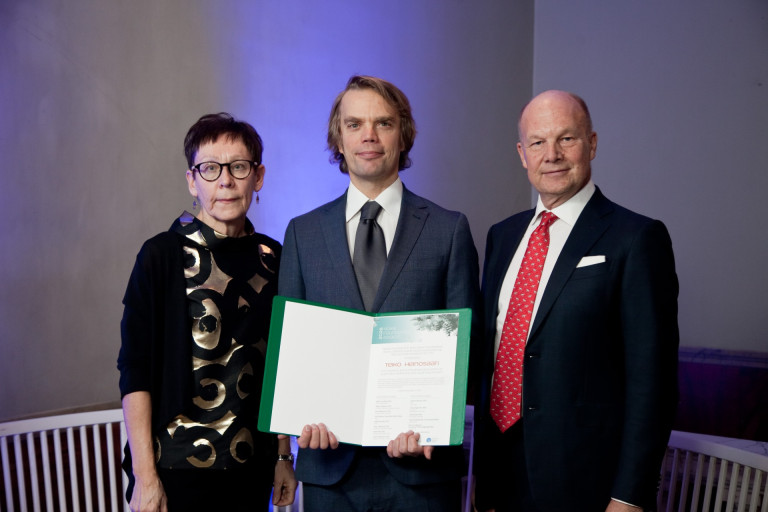
Professor Heinosaari received the award at the annual Nokia Foundation awards ceremony 26 November 2026. Photo: Mats Vuorenjuuri.