
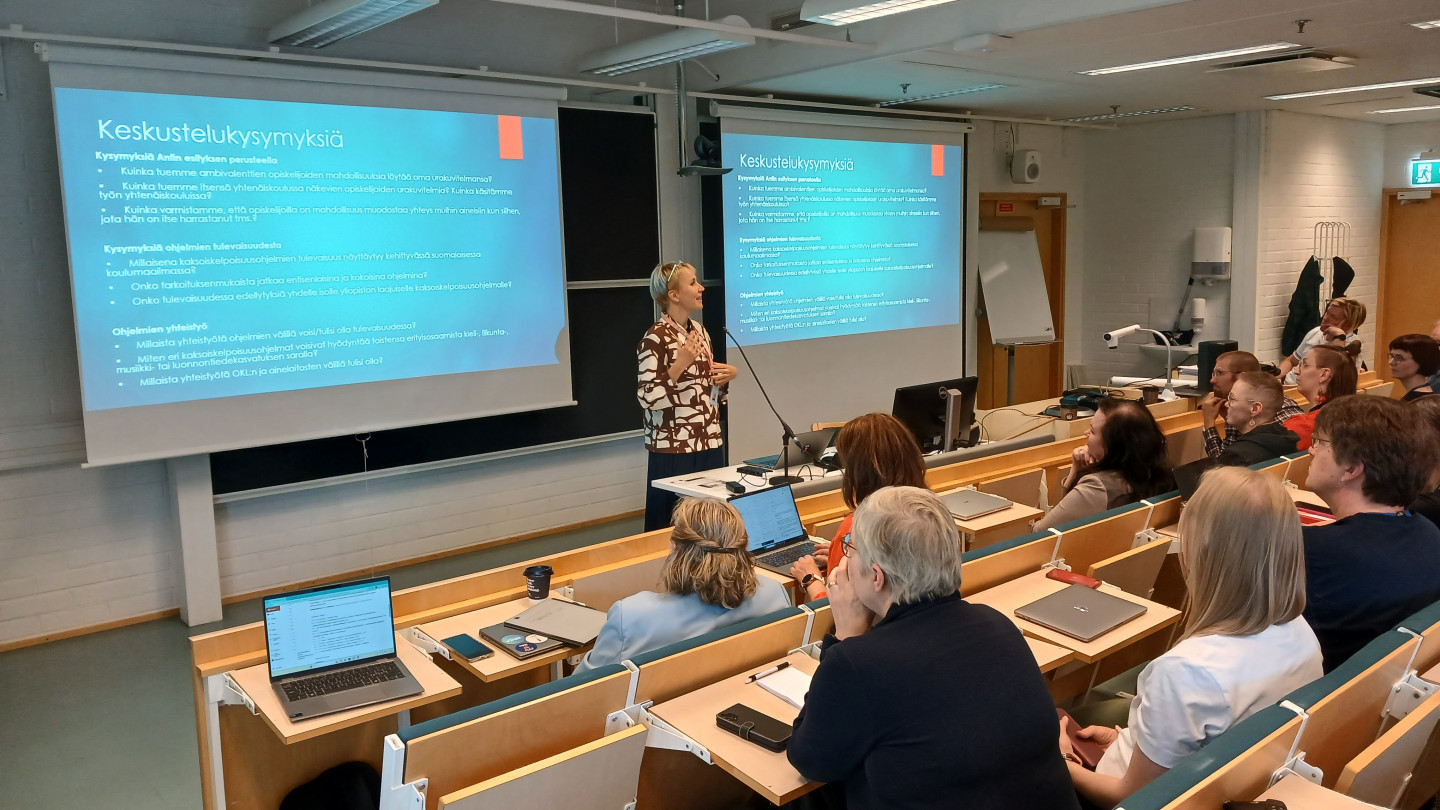
Stakeholders involved in teacher training programmes leading to dual qualifications met to discuss the development of the programmes
Although the training of class teachers and subject teachers has traditionally been delivered through separate degree programmes, the University of Jyväskylä offers four degree programmes leading to qualifications as both a class teacher and a subject teacher.
This dual qualification can be obtained in music, mathematics, physical education and the KIMO languages programme. The University of Jyväskylä has established itself as a nationally significant provider of training for dual-qualified teachers in order to better meet the educational needs of the future. Declining pupil numbers in many local authorities and the increase in the number of comprehensive schools are driving up the demand for dual-qualified teachers in the workforce. Dual qualification also creates new opportunities to combine expertise in a specific subject with the development of classroom teaching.
At a meeting on teacher training programmes organised by JYU.Edu, Senior Lecturers Maria Ruohotie-Lyhty, Antti Lehtinen and Juha Kokkonen presented a research project examining the development of professional identity and career aspirations among teacher training students with dual qualifications. According to preliminary findings, students entering dual-qualification programmes form a heterogeneous group with widely varying motivations for studying to become teachers and diverse career aspirations. However, in many cases, the decision to enrol in a dual-qualification programme was driven by an interest in working at different school levels, either simultaneously or at different stages of their career. Another commonality among the students was an understanding of the central importance of their chosen subject within holistic educational work.
During the day, presentations on various dual-qualification programmes were also given, providing an opportunity to compare practices and hear about the programmes’ strengths and areas for development.
Discussions focused, amongst other things, on the future direction of the programmes and their development as part of the ongoing curriculum work. The discussion raised, amongst other things, the question of whether the aim for dual-qualification students is to develop both a class teacher’s and a subject teacher’s identity, and what potential challenges this might entail.


