
Studying nuclear weak processes for neutrino and dark matter physics
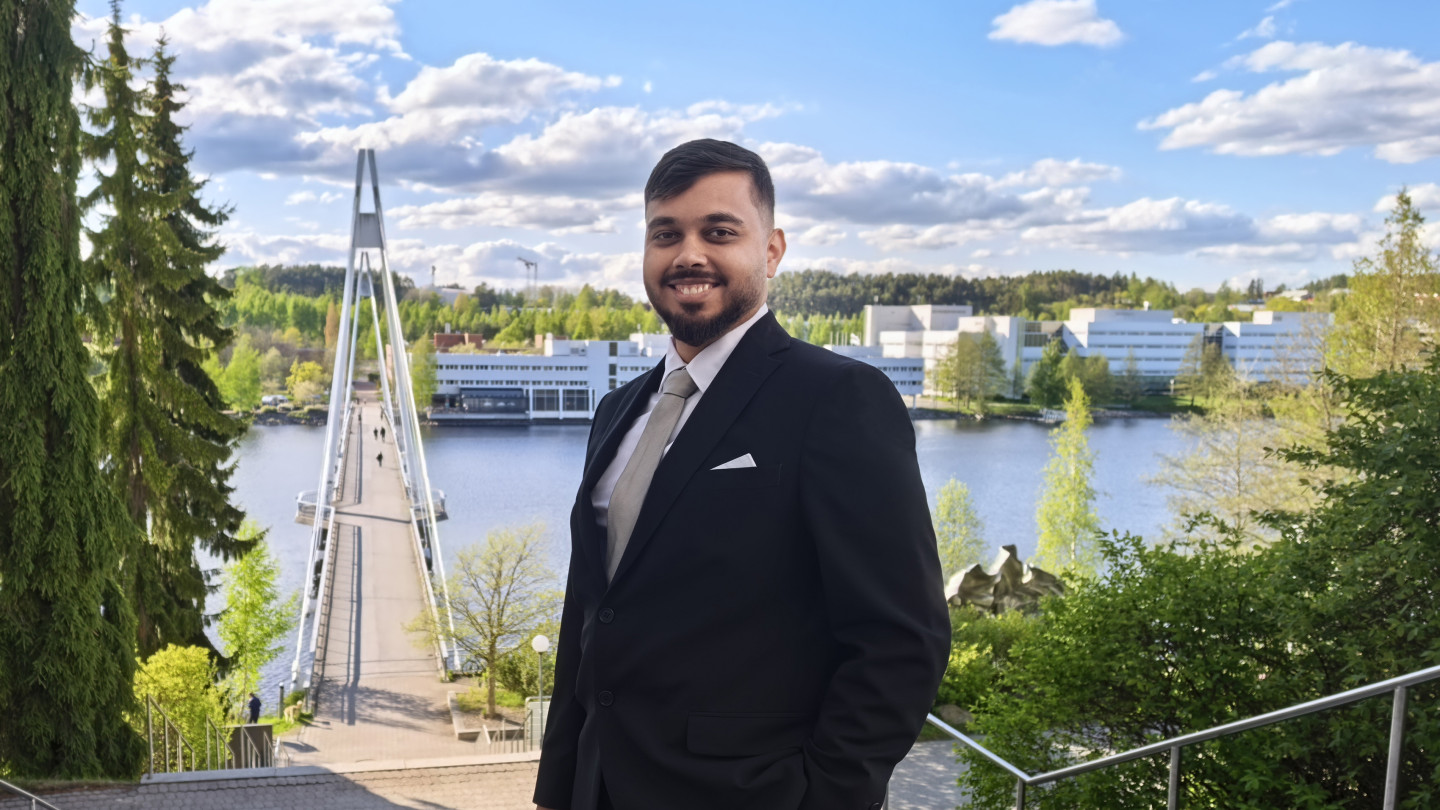
M.Sc. Aagrah Agnihotri has studied nuclear weak processes, including beta decay, ordinary muon capture, and neutrinoless double beta decay as an essential step towards further unraveling current physics beyond the Standard Model, including properties of neutrinos and dark matter.
Dark matter is the largest segment of matter known today to interact gravitationally with the contents of our universe, a mysterious key element in the cosmological evolution as we understand it today. Neutrinos are another fundamental mystery integral to this evolution, as they potentially hold the answer to the matter-antimatter asymmetry in our universe. The hunt to determine the properties of neutrinos and dark matter is among the most important pursuits in physics, and the study of nuclear weak processes can aid this purpose in an irreplaceable way.
Nuclear weak processes at the forefront of physics
Nuclear weak processes, which involve nuclei undergoing transformations mediated by the weak interaction, can illuminate the properties of neutrinos and dark matter. Neutrinoless double beta decay is a rare hypothetical second-order nuclear weak process; it is our best bet in determining the properties of neutrinos. Studying other nuclear weak processes, including single beta decay and ordinary muon capture, is needed to accurately evaluate the effective axial-vector coupling and nuclear matrix elements for neutrinoless double beta decay. Additionally, in relation to dark matter, electron-capture type beta decays can mimic the detection of exotic dark matter particles in the new generation of tabletop nuclear experiments.
New developments
The research addresses important issues, including giving theoretical constraints on rates of rare unknown electron-capture decays that can mimic the detection of exotic dark matter particles. Other issues addressed include establishing a novel method to determine effective axial-vector coupling in single beta-plus/electron-capture decays and investigating correlations between ordinary muon capture and neutrinoless double beta decay, which are necessary for studying neutrinoless double beta decay.
M.Sc. Aagrah Agnihotri defends his doctoral dissertation, "Study of Nuclear Weak Processes for Physics Beyond the Standard Model”. The event will be held on Friday 26.6.2026, 12:00 - 15:00 in Mattilanniemi Agora Auditorium 3 (Ag B103). Opponent is Professor Nunzio Itaco (University of Campania “Luigi Vanvitelli” and Istituto Nazionale di Fisica Nucleare), and custos is Senior Researcher Jenni Kotila (University of Jyväskylä). The event is held in English.
The link for live broadcast: Doctoral dissertation, Aagrah Agnihotri 26.6.2026 at 12:00, in Finnish local time (+03:00 Eastern European Time).


