Engaged pedagogies for the multilingual university: Reflections from the ICLHE Symposium 2026
In mid-October, I travelled to Winterthur, Switzerland, to attend the 2026 Integrating Content and Language in Higher Education (ICLHE) Symposium, hosted by the School of Applied Linguistics at ZHAW Zurich University of Applied Sciences, on 14-16 October 2026. The symposium brought together researchers, teacher educators and practitioners from across Europe and beyond, under the theme Engaged Pedagogies for the Multilingual University: Empowering Learners through Integrating Content and Language in Higher Education. For me, it was also a great opportunity to share findings from my ongoing Marie Skłodowska-Curie Postdoctoral Fellowship project, Multilingual and Multimodal Approaches in EMI for Enhancing Disciplinary Literacies (MultiAp-EMI).
The ICLHE Association is an international community concerned with the interface between content and language in higher education. Its members include researchers, educators, and other stakeholders interested in teaching and learning through additional languages in higher education. Through international symposia, regional groups and special interest groups, the association creates opportunities for networking and collaborative research. This year’s symposium was also an occasion to look back, as the ICLHE Board reflected on ten years of the association and outlined its prospects for the future.
Presenting MultiAp-EMI
I presented a paper titled Tracing the Dynamics of Knowledge Building in EMI Classrooms through Idiodynamic and Multimodal Approaches. The presentation drew on MultiAp-EMI, the project I am carrying out at the Centre for Applied Language Studies under Tarja Nikula’s supervision, with funding from the EU’s Marie Skłodowska-Curie Actions. MultiAp-EMI investigates how English-medium instruction (EMI) instructors across disciplines use multiple linguistic and semiotic resources in classroom interaction, and how these practices relate to students’ subject-specific knowledge building. The project builds on work begun in the COST Action network CLILNetLE (CA21114 - CLIL Network for Languages in Education: Towards bi- and multilingual disciplinary literacies) on conceptualising bi- and multilingual disciplinary literacies (BMDLs) (Nikula et al., 2026), and draws on data from EMI programmes in Finland and Türkiye.
In Winterthur, I also focused on the project’s methodological design, which combines the idiodynamic method with stimulated recall interviews to explore moment-by-moment fluctuations in students’ perceived understanding during key instructional episodes. Drawing on Legitimation Code Theory (LCT) (Maton, 2013), we explore how these fluctuations may align with shifts in the complexity of the disciplinary knowledge being introduced/discussed. In this way, the project brings theoretical perspectives on knowledge complexity into dialogue with students’ own reflections on their learning. In the longer term, we hope the findings will help further develop the BMDLs framework for tertiary-level EMI and support pedagogies informed by it. The discussion after the talk was lively and gave me valuable ideas for the next stages of analysis, particularly Ana Llinares’ suggestions regarding developing the translation device for applying the semantic dimension of LCT to our research data.
Two thought-provoking plenaries
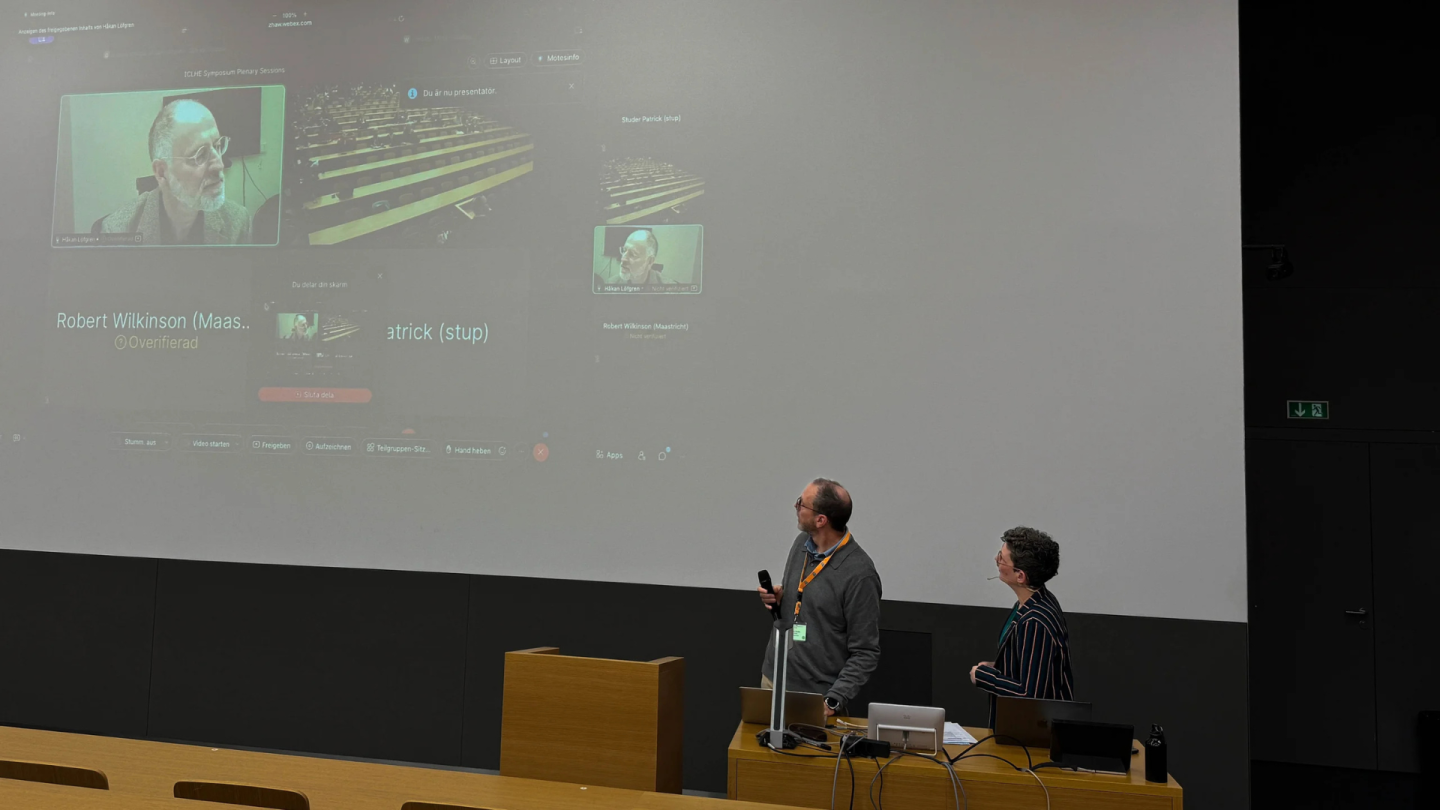
In his keynote When Care Counts: Emotions, Learning and Teaching, Håkan Löfgren (Linköping University) addressed a paradox. Caring for students and handling emotions are part of teachers’ daily work, yet these dimensions rarely show up in the way educational institutions describe and evaluate what they do. His argument that care and emotions are fundamental conditions for learning, teaching and human flourishing encouraged reflection on what classroom research, policy and curricular documents capture and what they may overlook.
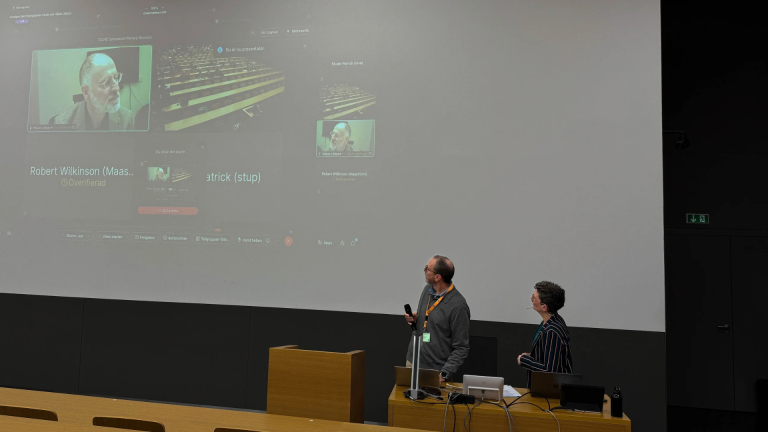
Photo: Håkan Löfgren's plenary
Iris Schaller-Schwaner (University of Fribourg) spoke on The importance of oracy in ICLHE/EMI, with(out) ELF or AI? She first took us into the linguistically complex setting of Switzerland. Next, she showed that spoken language does double work in disciplinary teaching, as students need to learn how experts in a field talk, and much of their learning of the field itself happens through talk. She also raised the question of what becomes of oracy and English as a lingua franca when machine translation and other AI tools increasingly mediate communciation.
Knowledge building, multilingual repertoires and interdisciplinary collaboration
With a large number of participants and several parallel sessions, the event felt closer to a conference than a symposium in scale. The organisers playfully dubbed it a ‘conposium’ (conference + symposium). With so many sessions running at the same time, I inevitably missed some talks, but I was able to attend many excellent presentations, a few of which I highlight here.
Several sessions connected closely with the research interests of MultiAp-EMI. Beatrice Zuaro presented a longitudinal study tracing how disciplinary concepts develop for the same student across lectures, peer dialogue and independent study. Drawing on Legitimation Code Theory, the study examined how different linguistic resources contribute to conceptual unpacking and abstraction. Marella Tiongson (co-author: Sanne Larsen) shared initial findings from a grounded theory study of multilingual master’s students in physics, showing how students assign different roles to their languages across learning activities inside and outside the classroom.
A panel by Tsou Wenli, Lin Han-Yi, Chen Fay and Lu-Chun Lin from Taiwan proposed a shift towards sustainable EMI through translanguaging and transknowledging. Drawing on examples from teaching Chinese philosophy and poetry, they explored how students can use their full cultural and linguistic repertoires and engage with multiple knowledge systems.
Collaboration between language and content specialists was a recurring theme in other talks. Ana Llinares described how Legitimation Code Theory served as a shared toolkit for applied linguists and a molecular pharmacology lecturer. Llinares collaborated with Tom Morton and Cristina Murga to explore whether semantic waving (movement between context-specific and more general meanings) may be an indicator of quality in students’ writing.
Professional development and equity
Professional development for EMI teachers was another strong strand. Vicent Beltrán-Palanques and Nuria Edo Marzá outlined a context-sensitive programme integrating multilingualism, multimodality and internationalisation. Patrick Studer, Paul Kelly and Nadja Spillmann presented the launch of a new six-unit EMI e-learning course developed with the University of Freiburg. The research by Olivia Mair, Amani Eltayb, Diego Hernan Giunta, Magnus Gustafsson and Jennifer Valcke showed how an ELF-focused module in a course based on Collaborative Online International Learning (COIL) became a space for building a transnational community of practice among English-medium education (EME) educators. Questions of equity were addressed by Ana Luiza Pires de Freitas, Bernardo Sfredo Miorando and Julie Celine Walaszczyk’s study exploring how academic communities at partner universities in the Global South and North perceive the relationship between anglicisation, social justice and equity in internationalisation.
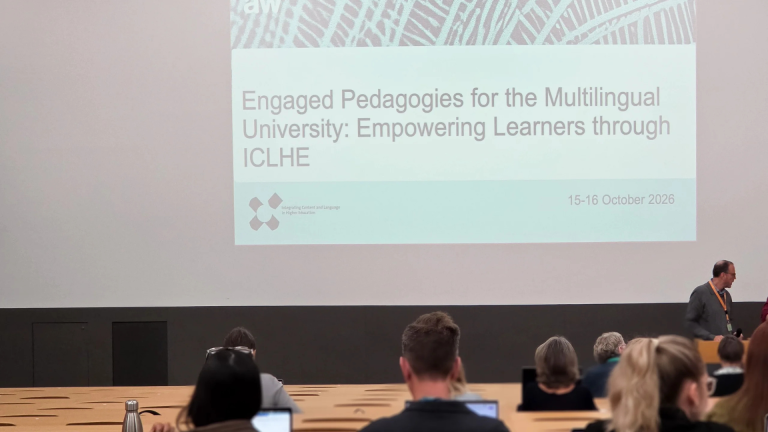
Picture: Patrick Studer opening the symposium
A new regional group and a new role
Doğan Yüksel and Mehmet Altay co-founded the new Turkic Regional Group of ICLHE, and I was glad to take part in its launch and join as a member during the symposium. The group will aim to strengthen connections among researchers and practitioners interested in ICLHE in Türkiye and the wider Turkic region.
At the Annual General Meeting, I was elected to the ICLHE Board alongside Elena Borsetto. Elena will take on the role of Regional Groups and Special Interest Groups Coordinator, and I will be responsible for Membership Development. I look forward to helping the association grow and welcoming new colleagues, including colleagues in Finland, into the ICLHE community.
I returned to Jyväskylä with new ideas for MultiAp-EMI, new connections and a renewed sense of how relevant this work is for universities where teaching and learning increasingly take place across multiple languages.
You can find more information about the association at iclhe.org. More information about MultiAp-EMI is available on the project page.
References:
Nikula, T., Gülle, T., Bayyurt, Y., Dafouz, E., Gerns, P., Hüttner, J., Kaygısız, S., Llinares, A., Minardi, S., Mortimore, L., Nashaat-Sobhy, N., & Tiermas. (2026). A multidimensional framework of bi- and multilingual disciplinary literacies. Journal of Multilingual and Multicultural Development, 47(4), 1991–2007. https://doi.org/10.1080/01434632.2026.2617424
Maton, K. (2013). Knowledge and knowers: Towards a realist sociology of education. Routledge.
Acknowledgement:
Funded by the European Union’s Horizon Europe research and innovation programme under the Marie Sktodowska-Curie grant agreement No 101205164.
Views and opinions expressed are however those of the author(s) only and do not necessarily reflect those of the European Union or Horizon Europe research and innovation programme. Neither the European Union nor the granting authority can be held responsible for them.