
Music is an integral part of our everyday lives – not to mention celebrations!
From 22 to 24 May, we celebrated the University of Jyväskylä’s biggest event, the Conferment of Degrees Ceremony. I took part in the event as a Doctor Promovendus and was delighted by the prominent role that music played in the festivities.
Throughout the weekend, we enjoyed live music performed by talented ensembles at events ranging from the Sword Sharpening Dinner to the Dinner and Ball.
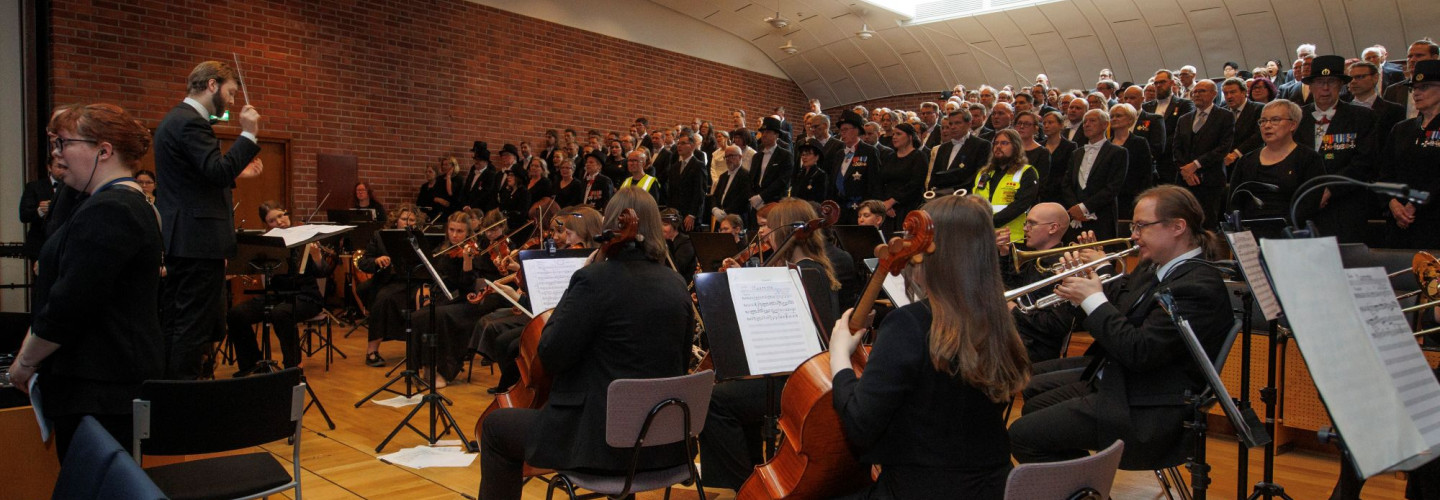
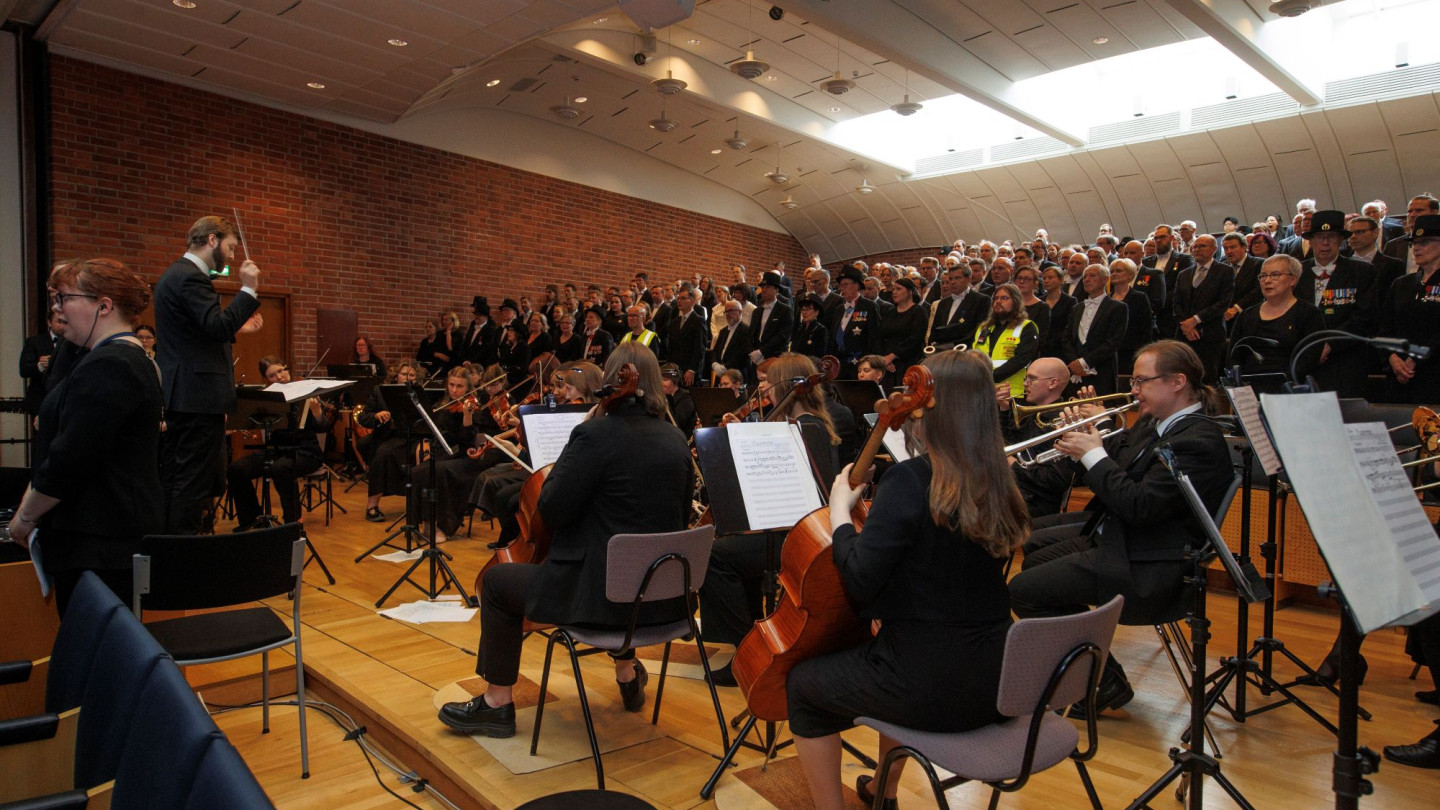
The choir Mieskuoro Alvar performed at the Sword Sharpening Dinner, the choir Musica at the Garland Weaving Dinner and the Jyväskylä University Symphony Orchestra, Sinfis – in which I played the violin briefly during my time as a student – performed at the Act of Conferment. During the festive service at the City Church, we enjoyed the magnificent Jyväskylän Kamarikuoro chamber choir, and skilfully accompaniment by organist Jukka Hassinen during the hymns and sung parts of the liturgy. The non-religious Festum Scientiae at City Hall was accompanied by Vox Aurea, the representative choir of primary education in Jyväskylä. I heard a lot of praise for their performance.
Puhkupillit, the wind orchestra of the University of Jyväskylä, provided the musical accompaniment for the Dinner and Ball at Paviljonki. They played old dances and legendary marches, including Porilaisten Marssi during Rector Jari Ojala’s procession on the sedan chair and Hakkapeliittain Marssi, a Finnish cavalry march from the Thirty Years’ War. To round off the evening, the band Bilebändi Buumi got the crowd dancing.

The secret of a singalong lies in participation
As a music professional and researcher-teacher in this field, I wondered what such a celebration would be like without music. I imagined a long queue of master’s and doctors receiving their laurel wreaths and hats.
What if we hadn’t sung the national anthem together at the end of the ceremony? The traditional “Gaudeamus Igitur” was sung during the dinner.
I was delighted that the Central Finland regional anthem had been chosen for the Sword Sharpening Dinner singalong, even though it might have been unfamiliar to most participants. After all, just a few decades ago, regional anthems were commonly sung at all kinds of celebrations, from birthdays to trade union events.
A singalong isn’t about singing in tune; it’s about taking part in a shared experience.
Indeed, Finnish festive culture has, in part, been built on singing together. I was happy to spontaneously lead the singing of the regional anthem, as I know it by heart – I sang it so often with senior citizens during my doctoral research.
The head marshal thanked me afterwards, saying that it was good I had acted as a lead singer, enabling the others to join in easily.
You see, the singalong tradition is no more as widespread as many people might think. We cannot assume that younger generations are familiar with these traditional songs, since they are not necessarily sung in schools or at other events anymore. Furthermore, the academic community is now multicultural and multilingual. For future celebrations, I recommend that organisers familiarise participants with the songs in advance.

Skilled teachers reinforce the musical traditions of school celebrations
Singalongs and musical performances are an integral part of Finnish celebratory traditions.
The school spring celebration, a tradition dating back to the Jyväskylä Teacher Seminary era, reflects the festive atmosphere of the Conferment of Degrees Ceremony.
It is a time to hand out certificates, and many pupils are leaving the school after working hard to achieve their goals, perhaps without knowing exactly what lies ahead.
Thanks to the efforts of skilled music and class teachers, music continues to play a significant role in school celebrations by providing pupils with the opportunity to practise and perform.
Music brings celebrations to life and adds an extra touch of festivity. Pupils with a background in music, whether through self-study, liberal education or lessons at a music school, may also play instruments other than the standard school instruments, such as violins and flutes.

Jyväskylä trains music teachers and musicians
The University of Jyväskylä is one of only three higher education institutions in Finland where you can train to become a school music teacher. We also offer a unique degree pathway in Finland: a combined degree in music and class teacher education (LuoMus). We educate the organisers of school spring celebrations for future generations, as well as the people who make such events possible. This helps to ensure that intergenerational traditions are woven into our ever-changing society and culture.
In collaboration with the Finnish Music Campus, we offer the opportunity to study for an upper secondary-level musician’s qualification in Jyväskylä, as well as qualifications in music education and instrument teaching at Jamk University of Applied Sciences. You can also study in basic arts education as a hobby there.
The Finnish Music Campus trains amateur and professional musicians – the players we hear in wind and symphony orchestras.
Mastering an orchestral instrument requires thousands, if not tens of thousands, of hours of individual practice.
Practising with others is also necessary to participate in skilful ensemble playing and deliver magnificent performances such as those at conferment festivities.
Music is linked to learning
If we want to continue enjoying live music in the future, both in everyday life and at celebrations, it is crucial that we provide opportunities for people to practise and study music. It is also important to train skilled instrument and school music teachers, as well as orchestra and choir directors and class teachers with sufficient musical proficiency. Not to mention other professionals in the music sector.
Teaching an instrument is one of the few things that is extremely difficult to outsource to a machine, at least for now (fortunately).
Research shows that playing, singing and listening to music are linked to learning, health and well-being, including emotional regulation, language learning and the repair of neural networks in the brain.
Music is often part of our daily lives without us even noticing, but it is definitely also part of celebrations.

Live music offers a unique experience
During the festivities, several speakers referenced artificial intelligence, highlighting the challenges and opportunities it presents. Some have even suggested that AI-based music and performers could partially replace live music in the future.
For me, it is the real musician who transforms an event into a celebration, with their humanity, the breath of their music and the joy they bring. I would never want to deprive either listeners or performers of this experience by replacing live music with non-human simulations.
I firmly believe that the Conferment of Degrees Ceremony was a wonderful and unforgettable experience for the musicians who played and sang at the event, many of whom are also students at our university. I am therefore grateful that live music was chosen over playing a readily available recording over the loudspeakers.
Thank you to everyone who shared their musical talents with us at the ceremony, and to everyone who joined in the collective singing.
Without music, the celebration would not have been quite so wonderful.
The author is a university teacher and music researcher at the Department of Music, Art and Culture Studies and the Centre of Excellence on Music, Mind, Body and Brain at the University of Jyväskylä. In her doctoral research, she studied the musical memories and singing experiences of older Finnish adults.


