
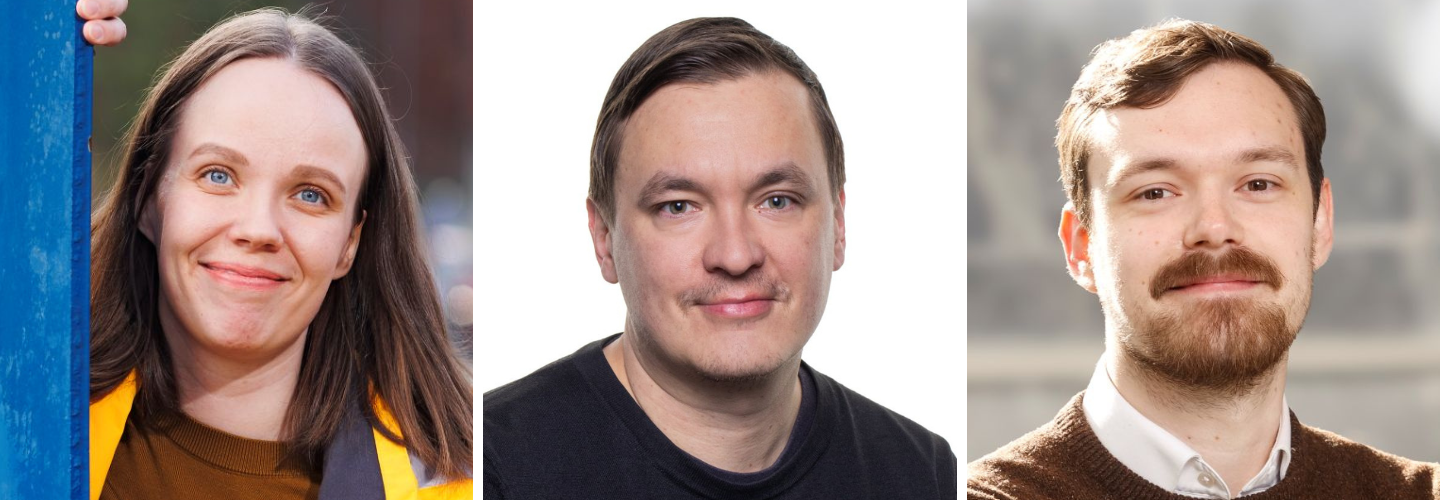
What did you research today? Artificial intelligence mines data and shapes the research subject
Minna Koivula: How are the business models of media organisations adjusting to the changes brought by artificial intelligence (AI)?
The development of AI is forcing media organisations to adapt their operations in many ways. It will also change a fundamental aspect of the media landscape: the way people consume news in the future.
As people increasingly search for information about current issues using generative search engines, numerous visits to the websites of news outlets may no longer occur.
A postdoctoral researcher at the University of Jyväskylä, Minna Koivula, studies how media organisations will adjust their finances and journalistic practices to anticipated changes.
“Alongside questions related to business models, the growing use of generative search also raises questions about journalistic autonomy and the ethical aspects of news production,” says Koivula, who is involved in an upcoming Nordic collaborative research project.
Visibility of Nordic news content must be studied
It’s especially important to anticipate the effects of AI on information seeking in small language areas, such as Finland.
Getting up-to-date information from generative artificial intelligence can be challenging in small language areas,” explains Koivula. “For this reason, the research project examines both language models and the visibility of Nordic news content within them.”
The use of generative AI can blur the source of information and simultaneously contribute to the spread of false information. Koivula emphasises that it’s therefore crucial to examine whether algorithms weaken locally produced content.
How will AI transform newsroom culture?
Minna Koivula also examines the impact of AI on media organisations from another perspective. In the current study, she explores how journalists perceive the role of AI in newsrooms.
Koivula is seeking answers to two questions: (a) Is AI seen as a tool that improves the quality of journalism? and (b) Is it understood that AI, as a communication tool, can also shape relationships between people?
The results suggest that Finnish newsrooms should focus more on the transformative impact of AI on organisational culture,” says Koivula.
“It changes both interpersonal relationships and the way organisations function. Right now, there is too much focus on what artificial intelligence can offer journalism as a tool.”
She says that in newsrooms, relationships between people can change if, for example, feedback or brainstorming assistance is requested from AI rather than from a colleague, as the latter requires trust in one’s co-workers.

What progress have you made in your research today?
“Today, I worked on an analysis exploring the role of communicative artificial intelligence in Finnish newsrooms,” says Minna Koivula.
“The goal is to write a piece that’s more accessible than an academic article, one that reaches not only researchers but also media professionals, while encouraging newsrooms to reflect more broadly on the impacts of artificial intelligence.”
In brief: Minna Koivula |
|
| Who | Postdoctoral researcher at the Department of Language and Communication Studies, University of Jyväskylä |
| Studying | The transformation of journalistic work from the perspective of digitalisation |
| Member of | The CoCoDigi research group that studies communication and interaction, networks, and information sharing on digital platforms in workplace contexts. |
| Involved in | The (Re)Capturing AI research project, which studies the impact of generative search engines on media environments and democracy. She leads the project Becoming a leader in the media field: How journalists grow into managers and is involved in the project GET:ORG – Generative technologies in communicative organizing. |
Risto Turunen: Text mining generates entirely new knowledge about the history of democracy
Democracy has been a classic topic in the humanities from ancient times to the present day. Yet the subject continues to offer new insights, says Risto Turunen, a postdoctoral researcher at the University of Jyväskylä. According to Turunen, exploring it requires innovative methods and creative approaches.
Turunen uses innovative digital methods to study the history of democracy, including analysing digitised parliamentary records with text-mining techniques. In practice, this involves both simply counting words and converting texts into vectors using language models, which allows us to identify differences and similarities that the human eye might easily miss. Then he examines them through close reading to determine their historical significance.
Noticeable similarities in the democratic discourse of the far right and far left
Turunen is currently exploring how democracy has been discussed in Finnish, Swedish, and German parliamentary debates since the 1990s.
He says that data-driven analysis has highlighted how ideologically similar parties in different countries discuss democracy in very similar ways, such as the Social Democrats in Finland, Sweden, and Germany.
A surprising feature can also be seen in the noticeable similarities in the democratic discourse of the far right and far left,” explains Turunen.
“These similarities aren’t due to a shared ideology, but because both primarily use the concept of democracy to criticise their opponents.”
Democracy has always been contested
Risto Turunen points out that people’s understanding of democracy has changed continuously throughout history.
Democracy has always been contested, and it will remain so in the future.”
Turunen is part of the research group of Academy Professor Pasi Ihalainen. The group produces comprehensive, comparative interpretations of the history of democracy spanning a long period.
“Our empirical dataset is exceptionally broad. The approach we use generates entirely new insights into which meanings of democracy are transnational and which are specific to particular countries.”
The dataset includes plenary debates from ten different parliaments since the 19th century, as well as debates from the European Parliament between 1999 and 2026.

What progress have you made in your research today?
“Today, I analysed discussions on democracy in Finnish, Swedish, and German parliamentary debates since the 1990s, using large language models,” says Turunen. “Large language models make it possible to project each speech into a shared semantic space, while visualising which parties most closely resemble one another in their debates on democracy.”
In brief: Risto Turunen |
|
| Who | Postdoctoral researcher at the Department of History and Ethnology |
| Studying | The history of democracy, particularly using computational methods |
| Member of | The research group of Academy Professor Pasi Ihalainen |
Dominic Saari: Early warning of emerging disinformation campaigns?
The world is experiencing a time of accelerating malign influence operations. One of the most famous information operations of recent years, the Russian-operated “Doppelgänger”, was exposed in 2022. The operation used fake websites, bot networks and artificial intelligence in an attempt to shape public opinion climate in Western countries – with the primary goal of decreasing support for Ukraine.
Since then, other operations have emerged. Doppelgänger is still active, and others have joined it: Matryoshka, Storm-1516, and Portal Kombat, which produces millions of fake news stories per year.
Dominic Saari investigates how states recognise various kinds of information operations.
During the Quran burnings in 2023, the Swedish Psychological Defence Agency warned of an ongoing information operation.”
“A bulletin issued to decision-makers and citizens warned that foreign powers, primarily Russia, were attempting to exploit the situation by spreading disinformation,” Saari says. “The goal of the operation was to paint a picture of Sweden as an Islamophobic country and to deepen divisions within society.”
Could an emerging operation be detected earlier?
When it comes to malign influence operations, European countries seem content to assume a defensive posture – they mainly react to threats directed at them, Saari explains.
But could an early warning be issued to decision-makers about an emerging or potential disinformation campaign? This is a question Saari is currently investigating in his doctoral dissertation. A central element of this is creating a real-time situational picture.
Who participates in creating the situational picture?
“At first glance, one might think that the situational picture is created solely by the authorities,” Saari says.
“However, there are a vast number of actors in the information environment, and authorities often have quite limited resources. Disinformation campaigns are also detected by the media and various civil society organisations. Private companies like CheckFirst play a particularly significant role, as they have the capacity and expertise to detect such campaigns.”
Saari says that creating a situational picture requires knowledge of how the adversary typically operates.
Research on information operations is important
The pace of information-psychological operations has accelerated over the past decade. The World Economic Forum (WEF) and the United Nations (UN), for example, have identified information that is spread either intentionally or unintentionally that is, disinformation and misinformation, as a major threat.
In the ‘super election year’ of 2024, election interference – often in the form of false narratives – was observed in up to 80 percent of the elections,” Saari states.
Saari points out that from the perspective of those organising information operations, the goal is not only to influence election results but also to increase polarisation and distrust within the targeted society.

What progress have you made in your research today?
“I investigated how the relationship between intelligence and information operations has been addressed in research. The problem has certainly been recognised, but solutions or methods have not yet been found. It appears that information influence and other means of hybrid influence fundamentally challenge traditional intelligence methods. In Finland and some other European countries, it is still somewhat unclear whose responsibility it is to detect and counter such operations.”
Since information operations can, at their worst, cause significant disorder and uncertainty, Saari hopes that an increasing number of people will begin to study how to detect and counter them. At present, the topic is of particular interest to authorities in Sweden and France as well as within the EU’s foreign affairs administration.
In brief: Dominic Saari |
|
| Who | University teacher and doctoral researcher at the Faculty of Information Technology, University of Jyväskylä |
| Studying | Intelligence regarding information influence |
| Member of | The CCSI research team, which studies the changing security environment in the digital world, research topics include information-psychological influence, cognitive security and strategic intelligence |
| Involved in | MATINE-project: Cognitive Security – Experiences and Preparedness to Defend |


