Co-Creative Citizen Science in the Centre for Applied Language Studies
As part of the Centre for Applied Language Studies focus area on renewing research methods in multidisciplinary applied language studies, Co‑Creative Citizen Science (CCS) is practiced in several projects engaging researchers, students, educators, pupils, teenagers, and adults in collaborative, inclusive and responsible ways.
To showcase this emerging field, we peek into a FORTHEM Alliance Lab project in which, since 2020, we have developed and refined multipartite collaboration among partner universities, researchers, students, schools, (head)teachers, and teenage (13–16) students in conducting CCS projects.
Citizen Science in Schools
The Co‑Creative Citizen Science in Schools project, co‑chaired by Petteri Laihonen (University of Jyväskylä) and Katarzyna Molek‑Kozakowska (University of Opole), is coordinated by the Universities of Jyväskylä and Opole in collaboration with FORTHEM partner universities and schools. It addresses challenges of multilingualism and linguistic diversity in European schools while testing and refining a CCS model in applied language research. A central aim is to examine how shared ownership, inclusiveness, and co‑creative knowledge production can support sustainable partnerships between academia and schools. Methodologically, the project follows a fully co‑creative approach in which researchers, university students, pupils, and (head)teachers participate at all stages of the research process. The collaboration has generated trust and new knowledge, disseminated and exploited in science communication, academic publications, researcher training, further projects, and various spin‑offs.
In Jyväskylä, alongside the CCS project facilitated by JYU’s Language Aware Multilingual Pedagogy (LAMP) students at Mankola Comprehensive School since 2020, a special English‑medium edition with international student facilitators was implemented in autumn 2025 (see blog 1, the link below). This added a diversity dimension, embedding multilingual practices in everyday schoolwork and offering new perspectives on Finnish education through international students’ engagement in hands‑on co‑research with lower‑secondary pupils. Following positive feedback, this strand will continue in autumn 2026. The 2025 CCS project results were presented in Norway at the Multilingualism in School and Higher Education Lab meeting organised by the University of Agder (see blog 2, the link below).
Networking and participatory research as part of a research project
A current venture in the Centre for Applied Language Studies that includes a work package on Co‑Creative Citizen Science is the Research Council of Finland project IMPACT, which investigates the influence of Finland’s language requirements on migrants’ integration and wellbeing. The project aims to advance inclusion and democratic knowledge production by conducting co-creative participatory research with immigrants as co-researchers, shaping all research phases. During the project’s first year, Petteri Laihonen and doctoral researcher Minna Sorri participated in the main international Citizen Science conference, ECSA 2026.
The 6th European Citizen Science Association (ECSA) conference was hosted by the University of Oulu on 3–6 March 2026. The conference theme, Citizen Science Bridging Centre and Periphery, highlighted the diversity of contexts in which citizen science takes place as well as the fundamentally multidisciplinary and collaborative nature of citizen science.
Petteri participated in several meetings, such as the ECSA Co-Creation Working Group and the meeting to establish the new Finnish Association of Citizen Sciences (FACTZ). Petteri presented about his CS work since 2020 in the panel Inclusive Citizen Science in practice.
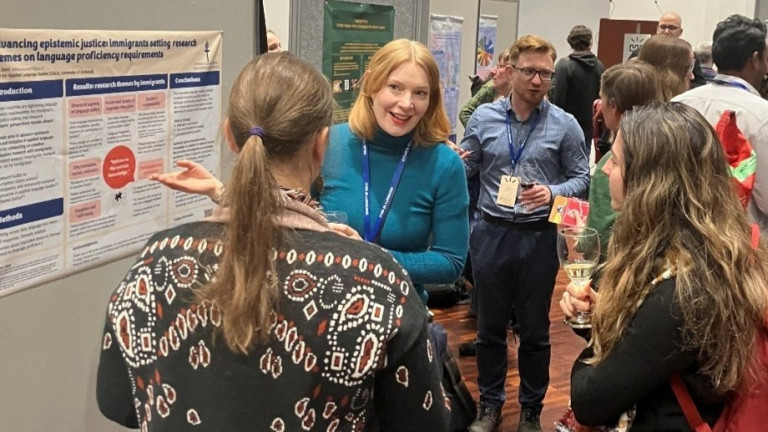
ECSA 2026, Minna Sorri presenting her poster. Photo by Petteri Laihonen
Minna presented a poster titled Advancing epistemic justice: immigrants setting research themes on language proficiency requirements, which introduced her research on the influence of language proficiency requirements from the perspective of adult immigrants through co-creative citizen science. An essential part of Minna’s doctoral research is the dissemination and action phase, during which co-researchers engage with national policy makers. At the conference, Minna also took part in activities for Early Career Researchers, which offered a chance to exchange experiences, challenges, and possible solutions for conducting citizen science projects in the early stages of an academic career. ECSA also offered an opportunity to connect and build multidisciplinary networks, e.g. with Finnish Science Centre Association.