
Computational tools offer new opportunities for understanding catalysis
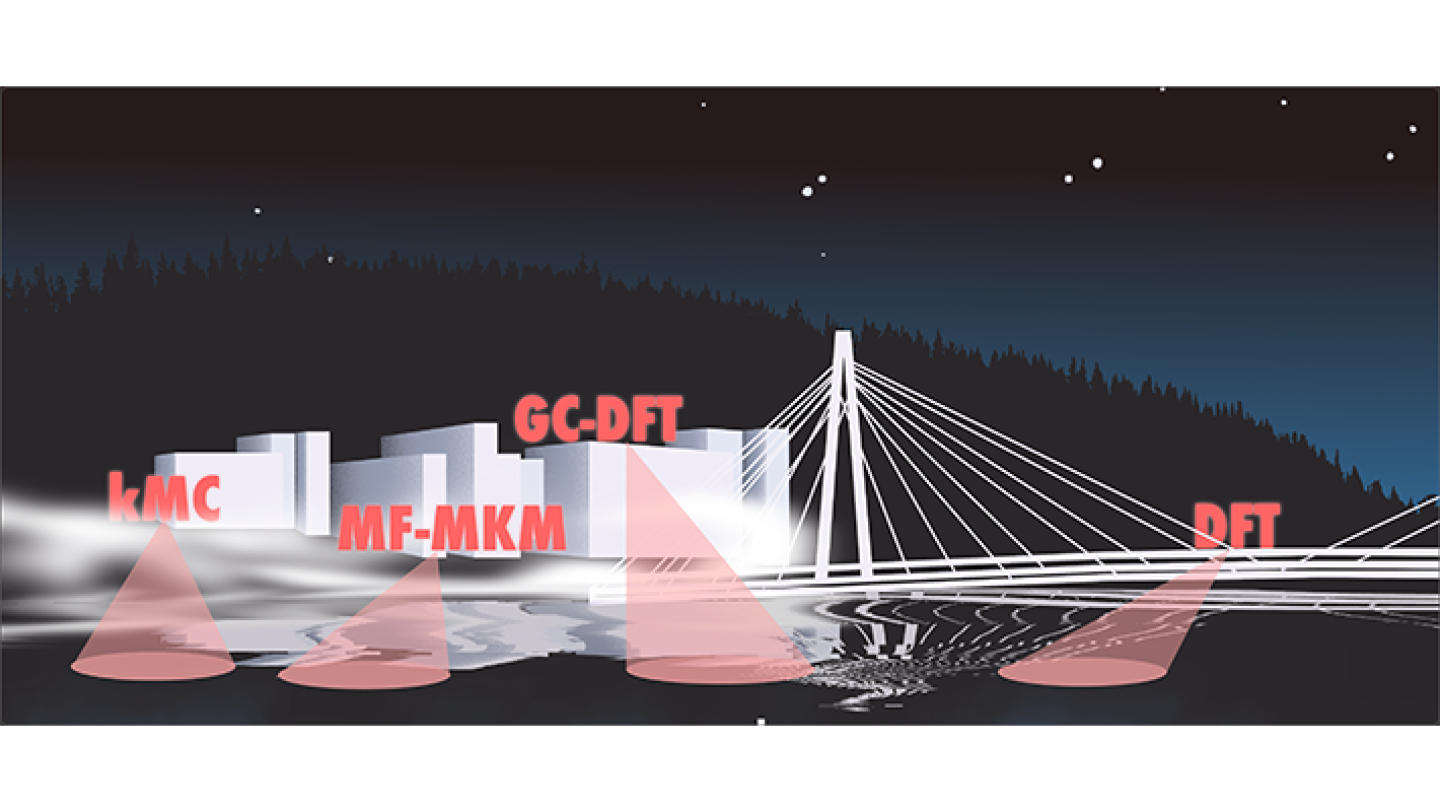
Catalysis is a field of science and technology that focuses on controlling the mechanisms and rates of chemical reactions using suitable catalysts and reaction conditions. A catalyst is a substance that affects the rate and selectivity of a reaction without being consumed in the process. It plays a key role in numerous industrial applications, for example in the production of clean hydrogen and carbon dioxide and biomass conversion.
However, the rational design of new catalysts is still challenging. Catalytic activity is determined by atomic level chemistry, but the practical performance of catalysts is also influenced by reaction conditions and the type of reactor. Modeling complex materials and reactions requires computational tools that can reliably model and integrate phenomena on different scales.
Computational methods to support the prediction of catalyst behavior
The perspective “DFT-Based Multiscale Modeling of Heterogeneous (Electro)Catalytic Reactions”, published by researchers by the University of Jyväskylä, presents and evaluates current computational methods from electronic structure simulations to reaction kinetics modeling.
The article focuses on how computational methods based on density functional theory (DFT) can be utilized to understand the microscopic properties of catalytic materials and reactions. It also examines how those methods can be integrated with the modeling of solvent effects, electrode potentials, and reaction kinetics. Finally, it describes how atomic-level information can be utilized to predict catalyst performance under experimentally relevant conditions.
“In modeling, it is essential to consider realistic reaction conditions at all levels of analysis. Otherwise, there is a risk that the results will not correspond to experimental results,” says Academy Research Fellow Minttu Smith from the University of Jyväskylä.

Computational tools require a broad understanding
Researchers also emphasize the importance of critical thinking when using computational tools. Although effective methods and software tools are available for different scales, these should not be used as black boxes. Simplifying assumptions have an effect at later stages in the chain. This requires not only the ability to use different calculation software but also an understanding of the theoretical principles.
“Multiscale modeling offers the possibility to describe the full complexity of catalytic reactions, but it requires careful integration of methods and an understanding of their limitations,” says Professor Karoliina Honkala from the University of Jyväskylä.
Comprehensive modeling of catalytic reactions is now possible
The key finding of the article is that a comprehensive understanding of catalytic reactions, from the atomic level to the reactor scale, is not only necessary but also possible with multi-scale modelling and advanced computational tools. This will open opportunities for modeling, predicting, and designing ever more complex catalytic processes. At the same time, it highlights the need for a thorough understanding of the methods used and the reactions being studied.
The article has been published as an open access article in ACS Catalysis. The article was supported by the Research Council of Finland and the Central Finland Mobility Foundation (Cefmof).
Article information:
- Minttu M. Smith, Laureline Treps, Marko M. Melander, Vesa Apaja and Karoliina Honkala, "DFT-Based Multiscale Modeling of Heterogeneous (Electro)Catalytic Reactions", ACS Catal. 2026, 16, 6, 5229–5244
- DOI number: https://doi.org/10.1021/acscatal.5c07967


