
New research reveals how semiconductor electrodes can achieve green hydrogen production
Electrocatalysis and photoelectrocatalysis play a central role in facilitating clean energy conversion and numerous other sustainable processes and technologies. However, the most effective catalysts currently available are based on noble metals, particularly platinum. The high price and limited availability of these materials slow down the expansion of hydrogen production and drive up the costs. Therefore, the development of new, less expensive but still highly effective catalyst materials is crucial for achieving cost-effective and large-scale hydrogen production. Here, semiconductor materials are one possible but relatively little explored alternatives for hydrogen evolution.
"Unlike traditional metal-based catalysts, semiconductor materials can utilize more common and less expensive elements. However, the development of semiconductor electrodes has been slowed down by the fact that their electrochemical and catalytic properties are not well understood", explain Professor Karoliina Honkala and Senior Lecturer, Academy Research Fellow, Marko Melander from University of Jyväskylä, who led the research.
JYU researchers developed a new computational approach to study the electrochemistry of semiconductors
Semiconductor electrochemistry has been studied less extensively than the electrochemistry of metals, largely due to limitations in available research methods. In particular, computational studies have been challenging because the effect of an external electrode potential has been difficult to model in atomic and electron level calculations. Melander and Honkala have, however, recently overcome this limitation by developing a new approach, the constant inner potential density functional theory, which enables the inclusion of the electrode potential in the simulation of semiconductor electrochemistry.
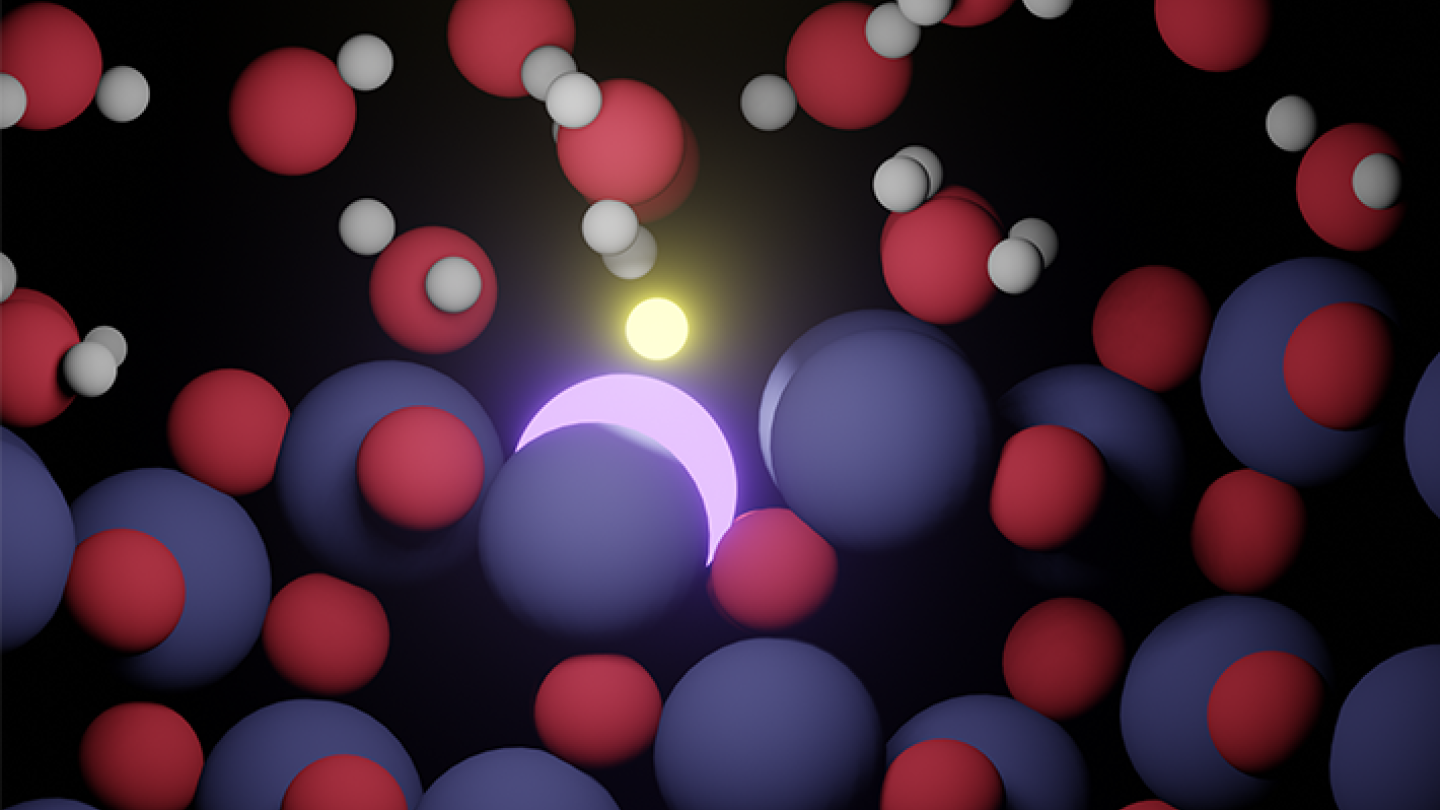
"We developed this method two years ago, and it opens new possibilities for modeling semiconductor electrodes. In the present study, we applied the method to the study of the hydrogen evolution reaction on a TiO2 semiconductor electrode. Our simulations showed how and why changing the electrode potential achieves hydrogen production on TiO2. Through the calculations made in collaboration with our partners, we predicted that local charge centers, polarons, form on the TiO2 surface and catalyze the hydrogen evolution," explains Melander.
Accurate experiments confirmed the computational predictions
Experimental testing and validation of the computational results was a significant challenge that needed the application of highly advanced experimental methods. For example, state-of-the-art photoelectrochemical Raman measurements, in situ electron resonance spectroscopy, and operando photoelectron spectroscopy were used to verify the computational results.
"The experiments carried out by our collaborators were extremely demanding and time-consuming. Nevertheless, they directly demonstrated and confirmed that changing the electrode potential can be used to create polarons on the TiO2 surface. These charge centers then drive the hydrogen evolution reaction on TiO2 electrodes and probably also on other semiconductors," explains Honkala.
New approaches and opportunities for catalyst development
The discovered electrode potential -controlled polaron formation is a previously unknown phenomenon in electrochemistry and does not occur on conventional metal electrodes. The JYU researchers believe that this phenomenon could be utilized in future catalyst design and materials development.
"We found that the formation of polarons enables semiconductor electrodes to avoid the so-called scaling relations. On metallic electrodes, these laws limit and constrain the achievable catalytic activity. Our discovery of the potential-dependent polaron formation may lead to new approaches to avoid the scaling relations and thereby improvement in catalyst design,” predict Honkala and Melander.
The research has been published in the journal Nature Communications. In addition to the University of Jyväskylä, several researchers from various Chinese universities and research institutes participated in the study. The research was supported by the Research Council of Finland, the Jane and Aatos Erkko Foundation, and the Central Finland Mobility Foundation (Cefmof).
Article information:
- Tongwei Wu, Xiaoxi Guo, Guangjie Zhang, Yanning Zhang, Li Song, Zheng Liu, Hui Zhang, Shucheng Shi, Limin Liu, Marko M. Melander & Karoliina Honkala, “Potential-dependent polaron formation activates TiO2 for the hydrogen evolution reaction”, Nat. Commun. (2026).
- Link to article: https://doi.org/10.1038/s41467-026-68892-5


