
Doctoral dissertation: Estimating the Uncertainties in the Initial Condition for the High-energy Evolution
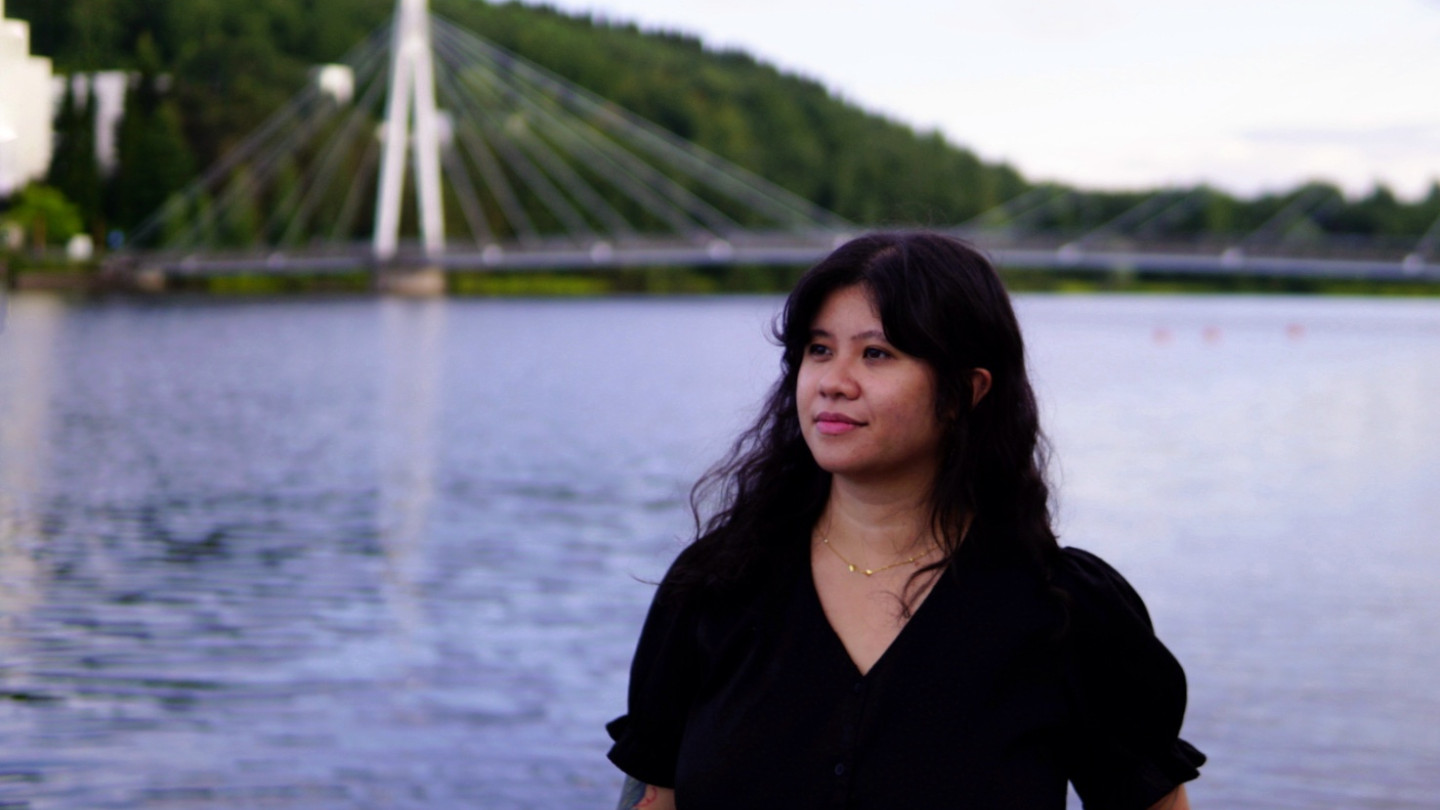
Raising the precision of high energy proton and gluon studies
In her doctoral dissertation, Carlisle Casuga develops a method for extracting the structure of the proton that is a necessary input for theoretical predictions in high-energy quantum chromodynamics (QCD).
The proton structure at extreme energies
The internal behavior of the proton is an ever dynamic thing; it changes depending on the resolution with which we observe it. Although the proton is often described as a combined state of three quarks, the discovery of gluon number growth with increasing probing energy at HERA supplements this picture. As gluons cannot continue to rapidly increase (this would ultimately violate the conservation of probability), non-linear behavior like gluon recombination begins to dominate and the number of gluons saturates. Saturation phenomena is most conveniently explained within the Color Glass Condensate framework. Understanding the quantum evolution of the proton structure in the saturation regime is essential to describing high-energy collisions.
Inferring the inaccessible proton structure
A key quantity in the CGC framework is the scattering amplitude describing the projectile-hadron interaction. We are specifically interested in its dependence on the energy scale of the system. An equation that defines this dependence is the Balistky-Kovchegov equation, which requires a reference value at an initial energy. This cannot be calculated through first principle quantum chromodynamics, and must be inferred from experimental observation.
In this doctoral research, Carlisle Casuga applies Bayesian inference to extract the otherwise inaccessible initial condition. The result is a posterior distribution that describes the spread of values of the initial condition where the theory best matches HERA lepton-proton scattering data. This is done for varying degrees of precision, i.e. accounting for more and more corrections in the theory.
Error propagation for high order predictions
Observables in high-energy QCD require the dependence of the scattering amplitude to energy, and hence the initial condition. Samples from the probability distributions obtained by the Bayesian inference allow the propagation of the uncertainty of the initial condition to the final observable. Data from the upcoming Electron Ion Collider are predicted to be sensitive to non-linear phenomena like saturation. For this identification to be possible, high precision theoretical predictions that contain reliable uncertainty estimates, such as the results from this work, are needed.
M.Sc. Carlisle Casuga will defend her thesis on August 26, from 12 o’clock, at the Department of Physics FYS1 lecture hall in Ylistönrinne. The opponent will be Associate Professor Tobias Toll (Indian Institute of Technology Delhi) and the custos will be Associate Professor Heikki Mäntysaari (University of Jyväskylä). The defense will be held in English.
The dissertation “Estimating the Uncertainties in the Initial Condition for the High-energy Evolution” is available in the JYX digital archive: [link].
The link for live broadcast: Doctoral dissertation, Carlisle Casuga 26.8.2026 at 12:00, in Finnish local time (UTC +3 / Eastern European Summer Time EEST).


