
Gold nanoclusters provide new modifiable materials for nanoelectronics
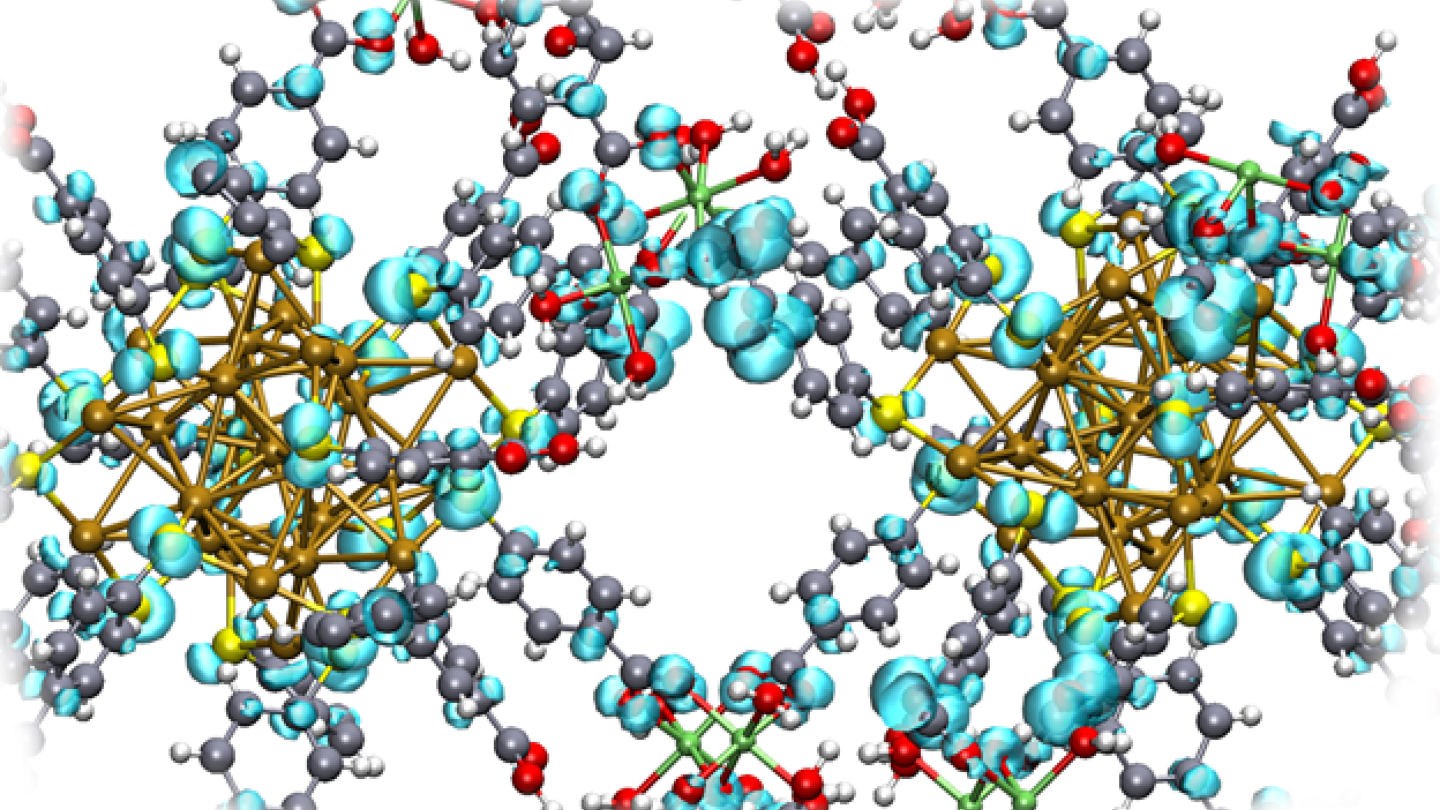
Groups of gold atoms, known as gold nanoclusters, can behave like individual atoms. When these clusters are assembled into a three-dimensional framework by incorporating metal ions, it is possible to create new materials whose properties can be fine-tuned for different purposes. These materials are known as cluster-based MOF materials.
The electrical conductivity of materials multiplied
Recent research collaboration between the Pohang University of Science and Technology (POSTECH, South Korea) and the Nanoscience Center of the University of Jyväskylä has resulted in the production of four new cluster-based materials based on gold nanoclusters. The research team, led by Professor of Computational Nanoscience Hannu Häkkinen at the University of Jyväskylä, analysed the properties of these new materials using computational methods.
“Our study revealed that reducing the distance between the clusters enhanced the material’s electrical conductivity by as much as 31 times,” says Professor Hannu Häkkinen from the University of Jyväskylä.
Cluster frameworks revolutionise material engineering
Supercomputer calculations based on density functional theory revealed that the electronical properties of these materials have similarities to those of traditional semiconductor materials. The analysis also showed that the electron structure of the metal ion combining the clusters significantly impacts the material’s electrical conductivity.
“The properties of individual gold clusters are well known and have been extensively studied,” says Doctoral Researcher Hanna Jääskö from the University of Jyväskylä. “When clusters are combined into networks using various metal ions, it is possible to design materials and modify their electronic properties precisely. The semiconductor-like behaviour and adjustable conductivity of these materials open up new possibilities in the field of nanoelectronics.”
The study is part of a doctoral education pilot in the field of quantum physics
The computational study formed part of the Finnish Quantum Flagship’s doctoral education pilot programme (Quantum Doctoral Pilot Programme, QDoc), in which Hanna Jääskö’s doctoral dissertation project involves researching cluster-based materials and their potential applications, particularly in quantum technology and quantum materials. The researchers used the Mahti supercomputer at CSC – IT Center for Science for the computational analysis.
Publication data:
-
Kim, S., Jääskö, H., Park, K. C., Malola, S., Häkkinen, H., & Park, S. S. Tuning the Electrical Properties through Metal-Ion-Mediated Assembly in Au25 Nanocluster- Based Frameworks. Journal of the American Chemical Society Vol. 147, p. 30803 (2025).


