
Research Council of Finland has awarded almost half a million euros to support biomass research utilizing high-performance computing
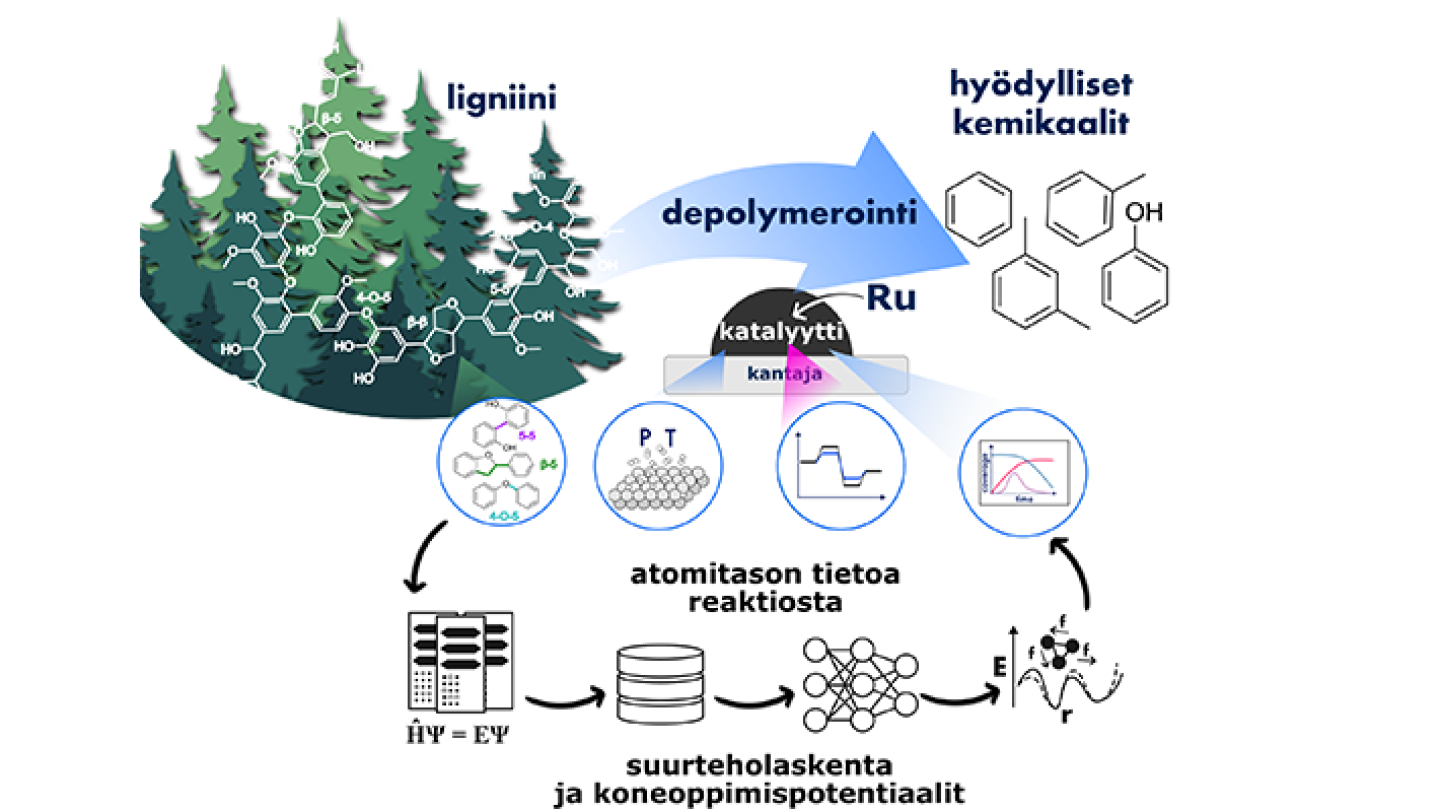
Professor Karoliina Honkala's research project, “Machine Learning Accelerated Modeling of Lignin Depolymerization on Transition Metal Catalysts” (MALT), has received a total of 499 443 euros in funding through a call for international collaboration in high-performance computing. The project will last three years and will be carried out from 2027 to 2029.
New opportunities for a sustainable chemical industry from lignin
The MALT project studies the depolymerisation of lignin using computational methods. Lignin is a biopolymer contained in plants that is separated from cellulose in the paper industry. Due to its unique chemical structure, lignin is a promising raw material, but as a side stream of the paper industry, it is mainly burned for energy.
However, with the help of a suitable catalyst and reaction conditions, lignin could be converted into valuable molecules that could replace substances obtained from crude oil.
- If we can better understand and control the decomposition of lignin into smaller molecules, it can be utilized in the production of sustainable chemicals and materials. This supports the transition toward a bio-based economy, says Professor Karoliina Honkala from the University of Jyväskylä.
Machine learning and high-performance computing in supporting research
The purpose of the MALT project is to use models and computational methods to find out how lignin polymer bond breaking proceeds at the atomic level. The project uses density functional theory (DFT), machine learning interatomic potentials (MLIP), and microkinetic modelling (MKM) methods. Machine learning can be used to speed up the modeling of complex chemical reactions and enable the development of new catalysts for biomass processing.
The demanding calculations are performed using the LUMI supercomputer provided by the Finnish CSC - IT Center for Science.
Atomic-level understanding for the development of new catalysts
The goal is to develop an advanced computational method that can be used to find efficient catalysts for biomass processing and to understand their behavior under realistic reaction conditions.
- The knowledge can be used to develop new catalysts for biomass processing and production of chemicals from renewable resources, says Academy Research Fellow Minttu Smith from the University of Jyväskylä, who is participating in the research project.
International collaboration speeds up research
The research is undertaken in collaboration with the research groups at Åbo Akademi University in Finland and Ruhr-Universität Bochum (RUB) in Germany.
Research data produced by MALT is electronic and will be shared publicly through online databases and libraries.


