

Academy Professors at the University of Jyväskylä
Academy Professors 1.1.2026–31.12.2031
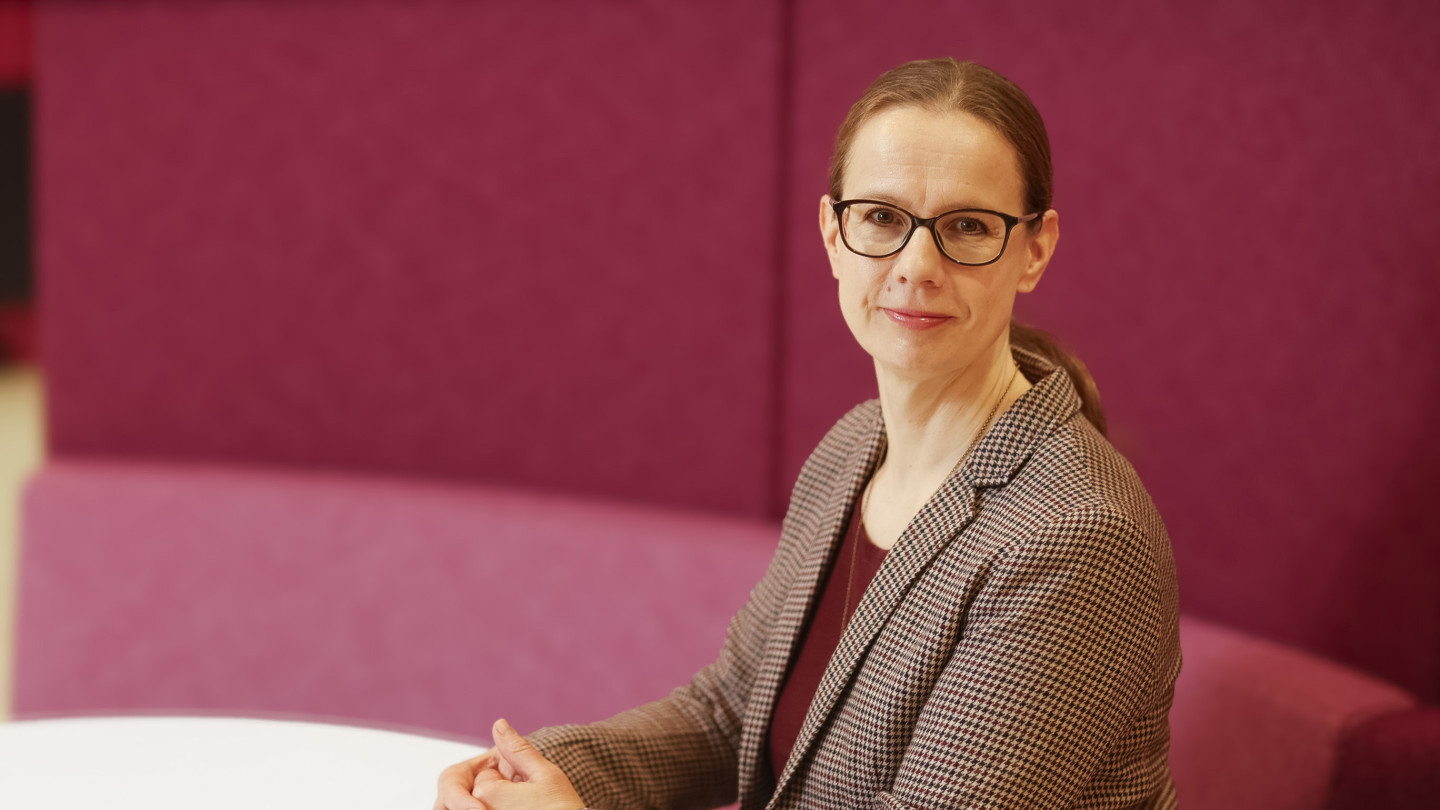
Academy Professor Anu Kankainen
Professor Anu Kankainen conducts basic research on the structures and origin of atomic nuclei. Nuclear astrophysics, her field of research, seeks to explain how elements were created in the universe. A central theme of her work is extremely precise mass measurements of radioactive isotopes. These masses provide information on the binding energies of nuclei and the amount of energy released in the nuclear reactions in stars, which in turn affects the likelihood of such reactions occurring.
In her academy project, Kankainen will be studying the structure and properties of nuclei to gain a better understanding of fundamental interactions, elemental synthesis in stars, and phenomena that deviate from the standard model of physics. This advanced research will be carried out at the Accelerator Laboratory of the University of Jyväskylä, and at other international laboratories.
Kankainen’s research is closely linked to the nuclear astrophysics research conducted at the Centre of Excellence (CoE) in Neutron-Star Physics, which was established by the Research Council of Finland. The CoE is led by the University of Helsinki. Professor Anu Kankainen and Professor Markus Kortelainen, both from the Department of Physics, represent the University of Jyväskylä in the CoE.
Academy Professor Jari Kaukua
Professor Jari Kaukua studies illuminationist philosophy in the Islamic World, specifically illuminationist (ishraqi) philosophy from the seventh/thirteenth to the beginning of the eleventh/seventeenth century. Initially developed in critical relation to Avicenna, Illuminationism became one of the prominent doctrinal options in Islamic philosophy.
In modern scholarship, Illuminationism is widely perceived as a form of mystically founded perennial philosophy. This picture does not match Suhrawardi's philosophical output, and we should be cautious about its validity for the reception of his thought as well. Philosophically oriented study of Suhrawardi's legacy can revise our understanding of postclassical Islamic philosophy, contribute to the inclusion of Islamic philosophy as a self-standing part of the global history of philosophy, and help to build bridges between analytic philosophy and contemporary Islamic philosophy.

Academy Professor Otso Ovaskainen
Professor Otso Ovaskainen's research focuses on the digital twinning of known and unknown biodiversity. A digital twin is a detailed and interactive description of a real-life phenomenon or process based on computational models and measurements.
Mitigating the adverse effects that the ongoing global change has on ecosystem services requires a comprehensive understanding of biodiversity. However, our knowledge of biodiversity is still very partial. For example, most species on Earth are still to be discovered, and thus we have no information about their roles in ecosystems. This project will develop much needed new tools for biodiversity research that enable reliable and fast monitoring of full biodiversity at the global scale.
To ensure broad applicability of the methods, we will test them in Finland, several European countries and Madagascar with a diverse set of stakeholders, including national and international biodiversity monitoring schemes and the private sector. Through digital twinning, the project will accelerate the interaction between scientific research and management, offering a new basis for biodiversity monitoring, environmental policy and societal decision making.
Otso Ovaskainen has also previously been funded as an Academy Professor for the period 1.9.2021-31.8.2026.

Academy professorships 1.9.2021–31.8.2026
Academy Professor Pasi Ihalainen
Pasi Ihalainen explores political representation, analysing tensions between parliament and the people from the age of revolutions to the 21st century.
Using the concepts of representation and popular sovereignty, Ihalainen will investigate historical and present-day constructions, deconstructions and reconstructions of parliamentary legitimacy in political discourse. He will search and analyse digitised parliamentary records from Finland and a number of other European countries.
Research Council of Finland:
Pasi Ihalainen explores political representation, analysing tensions between parliament and the people from the age of revolutions to the 21st century. Using the concepts of representation and popular sovereignty, Ihalainen will investigate historical and present-day constructions, deconstructions and reconstructions of parliamentary legitimacy in political discourse. He will search and analyse digitised parliamentary records from Finland and a number of other European countries.

Academy Professor Otso Ovaskainen
Otso Ovaskainen started as a professor of mathematical and statistical ecology at the University of Jyväskylä on January 2021. He moveed to Jyväskylä from his position as a professor of mathematical ecology at the University of Helsinki, where he worked since 2009.
Ovaskainen is a world-class expert in mathematical and statistical modelling. He has developed new methods for empirical data collection and statistical analysis in ecological research. The methods have been used all over the world.
Currently, Otso Ovaskainen is leading an internationally unique study in which the diversity of nature is mapped at the same time in over 450 locations all over the world. Data on species are collected through DNA and audio samples and camera trap photos utilising automation-based methods. In 2019, the research received 12 million euros of ERC funding.
Research Council of Finland:
Otso Ovaskainen will conduct research to generate new information about global biodiversity. Ovaskainen will focus on its current distribution, the drivers of its dynamics, and how it can be expected to change due to ongoing global changes. One of the aims of the project is to generate unprecedented global data on biodiversity, especially for fungi and arthropods, which comprise a major part of biodiversity but for which systematic globally relevant data are currently lacking.


