
Simulations and experiments meet: machine learning predicts the structures of gold nanoclusters
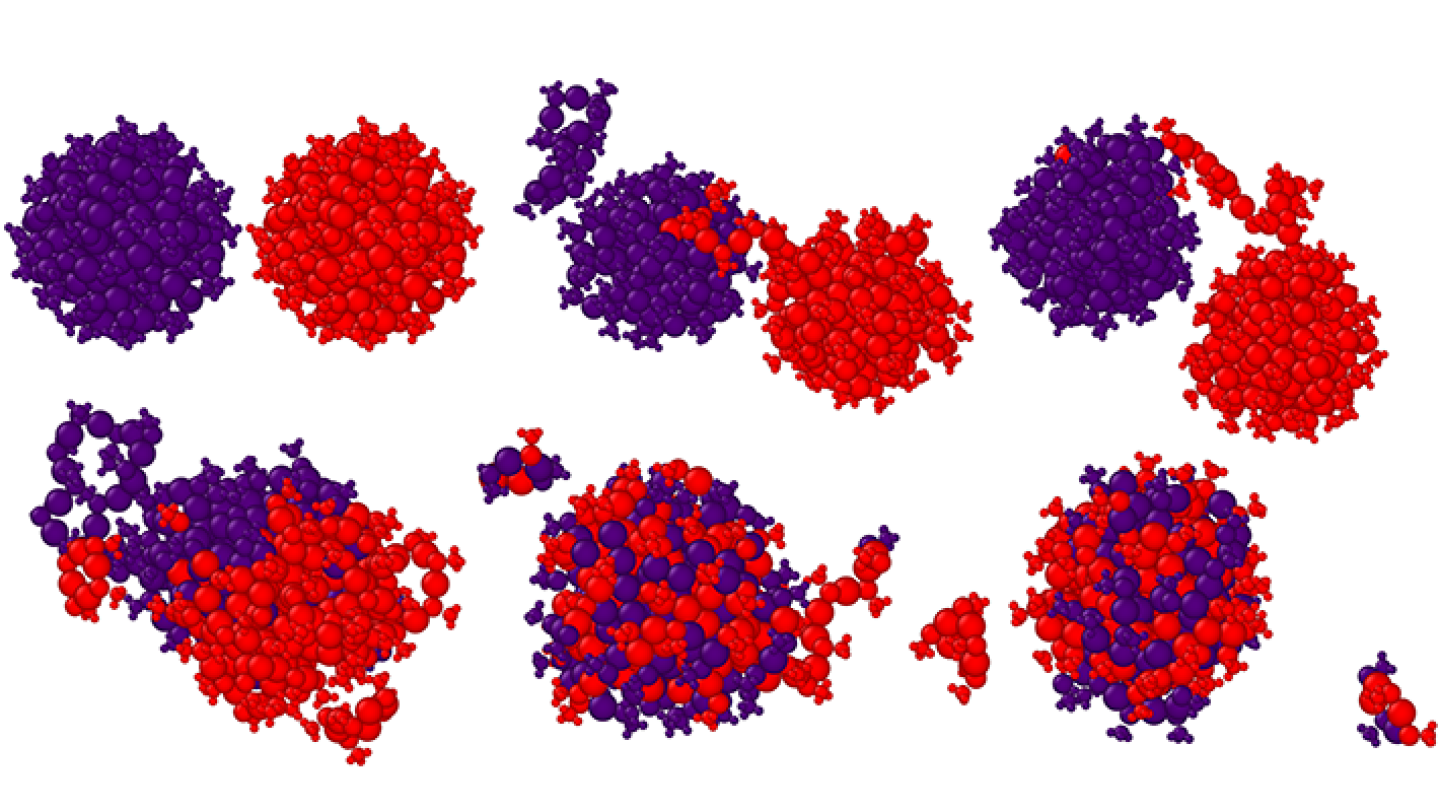
Thiolate protected gold nanoclusters are hybrid nanomaterials with promising applications in nanomedicine, bioimaging and catalysis. However, understanding how these nanoclusters behave under elevated temperatures, which is critical for their use, has remained largely unexplored due to the prohibitive computational cost of traditional simulation methods.
Record-long simulations of gold nanoclusters
Researchers at the University of Jyväskylä have successfully employed machine learning-driven simulations to investigate the thermal dynamics of Au₁₄₄(SR)₆₀, one of the most well-studied gold nanoclusters. Using a recently developed atomic cluster expansion (ACE) potential trained on extensive density functional theory data, the researchers conducted molecular dynamics simulations extending up to 0.12 microseconds. This is approximately five orders of magnitude longer than what is feasible with conventional quantum chemical methods.
"This work opens new possibilities for understanding how ligand-protected metal nanoclusters behave under realistic operating conditions," says lead author Dr. Maryam Sabooni Asre Hazer. "Through this work, we can observe in atomistic detail how these clusters transform, fragment, and even merge at elevated temperatures over timescales that are relevant for experimental conditions."
Layer-by-layer thermal transformations revealed
The study revealed that thermal effects induce structural changes in a layer-by-layer fashion, starting from the outermost gold-thiolate protective shell. At temperatures between 300 and 550 K, the researchers observed the spontaneous formation of polymer-like chains and ring structures of gold-thiolate units, which can dynamically detach and reattach to the cluster surface. The remaining cluster compositions closely matched those observed in experimental studies, demonstrating the accuracy of the machine learning potential.
"What's particularly exciting is that we can now see how gold atoms migrate between different layers of the cluster and how the surface restructures under thermal stress," explains Dr. Sabooni Asre Hazer. "These processes are directly relevant to understanding why thermally treated gold nanoclusters become effective catalysts."
Gold clusters joined together in the simulation
In an even more remarkable finding, the researchers successfully simulated the complete coalescence of two Au₁₄₄(SR)₆₀ clusters at 550 K. The fusion process produced a larger cluster with composition Au₂₃₉(SR)₆₉, strikingly similar to a gold nanocluster previously synthesized experimentally.
"The merged cluster exhibited a twinned face-centered cubic metal core structure, matching the symmetry determined from experimental X-ray diffraction data," says Dr. Sabooni Asre Hazer.
Opening new avenues for nanomaterials research
The methodology enables detailed atomistic studies of processes that were previously inaccessible to computational investigation, including cluster-cluster interactions, catalytic activation mechanisms, thermal stability, and inter-particle reactions.
"Our results provide fundamental insights into how ligand-protected nanoclusters behave as they transition toward larger nanoparticles," explains Professor Hannu Häkkinen, who supervised the research. "This knowledge is instrumental for the rational design of nanomaterials with tailored functionalities for catalysis and other applications.", he continues.
The research was published in Nature Communications. The publication was recognized as an Editors' Highlight in the Inorganic and Physical Chemistry section of Nature Communications.
The work was supported by the Research Council of Finland and the European Research Council (ERC) through the Advanced Grant project DYNANOINT. Computational resources on supercomputers Puhti and Mahti were provided by the Finnish national supercomputing center CSC.
Article information:
- Sabooni Asre Hazer, M., Malola, S. & Häkkinen, H. Thermal dynamics and coalescence of Au144(SR)60 clusters from a machine-learned potential. Nature Communications 17, 971 (2026)
- DOI number: https://doi.org/10.1038/s41467-025-67700-w


