
When the COVID-19 pandemic stopped the world in its tracks, I turned to history for macabre comfort. I picked up the phone and rang my older relatives, inquiring how they had dealt with past moments of global uncertainty. The most memorable story came from within my immediate family. My mother recalled how the Cuban Missile Crisis had made a terrifyingly great impression on her when she was just eight years old. She remembered walking to the lakeshore on a warm summer’s day, folding her clothing into a neat pile, and going swimming. Convinced that the world would end in nuclear apocalypse any minute now, it was of utmost importance to her that her childly belongings were shipshape.
The world did not end in nuclear apocalypse in 1962, nor did it end ravaged by a global pandemic in 2020. However, these meaningful conversations with my loved ones led me to my next research topic: I wanted to study the effects that threats of nuclear disasters had historically had on our ways of thinking and organising, and particularly how people had mobilised when threatened by the end of everything. In addition to the threat of nuclear war, I became interested in the risks that nuclear energy had been seen to pose. In 2022 I secured a Research Council of Finland postdoctoral grant for the research project “A Farewell to Arms”: Anti-Nuclear Protest, Emotion and Gender in Finland, 1979-1987, which enabled me to spend the next three years scouring the archives of Finnish anti-nuclear organisations and interviewing (former) activists about what it was like working for peace and/or the environment during the 1980s, a decade marred by the Euromissile crisis and the Chernobyl nuclear power disaster.
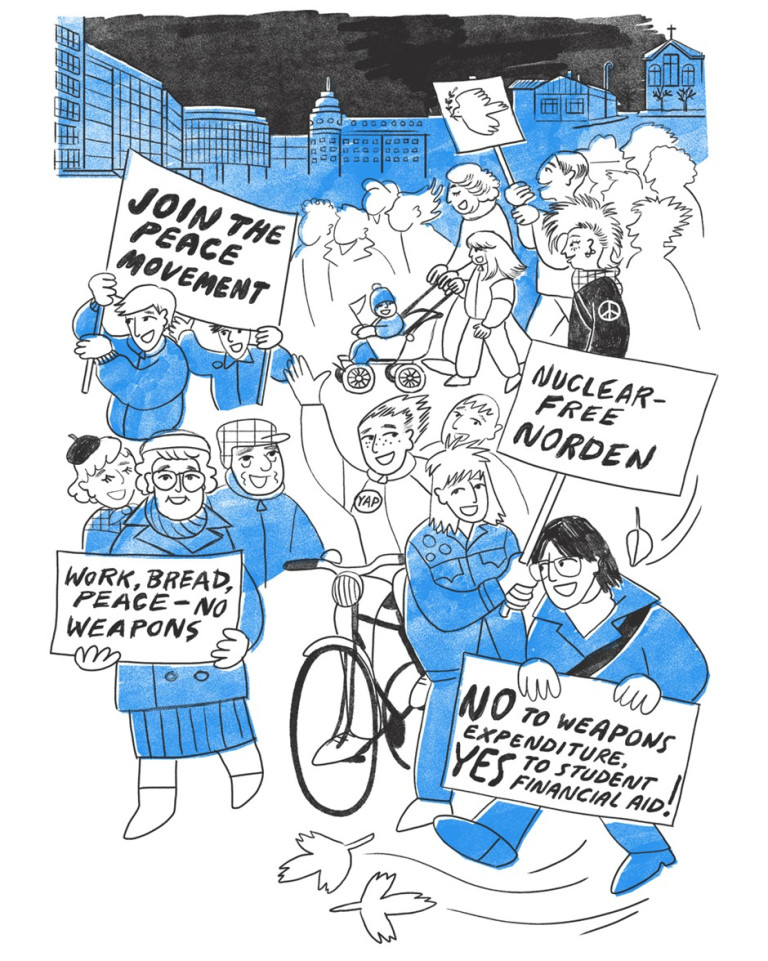
My research uncovered a wealth of innovative and creative protest tactics that Finnish people used to voice their discontent and promote anti-nuclear stances. Most notably, during the first half of the 1980s, hundreds of thousands of Finns joined peace marches each November as part of United Nations Disarmament Week.
Picture: Susanna Kaulanen / Tussitaikurit Oy
In April 1982, over 100 Finnish artists – from popular bands like Hassisen Kone to the modern dance company Raatikko – traversed Finland for 10 days by train, travelling from Helsinki all the way to Rovaniemi and back. The artists organised over 350 readings, performances, and concerts, which were attended by more than 140,000 Finns, and collected signatures for a petition urging the Nordic countries to become a nuclear-weapon-free zone. Exactly five years later, in April 1987, a group of women dressed in black funeral garb entered the Finnish Parliament and threw hundreds of handkerchiefs embroidered with political messages down onto politicians from the parliament’s lecterns. Protesting the militarisation of Finnish women into the country’s defence forces and opposing the construction of a new nuclear power plant, the assailants became known as Itkijänaiset, or Lamenting Women.
My interest in the intersections between anti-nuclear activism and gender – a somewhat niche meeting point of interests – led me to form connections with researchers outside Finland. In the late summer of 2025, as my three-year research project was drawing to a close, I invited a small group of historians from Sweden, Norway, and Iceland to Finland who also share an interest in gendered questions surrounding the history of pacifism. We spent two days in the atmospheric meeting rooms of the Finnish Literature Society discussing how best to establish a new research network focused on the gendered histories of peace activism in the Nordic countries. We set our aims high from the outset: we wanted to foster interdisciplinary dialogue and hoped that our research might also have an impact beyond academia. To help us think ambitiously, we invited a researcher from the Finnish think tank Demos Helsinki to help us conceptualise possible avenues for public engagement and identify novel ways to fund our plans. Most importantly, we were excited by the prospect of co-authoring genuinely transnational research, examining themes, events, and actors more coherently and completely by bringing together locally and nationally situated archival and oral history materials.
In early February of this year, I was among the group of researchers who gathered at the Swedish Labour Movement’s Archives and Library in Huddinge, just outside Stockholm, for an international workshop titled Gender, Class, and Peace in the Nordic Countries and Beyond in the 1980s. Funded by the Swedish Riksbankens Jubileumsfond Foundation, this workshop was our new network’s first tangible outcome. For two days we discussed the multiple ways in which class and gender shaped peace movements in the Nordics during the 1980s, as well as further afield. We presented research on a wealth of peace campaigns, the individuals behind these efforts, and the ways in which their activism was received by the media. We were delighted to notice that our analytical ideas often overlapped and our primary sources filled in missing pieces of the same puzzle, strengthening our desire to continue working together.
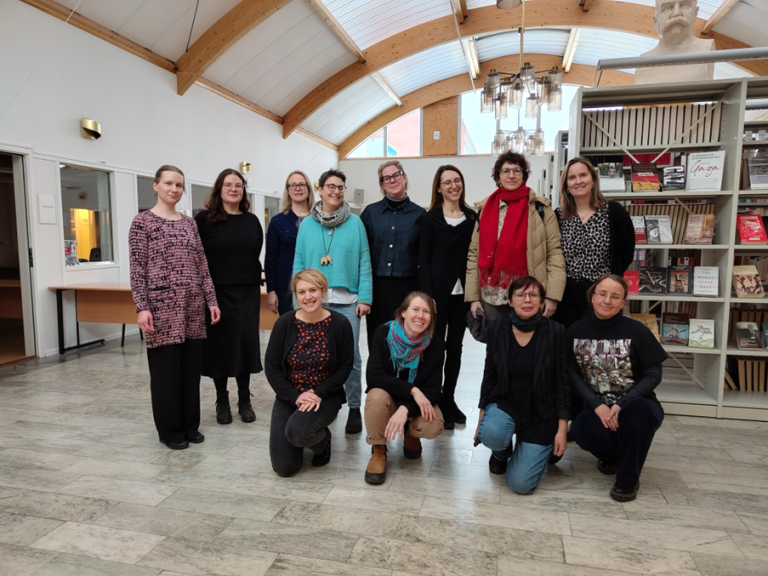
Some of the workshop’s participants after a fruitful two days of discussing gender, class and peace.
So, what comes next? I am confident when I say that our network’s story has only just begun. We have already planned and secured funding for our next workshop, which will take place in Norway later this year. We are eager to put our collaborative aspirations into practice and begin collating and co-authoring research that will illuminate the many ways in which Nordic activists have sought to work for peace both in recent history and today.
I have moreover learned that we cannot look to history for instantaneous solutions to our current problems – I realised this when talking to my relatives during the pandemic – but we can find sparks of connection and inspiration that might carry us through difficult times.


