
Hand-made Japanese watercolour woodblock prints, mokuhanga, are exceptional from the way of their technique and the usage of colour. Each work reflects printmakers’ personality and work manners through the subjects they used. In Japan, woodblock prints are still popular, although the production of traditional ukiyo-e prints is gradually declining, due to the lack of continuators. Watercolour woodblock prints currently face problems related to acquiring materials: Quality wood and paper are hard to find, which makes creating this style of art all the more difficult.
In October 2025 I travelled to Japan to research the current state of mokuhanga, and how Japanese and foreign artists uphold the tradition. During this trip, I made acquaintance to printmaker master Keizo Sato at his Kyoto-based traditional ukiyo-e printing workshop. I also visited the Mokuhanga Innovation Lab (MI-LAB) artist residence in Echizen. I interviewed the MI-LAB artists, as well as Finnish artist Terhi Tuulia Eskelinen, who currently lives in Osaka, to find out how they approach Japanese woodblock printing technique and how they innovate it with their own art.
There were four printers at work in the narrow upstairs of Keizo Sato’s workshop at the moment of interviewing the master. One of them, Kyoko Hirai, told me she daily prints 50 sheets with colour. She can print only 5-6 shades of colours in a day, which makes a multicolour work take a lot of time to finish. Printing blocks are carved elsewhere, so the workshop’s only duty is to print colours from them. In earlier times, the workshop employed seven printmakers working at the place, including Master Sato. Now Sato supervises the working process and has taken a step back from actual printing. There are only few masters like him left in the whole Japan.
Many of the printers in Keizo Sato’s workshop have graduated from Kyoto Seika University’s Department of Fine Arts. Only the most passionate and motivated ones will continue in this field of work. If one wants to get employed to a printmaking workshop, the applicant must be able to print the same colour up to 200 times, eight hours in a row. According to Sato, printer’s work requires mind and body, as well as good eye in colour, gained from earlier experience in arts.
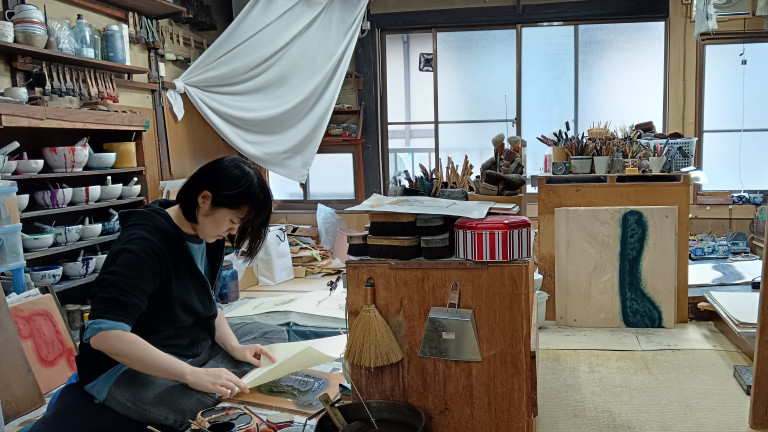
Mayuko Kawasaki at work in Keizo Sato’s workshop. In the printmaking process, the colour is first brushed on a relief block, and is then printed on a sheet of paper by rubbing it against the block with a tool called baren. Kawasaki has this tool close to her. Photo: Daniel Moilanen
I was given the permission to view mokuhanga works produced at Sato’s workshop. The motifs of the prints varied from Edo period ukiyo-e pictures to characters from 2000s popular culture. Modern themes don’t try to suppress traditional subjects, but rather enliven them. The motifs might be different, but the woodblock printing technique is the same in all production. Current works are printed with new, mineral-based colours. They do not fade as easily as the dye colours that were previously used in mokuhanga. New prints with contemporary motifs are aimed at young people, to increase their interest towards mokuhanga. Young printmakers and ukiyo-e workshops get subsidies from the government, which helps keeping the old tradition alive. From the point of sales, currently the most popular printworks are either classics from Hokusai or subjects from current popular culture.
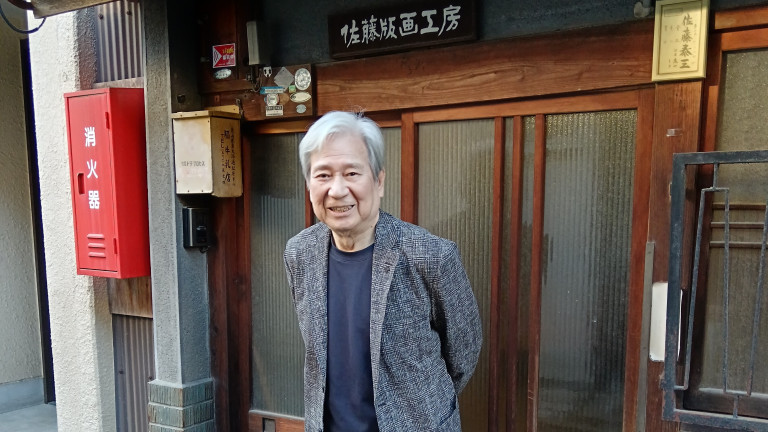
Printmaking master Keizo Sato is pleased with his workshop’s results. Sato wishes that also works from overlooked ukiyo-e artists could be printed at the workshop. During the interview, Sato mentioned that he is especially fond of the dynamic woodblock prints by Kuniyoshi. Photo: Daniel Moilanen
Alongside traditional ukiyo-e workshops, the MI-LAB artist residence upholds the old woodblock print technique. MI-LAB offers one-month-long courses in Japanese woodblock carving and printing techniques for contemporary international artists. Courses are held throughout the year, and each course takes in only six participants at maximum. I was able to interview the five artists who participated in the basic mokuhanga course this Autumn.
Dawn Grayford got acquainted with Japanese arts after seeing calligraphy and woodblock prints at a museum exhibition, and there she started to admire the printmaking technique. For the course, Dawn planned her work as figurative, where her personal style stands out. Nate Crosser found mokuhanga after seeing it on display at an art exhibition, and afterwards he bought Japanese art works and studied them, getting acquainted especially in their visual style. Nate too sketched his course work to be figurative. Jody Tableporter was familiar with Japanese economics through her job, but she started appreciating the beauty of the culture while traveling in the country. Jody visioned adding constructive collage alongside minimalistic Japanese elements, like flora and landscapes, to her work. For Paula Menchen the most attractive thing in Japanese culture and woodblock print art were the sense of nature and eco-friendly materials. Paula designed a personal-styled landscape print, respecting the traditional techniques taught during the course. Yanira Vissepo was originally interested in the non-toxic quality of watercolour woodblock printmaking, and how it represents one of the earliest forms of all print techniques. Yanira described her course work to be close to sōsaku hanga style.
When I asked about the course participants’ relation to the traditional technique, Dawn answered that she felt one part of herself wanted to keep the technique alive, but most of all, participating on the course was mainly for developing own artistry. Jody joined the course in order to learn the traditional technique, which she could utilise in her other art works. Nate viewed that just by attending the course he couldn’t influence much in the continuation of the woodblock print tradition, but he felt that it was great to be part of the printmakers’ community. Yanira told she took part in the course so that she could acquire skills to teach Japanese woodblock printing in her home country. Speaking of teaching, Paula saw that getting familiar with old ways of printmaking can increase passion to continue the mokuhanga tradition.
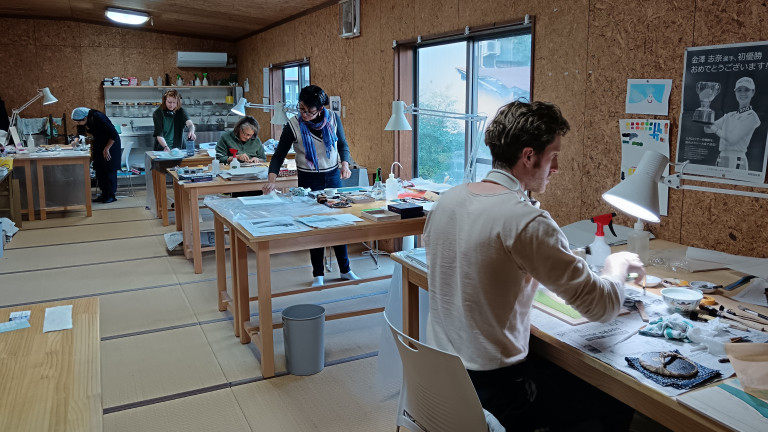
MI-LAB artists carve their woodblocks and print their works on their own. Photo: Daniel Moilanen
Terhi Tuulia Eskelinen too got originally interested in the nature-friendliness of the woodblock print technique. Right after moving to Japan, she made a lot of Japan-themed works, but after her initial enthusiasm calmed down, she started to feel that following Japanese motifs did not reflect well her own identity. Currently she has plenty of ideas for new works, and she wants to bring Finnish himmeli tradition forward in mokuhanga.
Looking back to the acquired answers in my interviews, interest towards mokuhanga comes mainly from the printmaking technique, visual style and environmentally sustainable materials. The international artists I interviewed didn’t directly plan on making ukiyo-e styled works, but rather to create woodblock print art with their own style. The technique functions as a tool for their own creativity, as a way of expressing themselves. Similarly, European artists in the late 1800s utilised the style and technique of Japanese woodblock prints to their own artistic experiments.
Eriko Fujieda, the interpreter who helped the MI-LAB artists, told me how Japanese considered mokuhanga, especially ukiyo-e prints, originally as commercial art. The printing blocks of popular motifs were re-carved and re-printed primarily to continue their sales. When Western styles of art were started to be applied in mokuhanga, the technique became appreciated as its own style of art. According to Terhi Tuulia, mokuhanga is nowadays seen in Japan with nostalgia, as every Japanese person has tried printmaking in the arts classes during elementary school. Japanese have a strong emotional bond towards old woodblock print art, but only few of them are willing to devote themselves into learning the traditional technique and becoming an artist.
Even though individual artists can’t be compared to a traditional Japanese printmaking workshop, both sides share the same wish and objective of keeping the mokuhanga technique alive. Yanira from MI-LAB artists said she would begin teaching Japanese woodblock printmaking technique. Other artists I interviewed utilise the technique in their own innovations. Keizo Sato’s workshop continues to carry on the printmaking technique with new and old subjects in the traditional way. There are only few successors, but those who stay in this field are passionate with their work. Woodblock print tradition continues in the hands of skilled professionals. I believe that the more world becomes digital, the more hand-made works will be preserved and appreciated in the future.
Special thanks to
MI-LAB artists Dawn Grayford, Jody Tableporter, Nate Crosser, Paula Menchen and Yanira Vissepo
MI-LAB’s interpreter Eriko Fujieda and the host of the residence Yasuhiko Sato
Keizo Sato and workshop’s printmakers Kyoko Hirai, Osamu Harada, Mayuko Kawasaki and Makoto Nakayama
Terhi Tuulia Eskelinen
Tuula Moilanen, for interpretation help
Scandinavia-Japan Sasakawa Foundation, for financing this research project


