
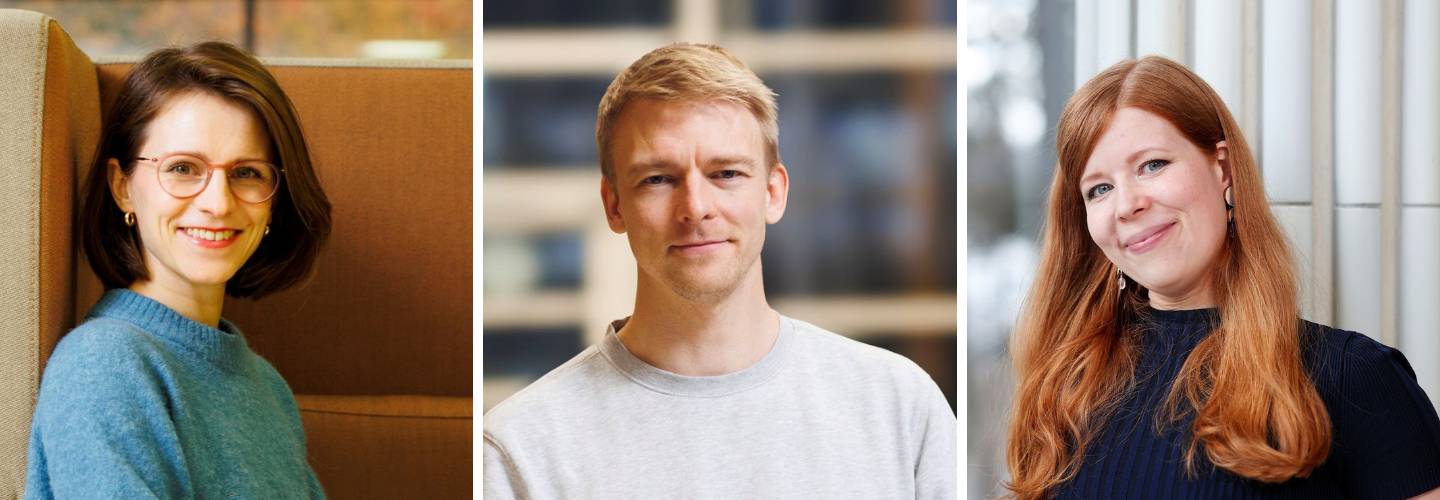
What did you do for your research today? Three perspectives on research in social development
The technology market researcher closely follows state investments in quantum technology
These days many states want to favour their domestic industries and restrict foreign investments in their strategic fields. Economic nationalism is on the rise, which becomes evident when following global politics and from various research findings as well.
“States are now more actively involved in shaping markets for new technologies. They seek to strengthen strategically important sectors by directing demand and creating markets,” says business researcher and postdoctoral researcher Olli Tyrväinen from Jyväskylä University School of Business and Economics.
States take action well in advance: they make investments before the technologies offer any clear competitive advantage.
Through these measures, they seek to secure national competitiveness in the changing operating environment – and Tyrväinen is interested in phenomena related to this approach. One excellent research field can be found in the rapid development of quantum technology. Numerous interesting research questions are emerging in these areas with regard to the development of national competitiveness.
New information about the interface between marketing and innovation policy
Quantum computers are already being built in Finland, and internationally respected research in the field is underway.
“States are committed to funding technological development by huge investments, although technology that brings concrete benefits is still at a developmental stage,” Tyrväinen explains.
“At present, for example, the clientele of our crown jewel of national quantum technology – quantum computer manufacturer IQM – still consists largely of public sector customers, who are creating early demand for this future technology that is not yet mature enough for widespread private-sector markets.”
Tyrväinen lists some unanswered questions in this field:
How does public demand bring about new markets? Why does success in public sector markets accumulate among certain players and how can this concentration trend restrict the creation of new, potentially better innovations? What tensions are there between the players in this ecosystem and how do these affect its formation?”
New research knowledge that falls at the interface between marketing and innovation policy is on the way.
“To my knowledge, hardly any research is being pursued in this context in Finland outside our team, but at the global level, these themes are researched intensively,” Tyrväinen states. “When it comes to quantum technology, we are talking about such a significant research theme for our national competitiveness that, naturally, financers are also directing resources to it.”

What did you do for your research today?
“Today, I have sought to model why corporations’ success in public sector procurements is cumulative,” Tyrväinen explains. “In this particular study, I draw on quantitative procurement data in order to prove the existence of this phenomenon, and on quantitative interview data in order to understand its mechanisms.”
Tyrväinen believes that this research also provides useful knowledge for policymakers: “For example, our ecosystem-related research offers very practical observations, which could certainly be of help in developing the ecosystem.”
In short: Olli Tyrväinen |
|
| Who | PhD in marketing, postdoctoral researcher at Jyväskylä University School of Business and Economics |
| Studying | Formation of technology markets |
| Participating | The Digital Marketing and Communication (DMC) research team |
| Funding | Research Council of Finland / Finnish Quantum Flagship programme |
It is a philosopher’s job to clarify the underlying assumptions of democracy education
In many European countries, democracy education is part of curricular objectives from primary school onwards. The ways of implementing it are manifold. In Finnish curricula, democracy education is mentioned in the syllabi on civics, human rights and social studies.
The purpose of democracy education is to foster active and responsible citizens who contribute to society.
Such education is needed now more than before, as many indicators point to a worsening state of democracy worldwide, notes Sari Hietamäki, a philosopher researching democracy education at the University of Jyväskylä.
“For democracy to function, it is important that every citizen has the skills and knowledge needed in society,” she says. “We need individual autonomy and critical thinking, but also communality and solidarity – in other words, the ability to act together.”
Hietamäki spent hundreds of ours observing teaching at general upper secondary schools
Hietamäki defended her doctoral dissertation last November on the significance of French philosopher Jacques Rancière’s thinking for democracy education. Hietamäki also studied the practical implementation of democracy education in general upper secondary schools.
For this purpose, she spent hundreds of hours observing teaching and interaction in classes. Her study is one of a growing number of school ethnographies published in recent years.
“Several researchers have spent long periods of time in the daily life of primary and lower secondary schools and vocational institutes, for which I’m particularly delighted,” Hietamäki says. “There is ongoing discussion about educational inequality and education policy. Although freedom and equality are touched upon in research, they have not previously been viewed through the lens of democracy education.”
Hietamäki’s own study also produced reform proposals for teacher education, which can support democratic teachership in practice:
For democracy, it is essential that teachers support the realisation of equality and do not undermine it through their own actions. To support students’ involvement, it is important that teachers recognise the moments of democracy.”
How did your study clarify the underlying assumptions of democracy education?
“My study showed how democracy education often leans on the notion of representative democracy and consensus. Rancière’s theory, by contrast, is centred around conflict, which challenges us to look for democracy in everyday events,” Hietamäki explains.
In the international research arena, democracy education is a popular research theme. It is also referred to using concepts such as critical pedagogy, political education and critical thinking.

What did you do for your research today?
“Today I have been writing abstracts for future conferences together with my colleague Ville Mäki,” Hietamäki says. “In Finland, there is active discussion about democracy education, and we are also researching the didactics of philosophy. Ville and I have been considering future research topics. Next, we will delve into the challenges of dialogue and reflection from the feminist perspective.”
In short: Sari Hietamäki |
|
| Who | Project coordinator at the Department of Social Sciences and Philosophy, University of Jyväskylä, defended her doctoral Nov 29, 2025. |
| Studying | Social and philosophical issues of education, democracy education |
| Participating | Architects of Utopia project, which integrates science education and philosophical discussion with children |
| Funding | The project is funded by the Finnish Cultural Foundation |
How can we ensure that every child benefits from pedagogical support?
Many studies have shown that some children do not benefit sufficiently from the support provided for learning basic mathematical or literacy skills. This is a fact even if the methods for supporting learning have been proven effective at the group level.
Postdoctoral researcher Pilvi Peura is rightly concerned about this lack of effectiveness.
If children could be better supported in learning basic skills, it would have far-reaching implications for both children and society.
“Reading and arithmetic skills form the basis for all other learning. These skills also predict later education level. Difficulties in reading and mathematics also seem to have a connection to later well-being, such as mental health issues and employment,” says Peura, who works as a postdoctoral researcher in the Centre of Excellence for Learning Dynamics and Intervention Research (InterLearn) at the University of Jyväskylä.
In Interlearn, identifying reasons for the responsiveness to support is a major research theme: Why do some benefit more and others less from pedagogical support?
Peura approaches this theme from a perspective that has rarely been studied: How is the responsiveness affected by the child’s self-beliefs as a learner? How do the child’s experiences of success and failure in learning situations influence learning? What kind of role does encouragement from the teacher play?
Large-scale experiments are rarely conducted in classrooms
So far, there has been little research on who actually benefits from pedagogical support and who does not – and the same applies to the role of the self-efficacy beliefs and socioemotional factors described above.
This knowledge will help us develop various forms of pedagogical support to better support each child’s learning of basic skills,” Peura notes.
Internationally, the learning of reading and mathematical skills as well as related support methods are researched extensively. In contrast, there are fewer studies that comprehensively examine the impacts of the learning environment, family, as well as socioemotional and motivational factors on the benefits of support. Intervention studies are arduous to conduct. Such studies call for a large number of participating schools, teachers and pupils.
“That’s why it’s so great that we are able to do this at our Centre of Excellence,” Peura says.

What did you do for your research today?
“Today I reviewed previous research evidence related to our ongoing mathematics intervention study. I examined what kinds of children’s thoughts and beliefs about their own skills we should study and how. I also worked on a handbook for teachers and designed mathematics exercises to be used for training this spring with my colleagues. With the research team, we examined the initial level of mathematical skills and need for support of the children participating in our study.”
In short: Pilvi Peura |
|
| Who | PhD (Education), postdoctoral researcher at the Centre of Excellence for Learning Dynamics and Intervention Research (InterLearn), University of Jyväskylä |
| Studying | Educational support practices, especially for reading and mathematical skills |
| Participating | InterLearn intervention studies Support for classroom behavioral climate, Support for reading and Support for mathematics as well as in longitudinal studies in Interlearn in University of Jyväskylä and Turku |
| Funding | The InterLearn Centre of Excellence is funded by the Research Council of Finland |


