
Playground Study

Project description
The aim of the project is to understand how playgrounds function as both physical and social infrastructures that enable diverse forms of movement, everyday encounters, and community-building among families with children. The study also incorporates a temporal perspective by examining how playground use, meanings attached to playgrounds, and related everyday practices have changed over time, as well as which continuities persist across generations. The project highlights the significance of playgrounds as equitable and accessible everyday environments that support children’s mobility, family life, and the development of socially sustainable neighbourhoods.
The project combines perspectives from sport sciences, early childhood education, and history in an interdisciplinary framework. Its theoretical point of departure is the concept of social sustainability, which is used to examine how well-being is produced and experienced within everyday environments. Particular attention is paid to local environments, such as playgrounds, where movement, social relationships, and everyday interactions intersect. The study explores how well-being is shaped in these spaces and how families’ everyday practices, time use, and mobility contribute to this process.
During the first phase of the project in 2023, a large-scale Webropol survey was conducted to investigate playground habits, mobility patterns, and socioeconomic backgrounds among families with young children (see Soini et al., 2025). The survey provides a comprehensive overview of who uses playgrounds, how they are used, and what kinds of differences exist between families. In the second phase, carried out in spring 2025, the survey findings were complemented with semi-structured thematic interviews that offer a deeper understanding of everyday experiences, meanings, and practices related to playground use.
By combining quantitative and qualitative data, the project provides a comprehensive picture of the role of playgrounds in the everyday lives of families with young children and offers new perspectives for the development of socially sustainable local environments. Specifically, the project:
- generates new knowledge on the significance of playgrounds for children’s and families’ physical activity and overall well-being;
- develops novel interdisciplinary approaches to childhood studies;
- identifies and promotes good practices for creating accessible and equitable spaces for children’s play and physical activity; and
- deepens understanding of historical changes in playground use, meanings, and inequalities.
The project is conducted as part of the Social Sustainability for Children and Families (SOSUS) profiling area (2021–2026) at the University of Jyväskylä.

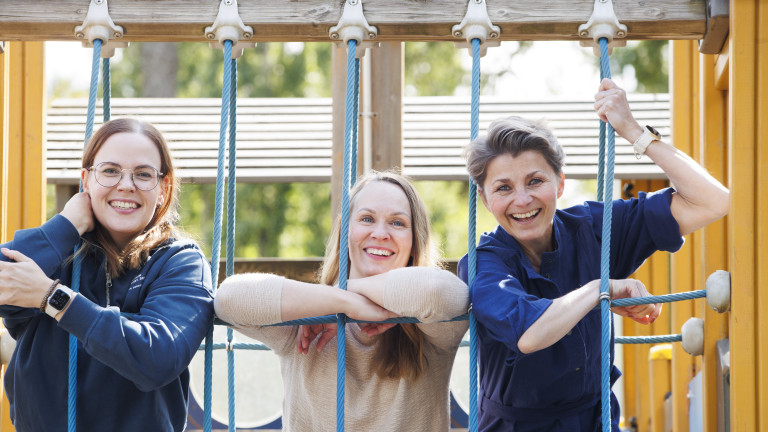
The research team Essi Jouhki, Kaisu Peltoperä, Anne Soini (image by Petteri Kivimäki).
Publications
- Soini, A., Jouhki, E., Kosonen, S., Minkkinen, J., Peltoperä, K. & Terävä, J. (2026). Playground Play Then and Now: Parents’ Perspectives and the Relationship Between Socioeconomic Factors and the Intergenerational Transmission of Play Practices [In Finnish]. Liikunta & Tiede, 63 (2), 85–93. https://urn.fi/URN:NBN:fi:jyu-202606125579
- Jouhki, E. & Moll, V. (2026). Education in a Sandbox: Making of an Educational Environment Through Supervised Play in Postwar Helsinki. History of Education, 55 (5), 641–662. https://doi.org/10.1080/0046760X.2026.2677686
- Soini, A., Minkkinen, J., Peltoperä, K. & Jouhki, E. (2025). Relationships between socioecological characteristics and families’ playground use in different seasons in Finland. European Early Childhood Education Research Journal 33 (6), 1011–1027. https://doi.org/10.1080/1350293X.2025.2452549
- Kosonen, S. (2024). Playground Play Then and Now From Parental Perspective [In Finnish]. Master's Thesis. Opettajankoulutuslaitos, Kasvatustieteiden ja psykologian tiedekunta. Jyväskylän yliopisto. https://urn.fi/URN:NBN:fi:jyu-202502041718
- Jouhki, E. & Moll, V. (2023). “An Amusement Park for a Child Living in Poverty”: Playgrounds as Builders of Children’s Well-being, c. 1950-1970 [In Finnish]. Historiallinen Aikakauskirja: Eriarvoisuuden ja tasa-arvoisuuden kaupunki 121 (4), 351–364. https://doi.org/10.54331/haik.126738
Conference presentations
- Hungry, Tired, but Happy: The Role of Playgrounds in Supporting Family Well-being. Kaisu Peltoperä (presenter), Essi Jouhki & Anne Soini. XI Conference on Childhood Studies, 6.-8.5.2026, Joensuu.
- Relationships between socioecological factors to playground use of Finnish families with under-school-aged children. Anne Soini (presenter), Jaana Minkkinen, Kaisu Peltoperä & Essi Jouhki. AIESEP International Conference, 13.–17.5.2024. Jyväskylä.
Research in the Media
- A Local Municipality Recognised the Benefits of Investing in Playgrounds. YLE, 20 October 2026.
- Children Continue to Play Outdoors, Researchers Find. YLE, 5 May 2026.
- Play Is as Important for Adults as It Is for Children. 360°, 18 April 2026.
- Playgrounds Attract Families Throughout the Year. YLE, 26 February 2025.
- Playgrounds Provide a Social Safety Net and a Framework for Everyday Life. Keskisuomalainen, 25 February 2025.
- Playgrounds Were Originally Established to Support Working-Class Children. Lapsen Maailma, 8 July 2025.
- New Study: Playgrounds Promote Equality and Inclusion. Kuntalehti, 17 February 2025.
- Playgrounds Foster a Sense of Belonging Among Children and Families. University of Jyväskylä News, 17 February 2025.


